
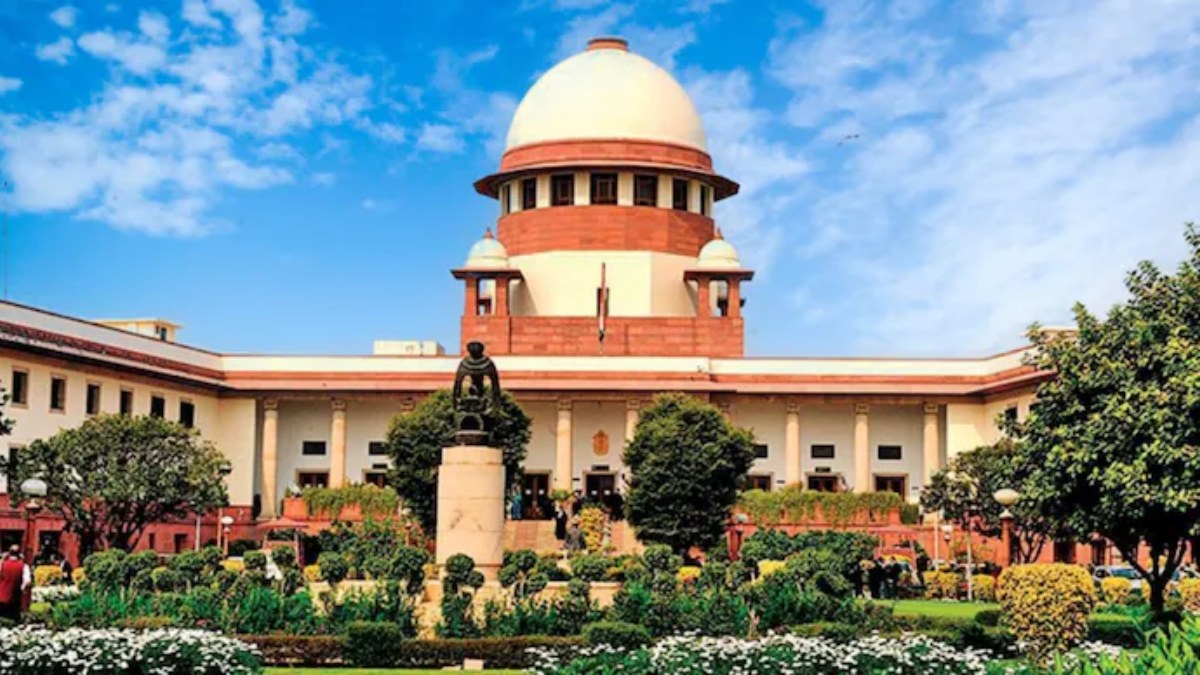
Image credits: Supreme Court of India
Judicial review is the “guardian of the Constitution” in India. It is the power of the courts to examine the actions of the legislative, executive, and administrative arms of the government and determine whether such actions are consistent with the Constitution.
If a law or an order is found to violate the constitutional framework, the Supreme Court (SC) or High Courts can declare it ultra vires (beyond authority) and void.
Grounds for Judicial Review
The court doesn’t strike down laws just because they are “bad” policy. They intervene based on three primary legal grounds:
a) Infringement of Fundamental Rights: If a law violates any rights guaranteed under Part III of the Constitution (e.g., Freedom of Speech or Equality).
b) Lack of Legislative Competence: If the Union Parliament enacts a law on a subject that belongs strictly to the State List, or vice versa (violating the federal distribution of powers).
c) Violation of the Basic Structure: If an amendment or law destroys the core features of the Constitution (like secularism, democracy, or judicial independence).
Kinds of Judicial Review
In the Indian context, judicial review is generally categorized into three types:
a) Review of Legislative Actions: Ensuring laws passed by Parliament or State Legislatures are constitutional.
b) Review of Executive/Administrative Actions: Ensuring that the decisions of the government and its officials are not arbitrary, biased, or in violation of natural justice.
c) Review of Judicial Decisions: The SC has the power to review its own previous judgments to correct “patent errors” (Article 137).
Landmark Cases Where Laws Were Rejected
Here are three pivotal moments where the Supreme Court upheld the Constitution by striking down legislative or constitutional overreach:
1. Kesavananda Bharati v. State of Kerala (1973)
This is perhaps the most famous case in Indian legal history. The government sought to give Parliament “unlimited” power to amend any part of the Constitution.
The Verdict: The SC created the Basic Structure Doctrine. It ruled that while Parliament can amend the Constitution, it cannot alter its “basic structure” (like the rule of law or federalism).
Outcome: This saved the Constitution from becoming a tool of the majority party.
2. Minerva Mills v. Union of India (1980)
The government passed the 42nd Amendment, which claimed that no constitutional amendment could be challenged in court on any ground.
The Verdict: The SC struck down those sections of the amendment. The court held that Judicial Review is a basic feature of the Constitution.
Outcome: It restored the “balance of power” between the Parliament and the Judiciary, ensuring the court remains the final interpreter of the law.
3. Supreme Court Advocates-on-Record Association v. Union of India (2015)
The Parliament passed the National Judicial Appointments Commission (NJAC) Act, which sought to change how judges are appointed, giving the executive a significant say in the process.
The Verdict: The SC struck down the 99th Constitutional Amendment and the NJAC Act as unconstitutional.
Outcome: The court ruled that “Judicial Independence” is part of the basic structure, and allowing the executive to control appointments would compromise that independence.
Conclusion
Judicial Review is not about the judiciary being superior to the legislature; it is about the Constitution being superior to both. It acts as a safety valve that prevents the “tyranny of the majority” and ensures that the government operates within its defined boundaries.
Yeh article aapko kaisa laga?