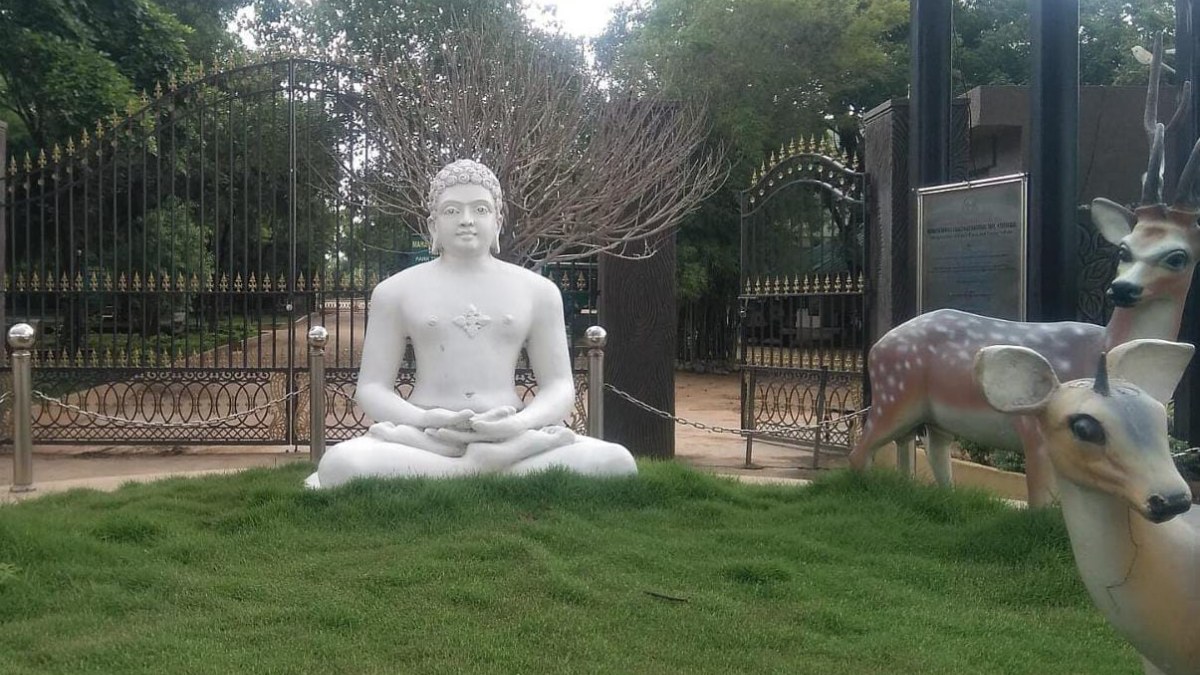
Photo: Adbh266 wikimedia Commons
Excerpt: In an era of global conflict and climate crisis, Mahavira’s message of “Live and Let Live” is more relevant than ever
As the month of Chaitra unfolds, the air fills with a sense of spiritual rejuvenation. On Tuesday, March 31, 2026, the Jain community and millions across the globe will celebrate Mahavir Jayanti, the birth anniversary of Lord Mahavira. This year marks the 2624th Janma Kalyanak (birth) of the 24th and final Tirthankara, a spiritual pioneer who redefined the path to liberation through the lens of non-violence and equality.
The Legacy of Lord Mahavira
Born as Prince Vardhamana in 599 BCE in Kundagrama (modern-day Bihar), Mahavira was the son of King Siddhartha and Queen Trishala. Despite being surrounded by royal luxury, his heart sought answers to the cycle of birth, suffering, and death. At the age of 30, he renounced his kingdom to lead a life of intense penance.
After 12 years of rigorous meditation, he attained Kevala Jnana (omniscience). For the next 30 years, he travelled barefoot across India, preaching a philosophy that dismantled social hierarchies and advocated for the sanctity of all living beings.
The Five Vows: A Blueprint for Ethical Living
The core of Mahavira’s teachings is encapsulated in the Five Great Vows (Mahavratas). These aren’t just religious rules but timeless ethical guidelines.
1. Ahimsa (Non-violence): The supreme virtue. It extends beyond physical harm to include non-violence in speech and thought.
2. Satya (Truthfulness): Speaking the truth that is harmless and rooted in kindness.
3. Asteya (Non-stealing): Never taking what is not freely given.
4. Brahmacharya (Chastity): Practicing self-restraint and discipline over one’s senses.
5. Aparigraha (Non-attachment): Detaching from material possessions to curb greed and environmental exploitation.
Rituals and Celebrations in 2026
The festivities are characterized by deep devotion and a spirit of service. Here is how the day is typically observed:
Prabhat Pheris & Processions: The day begins with early morning processions. The idol of Lord Mahavira is placed on a decorated chariot (Rath Yatra) and taken through the streets amidst chants and hymns.
Abhisheka: In temples, the idol is given a ceremonial bath with milk, water, and fragrant oils, symbolizing the purity of the soul.
Charity (Daan): Acts of kindness are the heartbeat of the festival. Jains engage in Anna Daan (donating food), distributing clothes to the needy, and Jiva Daya (saving and feeding animals).
Satsangs and Lectures: Spiritual leaders hold discourses on the Kalpa Sutra, narrating the life of Mahavira to inspire the younger generation.
Why It Matters Today
In an era of global conflict and climate crisis, Mahavira’s message of “Live and Let Live” is more relevant than ever. His concept of Anekantavada (the multiplicity of viewpoints) teaches us to respect diverse perspectives, fostering social harmony and dialogue in a polarized world.
“A man is great by deeds, not by birth.” — Lord Mahavira
Yeh article aapko kaisa laga?