
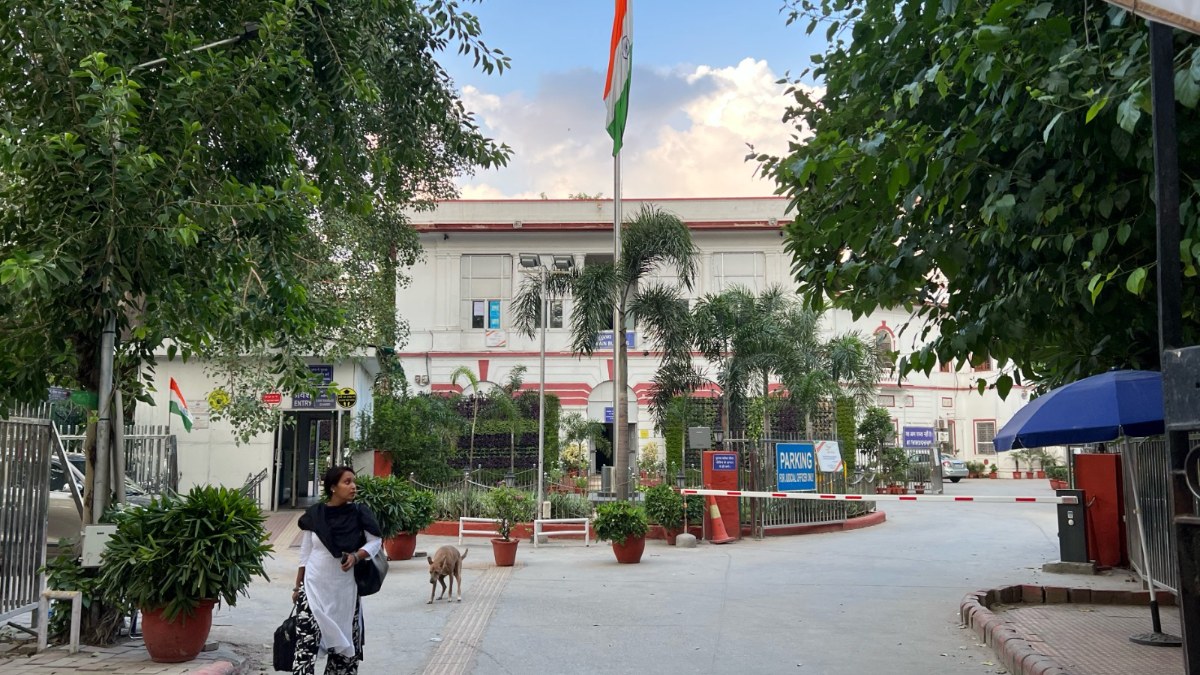
Photo: Main Entrance to the District Court of Patiala House, Delhi, Ramesh lalwani, CC BY-SA 4.0
In a case that highlights the growing intersection of artificial intelligence, free speech, and criminal law in India, a Delhi court has granted regular bail to a man accused of sharing an AI-generated morphed image depicting Narendra Modi bowing to Bollywood actor Shah Rukh Khan.
The decision underscores judicial caution in balancing individual liberty with concerns over digital misinformation and public harmony.
Background of the Case
The accused, Mujahid Jamal Shaikh, a 34-year-old resident, was booked by the Special Cell of the Delhi Police for reposting an allegedly derogatory AI-generated image on the social media platform X (formerly Twitter) on February 1, 2026. According to the prosecution, the image portrayed the Prime Minister in a manner deemed disrespectful and potentially capable of inciting disharmony among communities.
Authorities invoked multiple legal provisions against Shaikh, including Sections 336(4) (forgery), 356(2) (criminal defamation), and 353(2) (promoting enmity or hatred) of the Bharatiya Nyaya Sanhita (BNS), along with Section 66 of the Information Technology Act, 2000. The charges reflect the seriousness with which law enforcement is approaching cases involving manipulated digital content and its potential societal impact.
Court’s Observations and Rationale for Bail
The bail was granted by Additional Sessions Judge Saurabh Pratap Singh Laler of the Patiala House Courts. In his order, the judge emphasized key factors that weighed in favor of the accused.
Firstly, the court noted that Shaikh has “deep roots in society” and no prior criminal record. This significantly reduced concerns about him fleeing justice or engaging in further unlawful activity.
Secondly, the court observed that the evidence in the case is primarily electronic in nature. Importantly, the accused had already cooperated with the investigation. His mobile phone had been seized, and the social media account involved in the case had been deactivated at the request of the investigating officer.
Given these circumstances, the court concluded that there was no substantial risk of the accused tampering with evidence or influencing witnesses. As a result, continued custody was deemed unnecessary.
Defense Arguments
Shaikh’s legal counsel argued that the reposted image did not amount to promoting hatred or disharmony between groups. The defense maintained that the application of stringent penal provisions by the Delhi Police was unwarranted and disproportionate.
They further contended that merely sharing or reposting content without demonstrable intent to incite violence or hatred should not attract severe criminal liability. This argument touches on broader concerns about the interpretation of intent in cases involving digital expression and satire.
Prosecution’s Stand
On the other hand, the prosecution maintained that the image was derogatory in nature and had the potential to disturb public order. The Special Cell argued that such content, particularly when involving high-profile public figures, could contribute to societal tensions.
The case reflects an increasingly proactive stance by law enforcement agencies in regulating online content, especially when it intersects with politics, public sentiment, and emerging technologies like artificial intelligence.
Procedural Concerns Raised by the Court
In a notable development, the court also flagged procedural irregularities during the investigation. Specifically, it took note of a disputed document related to the “grounds of arrest.”
The authenticity of this document was questioned, prompting the court to direct the Deputy Commissioner of Police (Special Cell) to conduct a preliminary inquiry. The judge further stated that, if necessary, the opinion of a handwriting expert could be sought to verify the document.
This aspect of the ruling underscores the judiciary’s insistence on procedural integrity, even in cases involving sensitive or high-profile allegations.
Legal Representation
The accused was represented by advocates Aamir Raza Khan, Sazid SR Shah, and Amit Singh, who argued for bail on the grounds of cooperation, lack of criminal history, and absence of malicious intent.
The Delhi Police was represented by Additional Public Prosecutor Mukul Kumar, who opposed the bail application, emphasizing the potential societal impact of the content in question.
The Broader Context: AI, Free Speech, and Criminal Law
This case is emblematic of a larger legal and societal challenge: how to regulate AI-generated content without infringing on freedom of expression.
AI tools have made it increasingly easy to create hyper-realistic images, videos, and audio clips often blurring the line between satire, misinformation, and malicious manipulation. Governments and law enforcement agencies are grappling with how to classify and respond to such content under existing legal frameworks.
In India, laws like the Bharatiya Nyaya Sanhita and the Information Technology Act are being tested in new ways as courts interpret their applicability to emerging technologies. The present case raises important questions:
What constitutes intent in the sharing of AI-generated content?
Can reposting alone amount to criminal liability?
How should courts balance free speech with the need to prevent harm?
Implications of the Bail Order
While the court’s decision does not determine guilt or innocence, it sets an important precedent in terms of judicial approach. By granting bail, the court reaffirmed the principle that pre-trial detention should not be punitive and must be justified by clear risks such as absconding or evidence tampering.
The emphasis on electronic evidence and cooperation with the investigation suggests that courts may take a more nuanced view in cases involving digital content, particularly when the accused has not attempted to obstruct justice.
At the same time, the continuation of legal proceedings ensures that the substantive questions regarding the legality and impact of the content will be examined in due course.
Conclusion
The Delhi court’s decision to grant bail to Mujahid Jamal Shaikh reflects a careful balancing act between safeguarding individual liberty and addressing concerns over digital misinformation and public order. As AI-generated content becomes more prevalent, such cases are likely to shape the evolving legal landscape in India.
The outcome of the trial, as well as the inquiry into procedural irregularities, will be closely watched not just for its legal implications, but also for its broader impact on how society navigates the complex interplay between technology, expression, and accountability.
Yeh article aapko kaisa laga?