 Ahad Khan
Photo: Kosygin leishangthem by Pexels
Imagine the one place where you feel absolutely secure: inside your own home, fast asleep, with your family. For most of us, this is a basic human right. But for a five-year-old boy and his six-month-old sister in the Moirang Tronglaobi area of Manipur, their own bedroom became a deadly battleground.
In the early hours of Tuesday, a bomb hurled by suspected extremists shattered their home, tragically ending the lives of the two sleeping children and severely injuring their mother. As the news of this horrific attack broke, it did more than just break the hearts of the nation; it violently shattered a carefully constructed political illusion. For months, the state machinery has been pushing a narrative that the worst is behind us, that peace has returned, and that Manipur is finally healing. But the heartbreaking reality on the ground forces us to ask a terrifying question: If heavily guarded borders cannot protect sleeping infants, is the government’s promise of “normalcy” just a public relations campaign?
The Human Cost of a Political Mirage
To understand why the public reaction was so immediate and explosive, we have to look at the promises made to the citizens. After enduring nearly a year of President’s Rule, a period defined by fear, displacement, and ethnic violence in Manipur recently transitioned back to an elected state government. When Chief Minister Yumnam Khemchand Singh took office, the implicit promise was a return to stability. The political optics suggested that democracy was back to work, and the dark days of 2023 were fading into history.
However, the tragedy in the Bishnupur district proves that peace was only restored on paper. The area borders the highly sensitive Churachandpur district, a region that has been the epicenter of tension for nearly three years. Despite being one of the most heavily militarized zones in the country patrolled by state police, the Assam Rifles, and central forces, armed elements successfully infiltrated a civilian neighborhood and detonated an explosive. For the average citizen watching this unfold, it is clear that the transition of power focused more on political celebrations than on fixing the massive, gaping holes in the state’s intelligence and security grid.
A Reactive Machine: Bullets and Blackouts
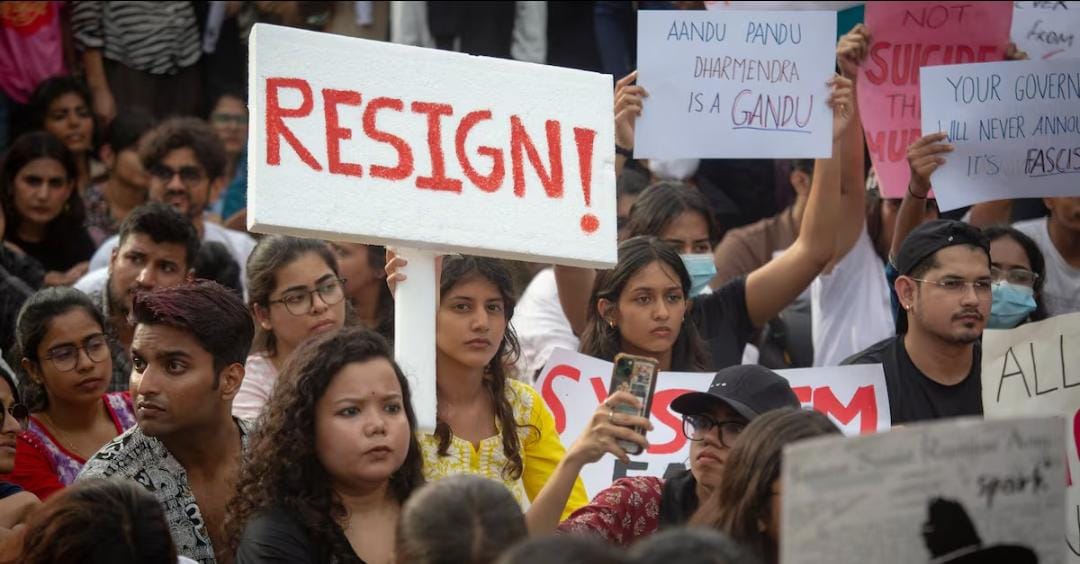
When the illusion of safety collapsed, the citizens of the Imphal Valley took to the streets in sheer desperation. Defying curfews, massive crowds gathered to demand basic accountability and the immediate arrest of the perpetrators. They wanted to know why the security apparatus, funded by their tax rupees, had failed to protect two innocent children.
The state’s response, however, highlights exactly why the system is fundamentally broken. When a mob of hundreds marched toward a Central Reserve Police Force (CRPF) camp near Gelmol, accusing the forces of negligence, the situation devolved into chaos. Security forces opened fire, resulting in the tragic deaths of three protesters and injuring dozens more. Within a span of forty-eight hours, the death toll of this “peaceful” period reached five.
Instead of addressing the massive intelligence failure that allowed a bomb to be smuggled into a residential zone, the government defaulted to its oldest, most reactive playbook: silencing the public. Mobile data and broadband services were instantly suspended across five key valley districts, including Imphal West, Imphal East, and Thoubal. Strict movement restrictions under Section 163 of the Bharatiya Nagarik Suraksha Sanhita were enforced, locking citizens inside their homes and shutting down schools and markets.
Demanding True Accountability
We must objectively criticize this approach. Shutting off the internet does not turn off the violence; it only turns off the world’s ability to see it. Imposing curfews prevents protests, but it does not prevent extremists from operating in the shadows. The state government must realize that peace cannot be manufactured through internet blackouts and forceful containment.
Chief Minister Yumnam Khemchand Singh rightly condemned the attack as a “barbaric act,” and the decision to hand the investigation over to the National Investigation Agency (NIA) is a necessary step. But an investigation after the fact brings little comfort to a grieving family. The true measure of a government is not how it investigates a tragedy, but how it prevents the next one.
As long as the state relies on reactive measures rather than proactive border security, the promise of normalcy remains a dangerous myth. For the ambitious youth of Manipur whose schools are shut, for the shopkeepers whose markets are closed, and for the families who sleep in fear, political statements hold no value. True accountability means the government must stop celebrating a fragile peace and start doing the hard, uncompromising work of actually protecting its people.