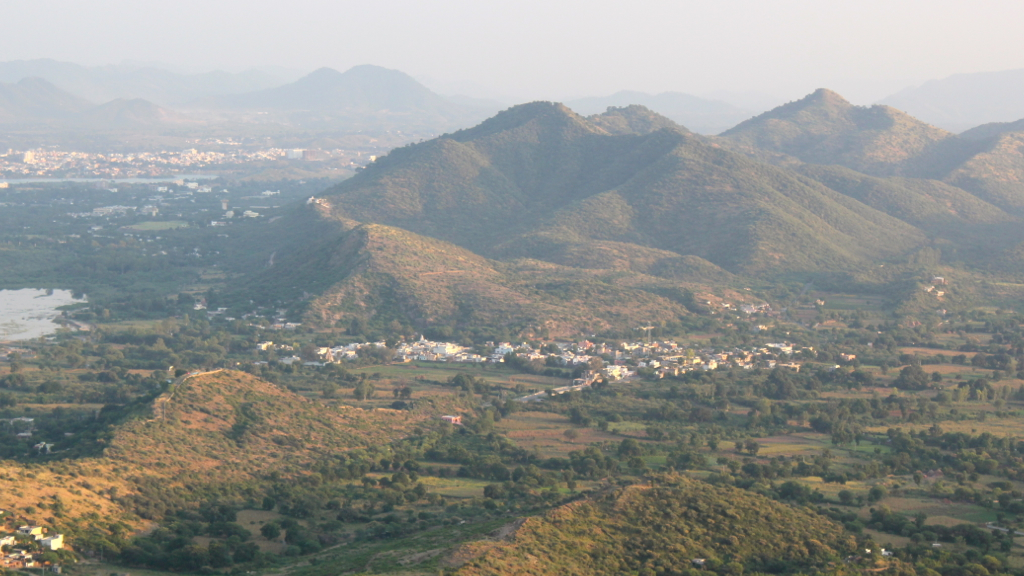
Photo: The Aravali hills / Nagarjun Kandukuru / CC BY 2.0
| Author K. Hency |
The one of the oldest mountain ranges in the world- The Aravalli Hills, have become the focus of a major legal and environmental controversy after the Supreme Court, based on the report of expert committee of Ministry of Environment, who examined how the range should be defined for regulatory purposes. In a deeper sense this dispute is not about geography alone but at its core, it concerns environmental protection, mining regulation, and the limits of administrative decision making under constitutional oversight.
The Aravalli Range, central to north India’s ecological balance, has rarely demanded public attention the way it has in recent months.
A recent attempt to introduce a uniform legal definition of the Aravallis triggered protests on ground and over the social media with #SaveAravalli campaign, scientific objections, political uproar and ultimately judicial reconsideration, turning the hills into a test case for India’s environmental governance framework.
How a Technical Definition Immediately Raised Alarm Against the Oldest Mountain Range?
Stretching from Delhi through Haryana and Rajasthan into Gujarat, these hills are not dramatic in height, but they quietly perform essential ecological functions like- recharging groundwater, slowing desertification, and stabilising fragile landscapes. Therefore, they are also known as Green Shield of The West.
Yet, in late 2025, the Aravallis found themselves at the centre of a legal dispute that had little to do with their age or history, and everything to do with how the law chooses to define nature.
The present definitional controversy arose from a committee formed under the Ministry of Environment, Forest and Climate Change (MoEFCC) to form a uniform standard for identifying the Aravalli Hills and Ranges. The panel, tasked in May 2024 after a Supreme Court order directed by then Chief Justice B.R. Gavai, was chaired by the Secretary, MoEFCC, Tanmay Kumar, and included the Joint Secretary of MoEFCC, the forest secretaries of the four Aravalli states (Delhi, Haryana, Rajasthan and Gujarat), as well as representatives from the Forest Survey of India (FSI), the Geological Survey of India (GSI), and the Supreme Court’s Central Empowered Committee (CEC). Six of the nine committee members were senior bureaucrats, was its composition.
On 20 November 2025, the Supreme Court accepted the definition proposed by this MoEFCC led panel, under which a landform would qualify as an “Aravalli Hill” only if it rose at least 100 metres above the surrounding terrain, and an “Aravalli Range” where two such hills lay within 500 metres of each other. This elevation-based criterion was praised by its supporters for its simplicity and uniformity, especially given that different states had adopted inconsistent standards for mining regulation and environmental controls.
Reason for the Ruckus and What the Critics Have to Say?
Environmental experts, civil society groups, and legal commentators pointed out key limitations in the committee’s formulation. They highlighted that the Forest Survey of India’s earlier mapping exercise under the Supreme Court’s direction had identified the Aravallis based on a three-degree slope criterion, a measure that covers far more of the range than a mere height test. According to an internal FSI assessment cited by The Indian Express, applying the 100-metre cutoff could exclude more than 90 per cent of landforms that had been previously recognised as part of the range, particularly lower ridges and hillocks that play a critical role in groundwater recharge, soil stability and biodiversity connectivity.
Environmentalists also argued that the Aravallis do not consist solely of tall peaks but form an ecologically interlinked landscape whose lower segments act as buffers against desertification and support local hydrology. By relying on a height-only test, they warned, the definition risked shrinking protected areas and opening vulnerable zones to mining and development pressures which could undermine the region’s ecological integrity and undoing decades of conservation efforts. What worried experts most was not just what the definition included, but what it left out.
The Apex Court Stays Its Own Order
The intense scientific criticism and continued public concern made the Supreme Court in December 2025 to take the rare step of staying its own November 2025 order, which had approved the new technical definition of the Aravalli Hills. The stay was granted by a Bench led by Chief Justice Surya Kant, which openly acknowledged that the issue could not be treated as a matter of administrative clarity alone. The Court noted that defining an ecologically sensitive mountain range involved serious environmental, geological and constitutional considerations, warranting deeper examination.
Now, the Supreme Court in its 22 January 2026 hearings led by Chief Justice Surya Kant bench held that existing environmental protections remain in force and that States such as Rajasthan must ensure that unauthorised quarrying and mining are restrained. During the proceedings, Additional Solicitor General Aishwarya Bhati and amicus curiae K Parameshwar also informed the Court that assurances had been given by the Rajasthan government that no new unauthorised mining would take place.
This interim stance ensures that regulatory safeguards are not diluted while the broader legal framework is under reconsideration.
Apart from the stay, the court has appointed a fresh expert committee under judicial supervision. The committee’s recommendations are expected to guide how the judiciary balances environmental protection with developmental pressures going forward.
What do you think readers?
Should courts rely strictly on expert committees, or interrogate their assumptions?
Can rigid legal definitions adequately protect complex ecosystems?
How far should judicial oversight extend into environmental governance?
These are not abstract questions. The answers will shape how India regulates fragile landscapes in the future. So, comment down below your expert answers.