Photo: Prime Minister’s Office (GODL-India), GODL-India
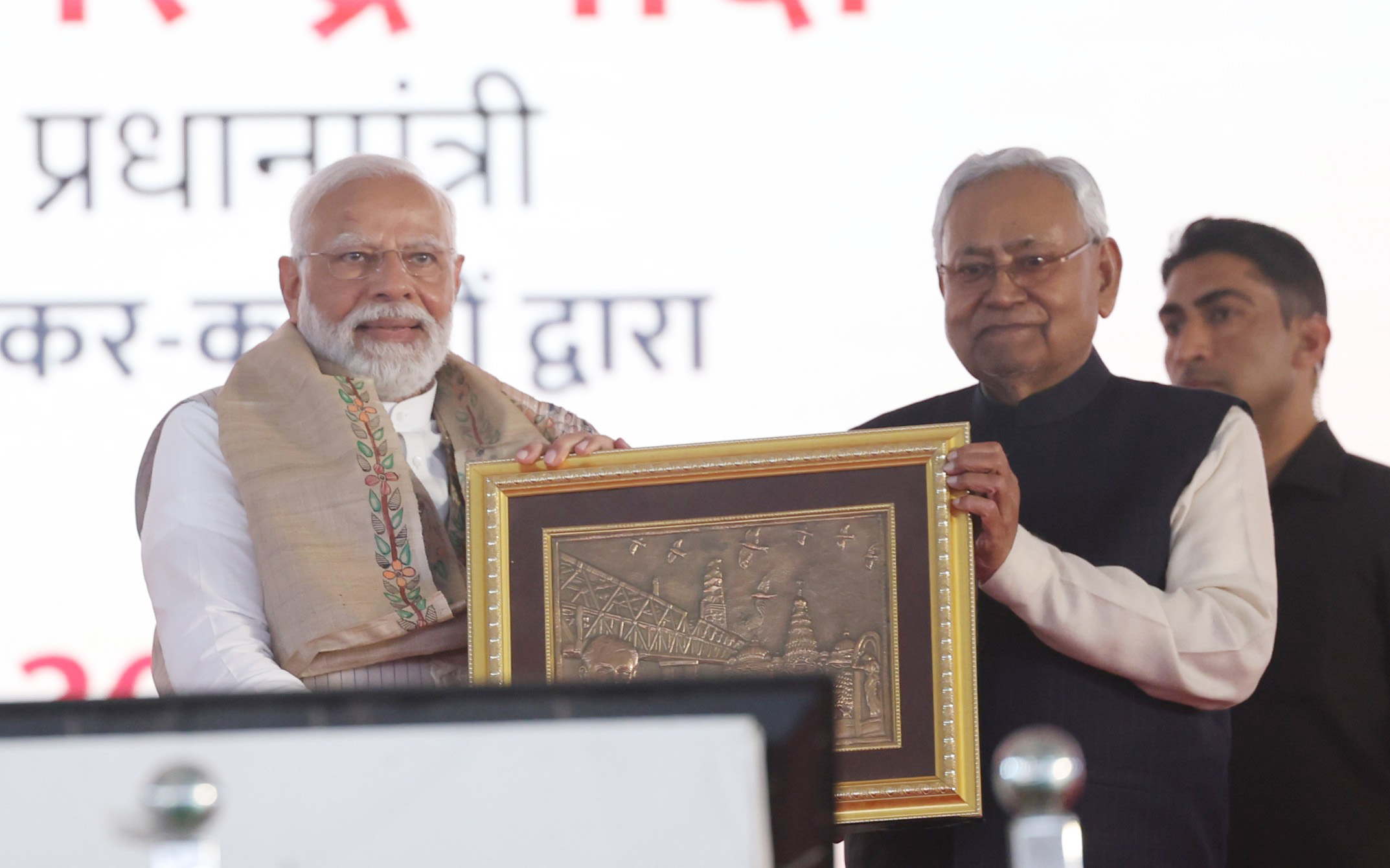
Just four months after taking the oath as Chief Minister for a historic, record-breaking 10th time, Nitish Kumar is reportedly packing his bags to step down. As of early March 2026, the undisputed center of Bihar’s political world is preparing to leave the Chief Minister’s office to enter the Rajya Sabha in New Delhi.
| Written by Anshika Chauhan |
This sudden and unexpected exit creates a massive power vacuum in Patna. With the state’s top chair suddenly sitting empty, a fierce, behind-closed-doors power struggle has erupted. The burning question on every citizen’s mind is no longer about development or state policies; it is entirely about who will take control of Bihar.
The Sudden Shift: What is Happening?
According to recent internal reports, Nitish Kumar is finalizing the paperwork to file his nomination for the Rajya Sabha by March 5, 2026. For decades, he has been the definitive face of Bihar, famously holding onto power through countless alliance changes and political storms. So, why walk away now?
At 75 years old, political experts see this not as a retirement, but as a highly calculated strategic exit. By moving to the safety of national politics in Delhi, he is actively making room for a “family succession” plan within his party, the Janata Dal (United) or JD(U). Strong political rumors indicate that his son, Nishant Kumar, is officially entering the political arena and is being heavily negotiated for a top spot, potentially the Deputy Chief Minister’s post.
The Fierce Battle for the Throne
With Nitish Kumar exiting the state legislature, the battle for the Chief Minister’s chair is intensely aggressive. The Bharatiya Janata Party (BJP) currently holds the absolute upper hand. In the recent November 2025 state elections, the BJP emerged as the single largest party in the ruling NDA alliance, securing 89 seats compared to JD(U)’s 85 seats.
Because they have the superior numbers, the BJP is now strictly demanding that the next Chief Minister must be from their own ranks. For the very first time in Bihar’s modern political history, the BJP sees a clear, unobstructed path to seat their own leader such as the current Deputy CM Samrat Choudhary on the ultimate throne.
However, JD(U) leaders are deeply nervous. They fear that without the protective shield of Nitish Kumar at the top, their party will be swallowed up, becoming nothing more than a “junior partner” forced to take orders from the BJP.
The Selfish Political Game
When we critically analyze this entire situation, it exposes a deeply flawed side of modern democratic politics. Elections are supposed to be a binding contract with the public. Just a few months ago, the people of Bihar cast their votes for a government functioning under a specific leadership structure. Now, before the ink is even fully dry on those election results, the leadership is being tossed around like a bargaining chip in closed-door meetings.
This is a textbook example of politically influenced objectives completely overriding the public mandate. The leaders currently sitting in Patna and Delhi are not discussing what is best for the economic development of Bihar. Instead, they are negotiating selfish power-sharing deals, fighting over cabinet portfolios, and securing powerful positions for their children. The BJP wants full, unchecked control of the state, and the JD(U) wants to secure a family legacy. In all of this intense political plotting, the choice of the everyday voter is completely ignored.
The Heavy Consequences for Society
The true cost of this political drama falls heavily and entirely on the ordinary people of Bihar. Whenever a state government is paralyzed by a fight over the Chief Minister’s chair, basic society stops working.
· Policy Paralysis: New infrastructure projects, educational reforms, and job creation schemes are immediately put on hold because government departments do not know who their next boss will be.
· Administrative Collapse: When the top leadership is unstable, the local administration loses its focus. The energy of the entire government machinery is wasted on party management and political survival instead of public welfare.
· Loss of Investor Trust: Businesses and foreign investors refuse to put their money into a state where the leadership changes overnight without a public vote, directly harming the state’s economic growth.
Conclusion
The resignation of Nitish Kumar to join the Rajya Sabha is not a simple administrative transfer; it is a massive political earthquake. As the BJP and JD(U) aggressively fight over who gets to be the next Chief Minister, they are leaving the entire state in administrative limbo. For future legal minds and policymakers reading this, the lesson is stark: in today’s political arena, securing ultimate power and family legacies almost always comes before serving the society that actually voted them into office.
This video provides important historical context on Nitish Kumar’s frequent resignations and shifting alliances, highlighting the ongoing political instability in Bihar that led up to his current move.