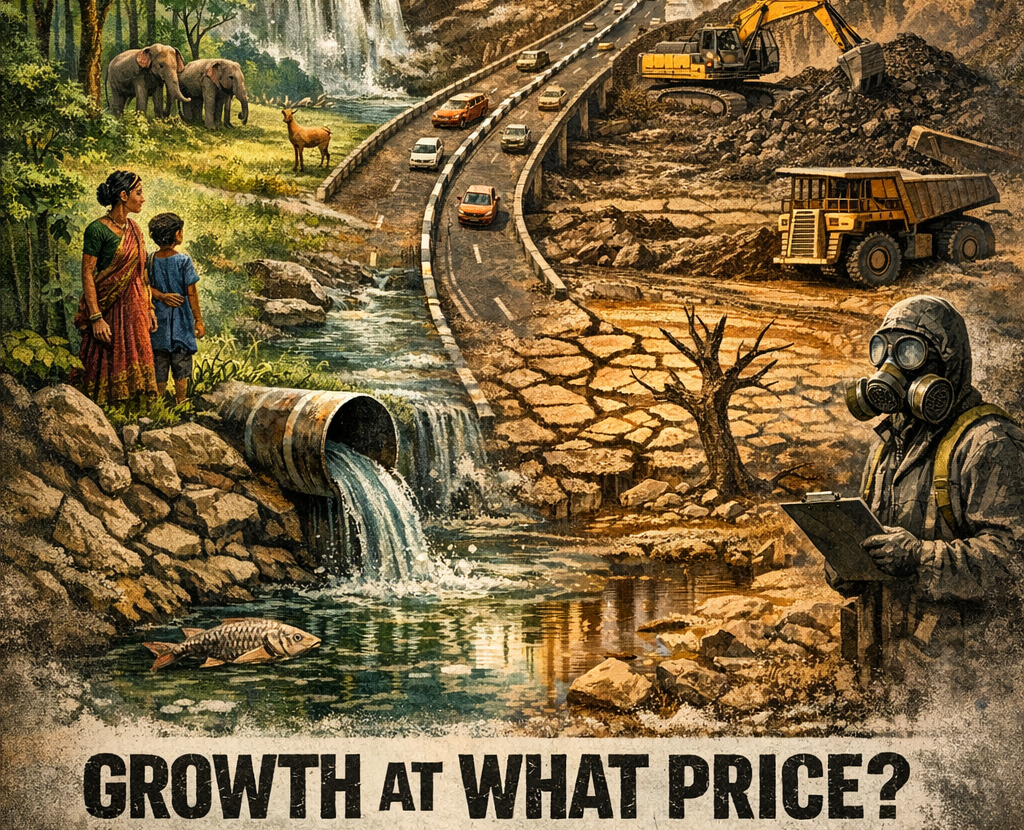
Image: Own Creation
|Author- K. HENCY|
India is building at a speed it has never seen before. Highways are cutting through mountains. Expressways are linking cities in record time. Coal mines are expanding. Riverfronts are being beautified. Forest clearances are being fast-tracked in the name of “ease of doing business.” On paper, it is a story of ambition. On the ground, it is also a story of loss.
The environmental cost of development in India is no longer theoretical. It is measurable in hectares of forest diverted, rivers polluted, air thickened, species displaced, and communities uprooted. The question is no longer whether development affects the environment. It is whether India is calculating that cost honestly.
Projects Cleared but Forests Cleared Faster
According to data from the Ministry of Environment, Forest and Climate Change (MoEFCC), thousands of hectares of forest land are diverted each year for mining, highways, transmission lines and industrial projects. Parliamentary responses have shown that between 2014 and recent years, over 1.5 lakh hectares of forest land were cleared for non-forest purposes.
Supporters argue that compensatory afforestation offsets the damage. But multiple reports by the Comptroller and Auditor General (CAG) and environmental researchers have flagged gaps between diverted forests and actual, ecologically equivalent restoration.
Planting trees is not the same as preserving forests. An old-growth forest lost to mining cannot be recreated by plantation drives on paper.
Coal and Energy: The Development Dilemma
India remains heavily dependent on coal with over 70% of electricity generation still coming from thermal power. While renewable capacity is rising with India among the fastest growing solar markets but the coal expansion has not stopped.
The controversial Hasdeo Arand forest in Chhattisgarh, often described as one of central India’s richest biodiversity zones, has repeatedly faced coal mining approvals despite protests from tribal communities and environmental groups. The argument from policymakers is straightforward: energy security is non negotiable. This argument seems legit as economic growth demands reliable power and jobs depend on industrial expansion. But climate science offers a competing reality in form of climate crises as India is already witnessing the intensifying heatwaves, extreme rainfall events, glacial melts and avalanches in the Himalayas and urban flooding.
The Intergovernmental Panel on Climate Change (IPCC) has repeatedly warned that countries like India face disproportionate climate vulnerability. Development fuels emissions. Emissions fuel climate risk. Climate risk threatens development. The cycle has a endless loop.
Rivers Under Pressure
Urban riverfront projects across India are frequently presented as symbols of modernization cleaner banks, promenades, commercial spaces, and tourism potential. The city administration frame them as reclamation efforts, transforming “neglected” rivers into public assets but ecological experts caution it that beautification often comes at the cost of hydrological logic. When riverbanks are concretized, floodplains are narrowed, and wetlands are filled for real estate or infrastructure, the natural absorption capacity of the river system is reduced. Floodplains are not empty land waiting to be developed but they are the buffer zones from the civilizations and natural disasters. They slow water ramqape, recharge groundwater, and prevent overflow during extreme rainfall.
India’s recent urban flooding crises, most recently in 2025 in Delhi, Bangalore, Indore etc reflect what happens when those buffers disappear. Bengaluru’s flooding has been repeatedly linked to the destruction of interconnected lakes and wetlands. Chennai’s devastating floods exposed years of encroachment over floodplains. Mumbai’s annual monsoon paralysis is tied to clogged drainage and lost mangroves. Delhi, despite sitting along the Yamuna, has seen construction expand into sensitive floodplain areas.
Hydrologists point out a basic truth that rivers are dynamic systems, they expand and contract seasonally and shift channels over time. Constraining them within concrete embankments may create temporary order, but it increases the intensity of flooding when extreme rainfall events occur.
Therefore, a river is not a decorative backdrop for urban design but an ecological engine carrying sediment, supporting biodiversity, recharging aquifers, and moderating floods. When development treats it as waterfront real estate rather than as a living system, nature does not negotiate. It reclaims space and its process if often disastrous.
The GDP Obsession
GDP rewards extraction immediately. The environment charges interest slowly.
India’s aspiration to become a $5 trillion economy has become a defining national goal. Infrastructure expansion, unregulated mining projects, industrial corridors, ports, and energy generation are framed as the engines driving that ambition. While growth is equated with strength, speed is equated with progress.
But traditional GDP accounting measures output, not depletion. For instance, when a forest is cleared for mining, the coal extracted adds to national income. When a river is diverted for industrial use, the resulting production increases economic figures. When wetlands are filled to build real estate, construction boosts quarterly growth.
What GDP does not subtract is, what is lost.
It does not deduct biodiversity decline. It does not calculate groundwater depletion. It does not factor in rising healthcare costs due to pollution. It does not measure ecosystem services such as flood protection, carbon sequestration, soil fertility that were silently performing economic functions and without them not only will the economy suffer but the civilisations would also do.
Environmental economists have long argued that India lacks comprehensive “green accounting” a framework that adjusts economic indicators by incorporating ecological damage and natural capital depletion. While discussions on natural capital accounting have begun at policy levels, implementation remains limited and fragmented.
The result is a distorted picture. A mining project may appear profitable in financial terms but if it permanently damages water systems, increases heat vulnerability, and triggers long-term health impacts, the true cost is deferred, not erased. And it is an open fact in India that how much regulated these systems are.
If growth is calculated without subtracting ecological loss, it creates an illusion of acceleration while quietly eroding the foundation on which future growth depends. The question is not whether India should grow. It is whether it can afford a model where environmental cost remains off the balance sheet. Because development that consumes its ecological base eventually slows itself.
The Hard Truth
The environmental cost of development in India is not invisible anymore.
It is visible in
• Delhi’s polluted air
• Receding groundwater tables
• Flooded cities
• Drying rivers
• Rising temperatures
India is building its future. But if ecological damage outpaces restoration, the foundation weakens. Development that destroys its own environmental base eventually undermines itself. Growth without ecological discipline is not strength. It is delayed instability.
The debate is no longer about whether India should grow. It is about whether it can grow without eroding the very systems that sustain it. And that calculation, more than any GDP target, will determine the country’s real progress.