|Written By Anshika Chauhan|
The Auditor in the Court of the people
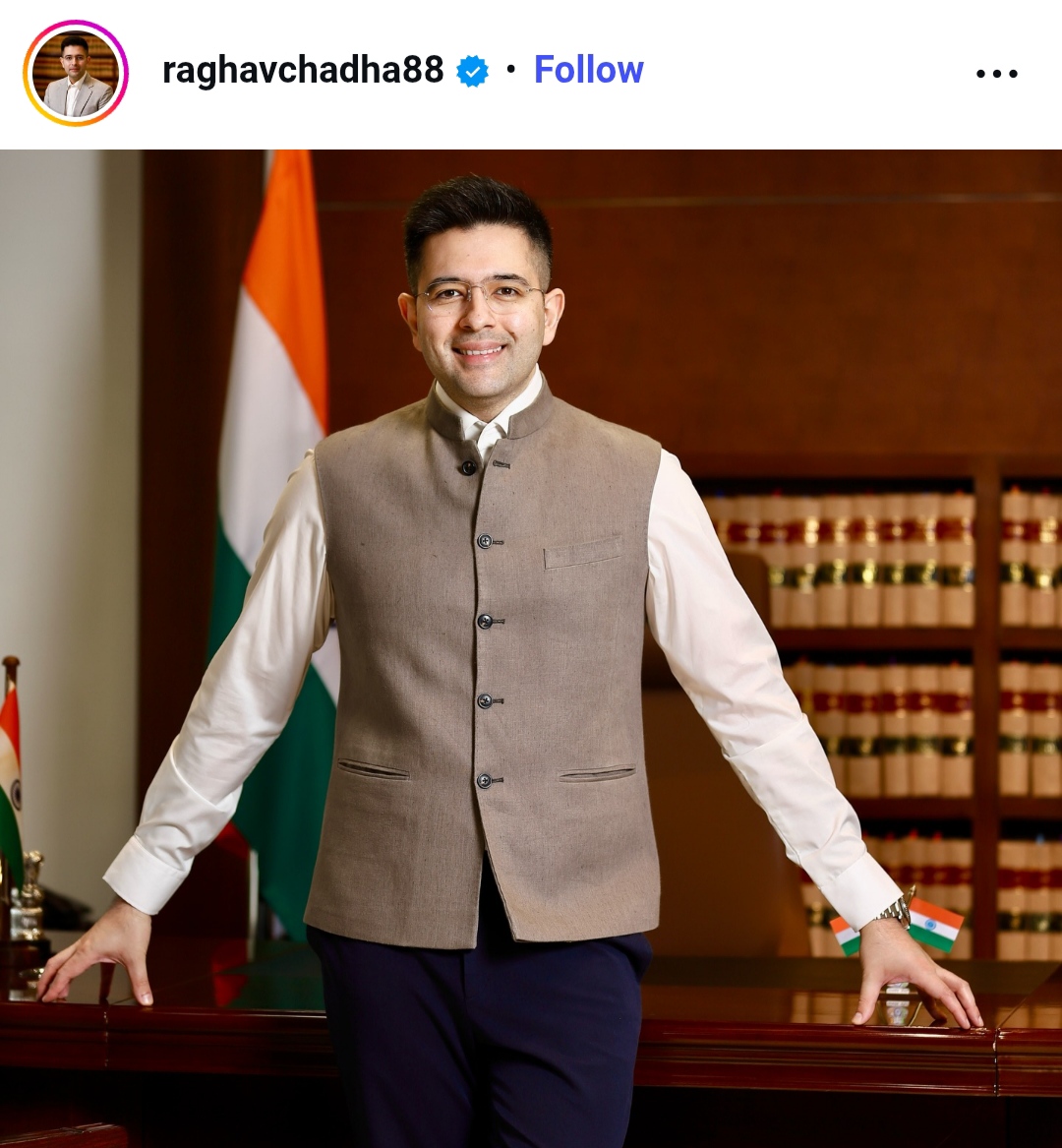
Raghav Chadha entered the fray of Indian politics not as a traditional leader born of a political dynasty, but as a professional anomaly, a “Chartered Accountant” who traded the precision of balance sheets for the unpredictability of ground-level governance. In my opinion, Chadha represents a significant shift in political humanization; he is the “Technocrat-Politician” who uses data as a shield for the common citizen. His journey is a testament to the idea that governance should be a “social and constitutional commitment,” rather than just a series of “sectoral expenditures”.
Ground-Level Mastery: The Punjab Surge
While Chadha is often seen as a polished national spokesperson, his most impactful “ground-level” work has been as a strategic architect of the Aam Aadmi Party’s (AAP) expansion. The “data” from late 2025 highlights the success of this grounded approach: AAP achieved a historic dominance in rural governance, claiming victory in “78% of Punjab’s Zila Parishads” .
This was not merely a political win; it was a response to the “raw, grassroots impact” of agrarian distress and the “fragmented leadership” of the opposition . Chadha’s presence on the ground in regions like Malwa has humanized the party for the Punjabi voter, bridging the gap between New Delhi’s policy-making and the “agrarian distress” faced by farmers. In my view, he has successfully moved the party away from an “inherited reflex” of centralization, proving that “Unity… is sustained not by command but by consent”.
The Fiscal Watchdog: Data as a Weapon
One of Chadha’s primary roles in the public consciousness is that of a fiscal watchdog. He has brought a humanized urgency to the dry numbers of the national treasury. For example, the “Health Budget 2026-27” presents a “troubling reality” when viewed through an auditor’s lens . While the nominal allocation rose to “Rs 1,04,559 crore”, the data reveals that as a share of GDP, health spending has stagnated at a mere “0.29% to 0.31%” over the last three years—well below the 5% goal.
Chadha’s critiques often highlight a “deep-rooted systemic issue” regarding accountability: between FY 2019-20 and 2023-24, the Ministry of Health surrendered an extraordinary “Rs 1,32,749 crore” in unspent funds. To Chadha, this is not just a “marginal administrative lapse” but a failure to address “human resource shortages” in rural areas and the “fragile surveillance systems” exposed by the post-COVID era. He has argued for the “ring-fencing” of special cesses like the Health Cess, which reached “Rs 71,159 crore” by 2023-24 to ensure they aren’t merged into the Consolidated Fund where they become “difficult to track” .
Advocating for a New Federal Compact
In the realm of opinion and political philosophy, Chadha has emerged as a champion for a “structural reset” of Indian federalism. He argues that the current system allows the Union Government to retain “14.09% of Gross Tax Receipts” through non-divisible cesses and surcharges, effectively weakening the fiscal capacity of the States who shoulder the “primary responsibility for delivering healthcare”.
Chadha’s vision aligns with a “Union of states” that “trusts its states” and “accommodates heterogeneity” rather than enforcing a “One-Nation-One-Something” template. He views this as a “civilisational mode of reasoning,” where the only way to rule a diverse subcontinent is to respect “local customs, practices, and rules”.
Conclusion: Resilience in a Corrupted Landscape
Raghav Chadha’s humanized appeal is also found in his resilience against a “fragmented media landscape” and “online censorship”. He operates in an era where “paid news” is used to “corrupt the information and deceive” the public, and where government tools like the “Sahyog portal” allow for unilateral takedowns of content without “independent review” or “notice to the affected party”.
In my opinion, Chadha is the necessary antidote to a “rotting” democracy . By grounding his politics in “data-driven accountability” and a commitment to “cooperative federalism”, reminds us that the promise of universal healthcare and equitable governance will remain a “distant dream” without leaders who place “people not industry—at the centre of policy” .