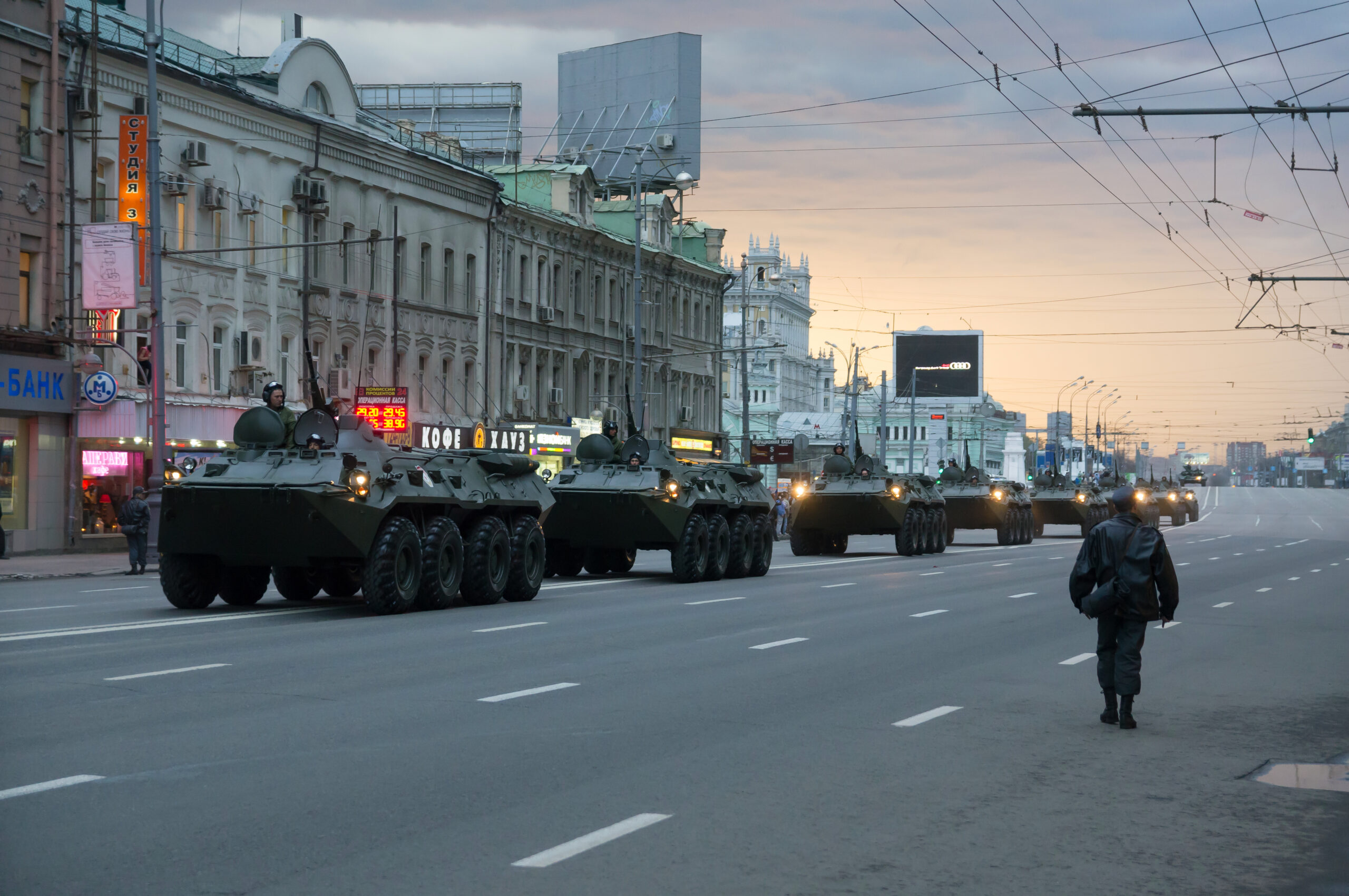
Photo: © Vyacheslav Argenberg, CC BY 4.0
A stunning statistic is circulating among global economists: Russia is pouring nearly 40% of its entire Federal Budget directly into defense and national security, amounting to over 15.5 trillion rubles (approximately $160 billion) for 2025 alone, according to analyses from the Stockholm School of Economics and recent federal budget data. To put that into perspective, for a modern nation to spend almost half of its government money strictly on the military is unheard of in the 21st century. It means Russia has officially transformed into a total “war economy.”
| Written by Ahad Khan |
While the Kremlin says with pride that its economy is surviving Western sanctions, the reality beneath the surface is much darker. By burning billions of rubles to fund the war in Ukraine today, Russia is effectively borrowing money, talent, and technology from its own future.
Military Keynesianism
If you look at Russia’s Gross Domestic Product (GDP) right now, it actually appears to be growing. In 2024, growth outpaced several Western nations, but economists refer to this as a dangerous illusion known as “Military Keynesianism,” as detailed by experts at the Center for Strategic and International Studies (CSIS).
The government is pouring massive amounts of money into tank factories, missile manufacturing, and high salaries for soldiers. Factories are running 24/7, and the national unemployment rate has plummeted to a historic low of around 2.3%, according to recent Russian labor statistics. But here is the catch: this growth does not produce anything of lasting value for the average citizen. You cannot export a blown-up tank, and building artillery shells and does not improve civilian infrastructure, healthcare, or education.
Furthermore, this artificial, steroid-fueled boom has triggered massive inflation, forcing the Russian Central Bank to hike interest rates up to a crushing 21% to prevent the economy from overheating. The moment the war ends and the government stops ordering weapons, this fragile economic bubble is primed to crash incredibly hard.
Brain Drain
This is arguably Russia’s darkest long-term crisis. Wars are not just fought with money; they are fought with the youth.
Hundreds of thousands of young, working-age men have either become casualties on the front lines or have permanently fled the country to avoid the military draft. In 2022 alone, an estimated 600,000 to 1 million Russians left the country, and research shows that 80% to 90% of those emigrants were under the age of 45, according to demographic tracking by the George W. Bush Presidential Center.
This massive “brain drain” includes IT professionals, software developers, engineers, and entrepreneurs. A study published in EPJ Data Science confirmed that highly active and central open-source software developers fled Russia at alarming rates shortly after the invasion began. Russia was already facing a severe, declining birth rate standing at a total fertility rate of about 1.41, well below the replacement level before the war even started. Now, the country is rapidly wiping out the exact generation of young minds it desperately needs to work in factories, start businesses, and build a sustainable future economy.
Western Sanctions
While the rest of the world is racing into the future, Russia is being forced into the past.
Because of crushing Western sanctions, Russia has been cut off from advanced microchips, modern software, and international scientific collaboration. While powerhouses like the United States, China, and India are pouring trillions into Artificial Intelligence, quantum computing, and green energy, Russia is forced to focus its resources entirely on basic artillery and daily survival.
Without access to cutting-edge components, non-military industries are suffocating. In the coming decades, this massive technological lag will make it nearly impossible for Russian industries to compete on the global stage. They are trading tomorrow’s technological dominance for today’s territorial gains.
The Asian Pivot
To survive the economic blockade from Europe and the United States, Russia has had to radically pivot its economy to the East.
Today, Russia is keeping its economy afloat by selling massive amounts of oil and gas to countries like China and India at steep, forced discounts. But this survival tactic comes at a massive geopolitical cost. In the long term, this makes Moscow heavily dependent on Beijing. Many geopolitical analysts, including those observing global trade shifts, argue that Russia’s future is no longer that of an independent, self-reliant global superpower. Instead, it is slowly becoming a resource-rich “vassal state” that must rely entirely on China for its economic survival, imports, and technology.
A Superpower in Decline?
Winning or losing on the actual battlefield might soon become irrelevant. Even if the guns fall silent tomorrow, the economic and demographic damage is already locked in. By turning its entire federal budget into a war machine, sacrificing its brightest young minds, and isolating itself from global innovation, Russia is surviving the present but systematically dismantling its own future.
Is Russia permanently crippling its status as an independent global superpower, or can a post-war economy bounce back from this unprecedented brain drain and financial strain? What do you think? Comment below!