Photo: His Holiness Bhaktiratna Sadhu Swami Gaurangapada, CC BY 2.0
त्वमेव माता च पिता त्वमेव । त्वमेव बन्धुश्च सखा त्वमेव ।
त्वमेव विद्या द्रविणम् त्वमेव । त्वमेव सर्वम् मम देव देव ।
“You alone are my mother and my father. You alone are my kin and my friend. You alone are knowledge and wealth. You are everything to me, O Lord of Lords.”
| Written by Siddhant Bijoliya |
The Dilemma of the Seeker
Have you ever stood at a crossroads in life, torn between the desires for deep inner peace, the need for intellectual clarity, and the demanding call to take action?
For thousands of years, seekers have faced this exact dilemma. While rituals and colorful traditions paint the surface of Hinduism, its philosophical core is built to answer these very questions. This core is not found in a single book, but in a triad of spiritual masterpieces collectively known as the Prasthana Trayi or “The Three Points of Departure.”
Imagine a complete map of existence:
1. The Upanishads (The Revelation): The destination and the intuitive map.
2. The Brahma Sutras (The Reason): The compass that keeps the intellect true.
3. The Bhagavad Gita (The Road): The walking shoes required to make the journey.
Together, they form a complete edifice of spiritual knowledge: revelation, reason, and practical discipline. Here is how these three ancient pillars guide us from ignorance to illumination.
Part I: The Upanishads – The Wellspring of Wisdom
(Śruti Prasthāna – The Departure of Revelation)
If you were to climb to the peak of Vedic thought, you would find the Upanishads (c. 800–200 BCE). Meaning “to sit near” (implied: sitting near the teacher), these texts mark a revolutionary shift from the external rituals of the ancient Vedas to an internal inquiry into the Ultimate Reality.
They are the whispers of the mystics those who closed their eyes and saw the truth of the universe.
The Core Revelations
The Upanishads provide us with the vocabulary of the infinite:
· Brahman (The Absolute): The central, non-dual reality. It is the canvas upon which the universe is painted infinite, eternal, and described as Sat-Chit-Ananda (Existence-Consciousness-Bliss).
· Atman (The Self): The revolutionary declaration that the Divine is not just “out there,” but “in here.” The Chandogya Upanishad famously declares “Tat Tvam Asi” (You are That). You are not a stranger to the universe; you are its very essence.
· Maya & Samsara: We are caught in a cycle of birth and death (Samsara), driven by the cosmic illusion (Maya) that makes the One appear as many.
· Moksha: The goal is not to go to heaven, but to wake up to attain liberation by realizing that Atman and Brahman are one.
Deep Dive: The Mandukya Upanishad analyzes our daily experience through four states: Waking, Dreaming, Deep Sleep, and the “Fourth” (Turiya) the pure consciousness that witnesses them all.
Part II: The Brahma Sutras – The Thread of Logic
(Nyāya Prasthāna – The Departure of Logic)
The insights of the Upanishads are poetic, ecstatic, and sometimes paradoxical. To the logical mind, they can be confusing. Enter the Brahma Sutras.
Composed by the sage Badarayana (c. 200 BCE–450 CE), this text takes the flowers of Upanishadic wisdom and strings them into a coherent garland. It comprises 555 terse aphorisms (sutras) designed to systematize spiritual thought.
The Intellectual Framework
The Brahma Sutras do not give us new revelations; they defend and organize the ones we have. Using rigorous logic (Nyaya), the text:
· Harmonizes: Reconciles apparently conflicting statements in the scriptures.
· Refutes: Defends Vedanta against opposing dualistic or atheistic schools (like Sankhya or Buddhism).
· Establishes: Proves that Brahman is the efficient and material cause of the universe the spider and the web alike.
This is the text for the philosopher. It ensures that our faith is not blind, but supported by an unshakeable intellectual foundation.
Part III: The Bhagavad Gita – The Song of the Lord
(Smriti Prasthāna – The Departure of Memory/Practice)
If the Upanishads are for the cave and the Brahma Sutras are for the classroom, the Bhagavad Gita is for the battlefield.
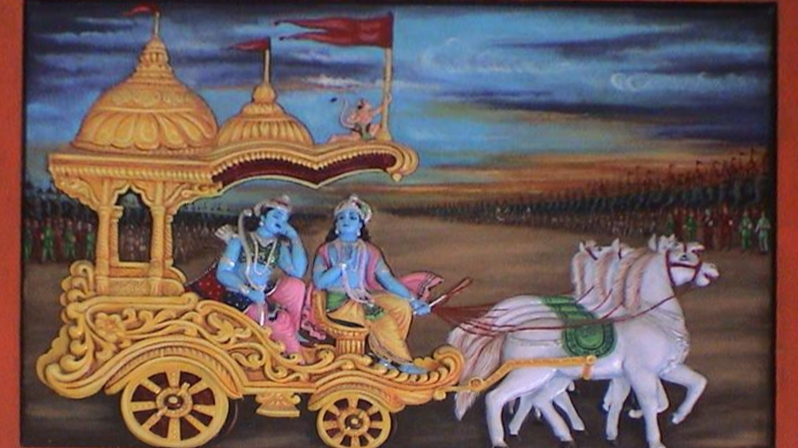
Set in the epic Mahabharata, the Gita (c. 2nd century BCE) is a dialogue between the warrior Arjuna, who is paralyzed by moral crisis, and Krishna, the Avatar and Charioteer. It brings the lofty philosophy of the Upanishads down to the dusty earth of human duty.
Philosophy in Action
The Gita’s genius lies in synthesis. It harmonizes the different paths (Yogas) to the Divine:
1. Karma Yoga (The Path of Action): The central ethical doctrine of Nishkama Karma acting intently according to one’s duty (Dharma), but surrendering the results.
2. Jnana Yoga (The Path of Wisdom): The intellectual discernment between the temporary body and the eternal Self.
3. Bhakti Yoga (The Path of Love): Here, the abstract Brahman becomes a personal, loving God. Krishna declares, “Abandon all varieties of religion and just surrender unto Me.”
The Gita creates the Stithaprajna the person of steady wisdom who remains calm in the midst of chaos, bridging the gap between the monk and the warrior.
Conclusion
The beauty of the Prasthana Trayi is that it acknowledges that every seeker is different. Some of us are driven by the heart, others by the sharp edge of intellect, and many by the call of duty. The journey through the Prasthana Trayi is a movement from questioning to understanding, and finally, to living the truth. The Upanishads spark the inquiry: “Who am I? What is real?” The Brahma Sutras provide the intellectual rigor to clarify and defend that understanding against doubt. The Bhagavad Gita takes this realized truth into the heart of the human condition the battlefield of duty, desire, and despair and shows how to live it with integrity, detachment, and love.
Together, they offer a complete spiritual curriculum: the end (Moksha), the means (Yoga), and the logical proof (Tarka). They remain not mere historical texts but living guides, inviting each seeker to move from the apparent duality of the world to the experiential unity of the Self, from ignorance to liberation. As the Katha Upanishad declares, “The Self is not attained by discourse, nor by intellect, nor by much learning. It is attained only by the one whom It chooses. To such a one, the Self reveals its own nature.” The triple canon lights the path for that revelation.
Reflect on where you stand today:
· Do you feel a pull toward deep, silent contemplation? You may find your home in the Upanishads.
· Does your mind demand logical proof and structure? The Brahma Sutras await your study.
· Are you in the thick of life’s battlefield, seeking a way to act with peace? The Bhagavad Gita is your guide.