\Written by Siddhant Bijoliya\
For nearly a 5000 years ago, the Indus Valley Civilization (c. 3300–1300 BCE) stood as a marvel of the ancient world. From the meticulously planned streets of Mohenjo-Daro to the advanced drainage systems of Harappa, it was a society defined by order, standardized weights, and far-reaching trade. Yet, by 1900 BCE, the Great Cities began to crack. The uniform bricks gave way to haphazard construction, trade networks withered, and eventually, the grand urban experiment was abandoned.
The disappearance of the Harappans is not a story of a single sudden catastrophe, but rather a complex “system collapse.” Historians and archaeologists have spent decades debating the catalysts. Here is an exploration of the leading theories behind the decline of one of antiquity’s greatest urban powers.
1. The Shifting Waters: Hydrological Changes
The Harappans were situated at near of the indus river civilization, utterly dependent on the Indus and its tributaries. One of the most compelling theories involves tectonic disturbances. The Indus region is seismically active; major plate movements could have diverted the course of rivers or caused catastrophic flooding.
2. Climate Change and the Weakening Monsoon
Recent paleoclimatological studies suggest that a shift in monsoon patterns played a decisive role. Around 1800 BCE, the summer monsoons—which provided the vital rainfall for Harappan agriculture—began to weaken significantly.
As the rains became erratic, the large-scale surplus farming required to support massive urban populations became impossible. The Harappans were forced to adapt by moving eastward toward the Ganges basin, where rain was more reliable. This resulted in “de-urbanization”—the transition from grand cities to small, localized rural settlements.
3. Ecological Degradation
The Harappans may have been victims of their own success. Building and maintaining massive brick cities required an astronomical amount of fuel.
4. The “Aryan Invasion” vs. Migration
In the early 20th century, archaeologist Mortimer Wheeler famously blamed the decline on “Indra” (the Hindu god of war), suggesting that Indo-Aryan invaders swept down from Central Asia and destroyed the Harappan cities. He pointed to skeletons found in the streets of Mohenjo-Daro as evidence of a massacre.
However, modern scholarship has largely debunked the “Invasion” theory.
5. Economic Collapse and Social Unrest
A civilization is held together by its “glue”—trade, religion, and administration. When the external trade with Mesopotamia (Sumer) began to decline around 1900 BCE, the Harappan elite may have lost their authority.
Without the wealth from trade and the stability of food surpluses, the complex social hierarchy likely dissolved. The standardized system of weights and measures vanished, and the script—still undeciphered today—fell out of use. The “Harappan identity” simply fragmented into smaller, regional cultures known as the Late Harappan Phase.
The Legacy of the Decline
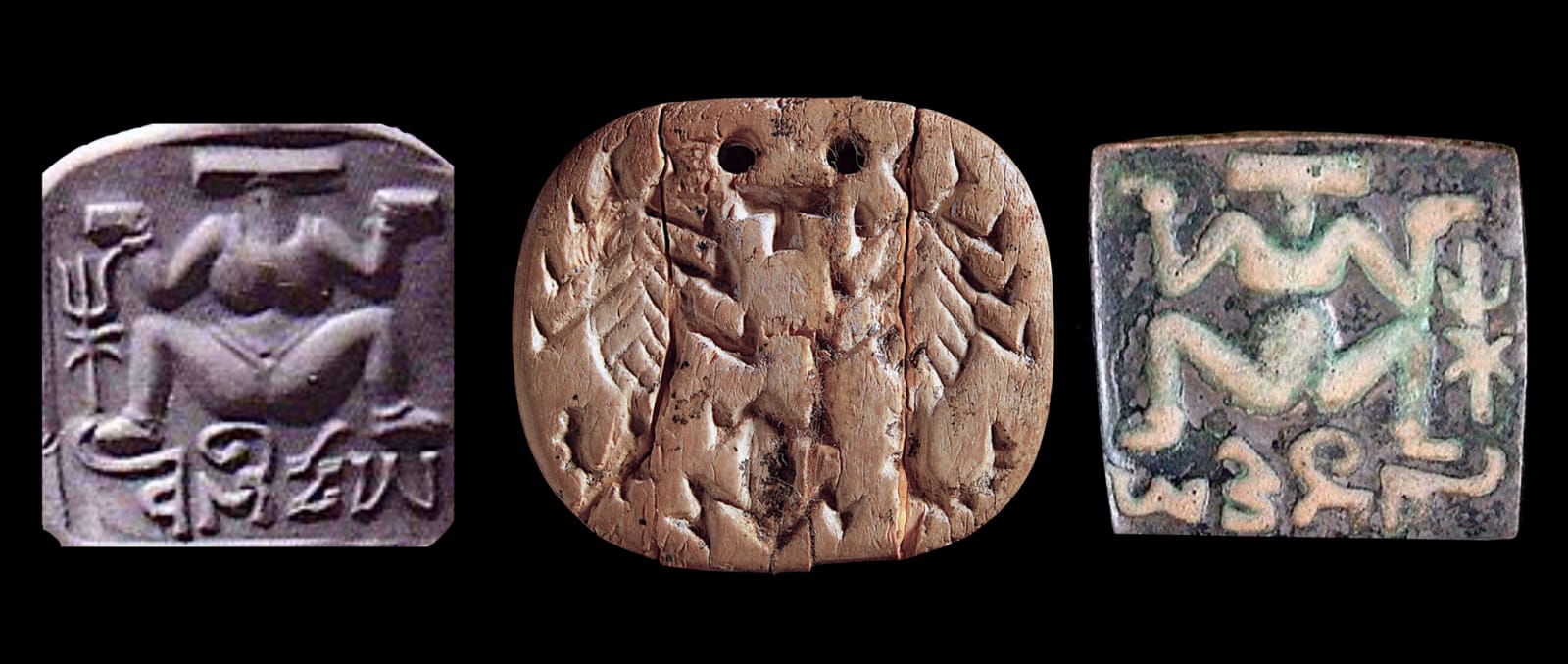
The end of the Harappan civilization wasn’t a “death” so much as a transformation. While the grand cities turned to mounds of dust, Harappan heritage lived on. Their techniques of pottery, jewelry making, and perhaps even certain religious symbols (like the pipal leaf and proto-Shiva figures) were absorbed into the emerging Vedic culture of the Iron Age.
The decline serves as a poignant reminder of the fragility of urban life when faced with a changing environment. The Harappans didn’t fail because they were weak; they vanished because the delicate balance between their technology and their environment finally tipped.