Photo: OWID, CC BY 4.0
You cannot build a “Viksit Bharat” on borrowed technology. To become a global superpower, a country must invent the future. Yet, when you look at how much India is actually spending on Research and Development (R&D) compared to the rest of the world, we are not just losing the race, we are barely at the starting line.
| Written by Anshika Chauhan & Ahad Khan |
Everywhere you look today, political billboards and campaign speeches are echoing the same grand promise: “Viksit Bharat 2047.” The vision is to transform India into a fully developed, self-reliant global superpower by its 100th year of independence.
It sounds inspiring. But if you strip away the political slogans and look at the cold, hard math of global innovation, a very different story emerges.
Where Does India Actually Stand?
In 2023-2024, the world poured a surprising $2.87 Trillion into R&D.
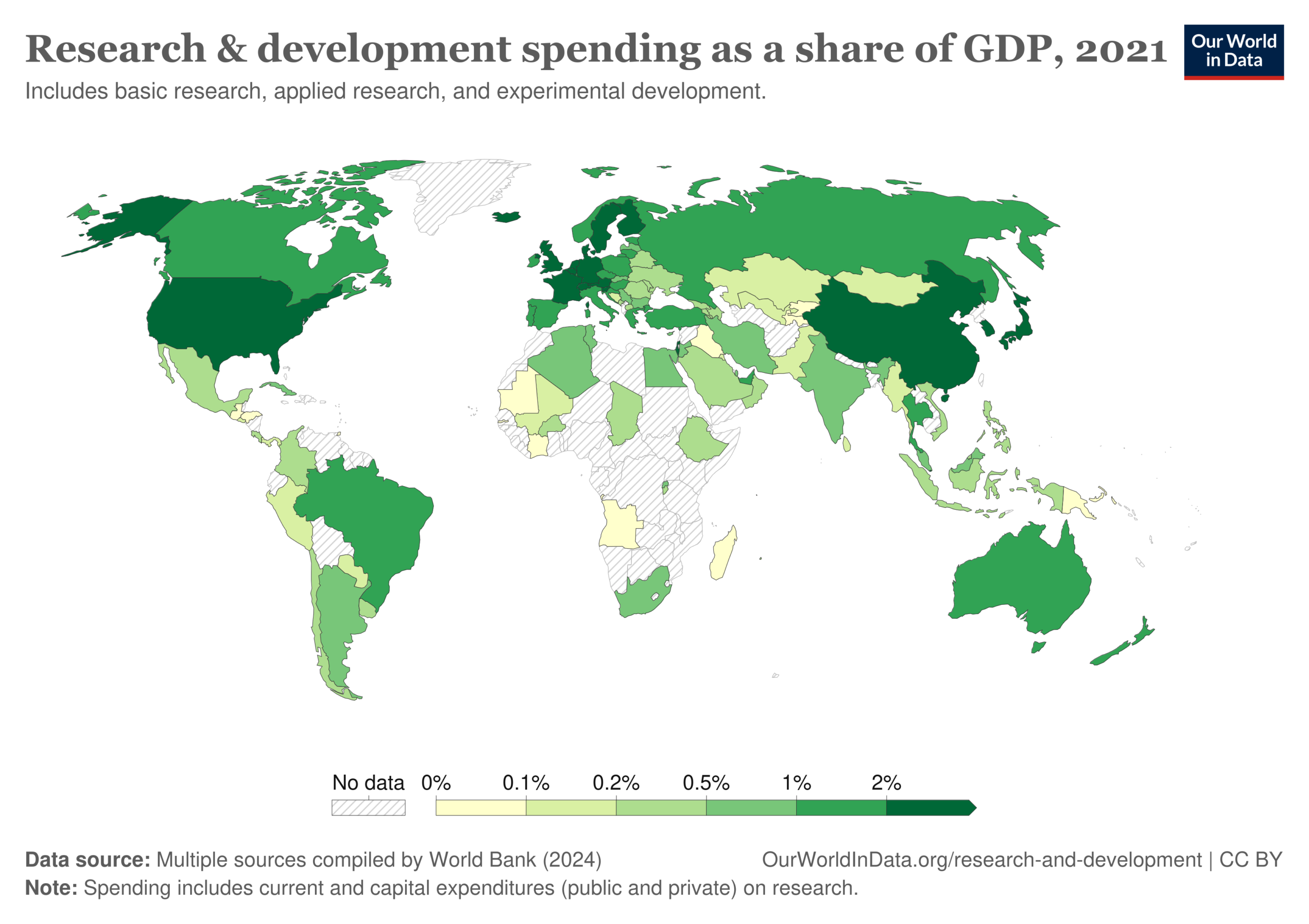
To see who is truly serious about the future, economists look at “R&D Intensity” which means how much of a country’s total wealth (GDP) is spent purely on research and innovation.
Smaller, highly developed nations treat R&D as a matter of survival. Israel leads the world, spending a massive 6.3% of its GDP on innovation. South Korea consistently follows at roughly 5.0%. The United States spends heavily to maintain its dominance, investing around 3.5% of its massive GDP. Meanwhile, China has aggressively ramped up its spending to over 2.4% (amounting to a jaw-dropping $785.9 Billion in cash), officially challenging the US for the top spot.
Despite the heavy political promotion of becoming a global tech hub, India’s R&D expenditure has been stubbornly stuck at roughly 0.7% to 0.8% of our GDP for the last decade. We are competing against nations spending 3% to 6% of their wealth on the future, while we are spending less than 1%.
Where Are the Corporations?
If you look closely at the data, you will find the exact reason why India is lagging so far behind.
In countries like the US, South Korea, and China, the government does not do all the heavy lifting. The vast majority of their R&D funding (often over 70%) comes from the private sector, massive corporations investing billions into AI, microchips, and medicine.
In India, the situation is completely upside down. The Indian government is forced to carry the burden, funding about 64% of the country’s total R&D (mostly pushed into Defense, Space, and Agriculture). The Indian private sector contributes a dismal 36%.
While Indian IT giants and corporations boast record-breaking profits, very little of that money is reinvested into deep-tech, original research, or patent creation. The Government’s recently announced ₹1 lakh crore RDI Scheme Fund is an attempt to fix this by offering cheap loans to private companies to do research, but it is a late start to a race that China and the US have been running for decades.
The “Viksit Bharat” Paradox
This brings us to the core issue. The “Viksit Bharat” campaign promises a fully developed India, but the numbers suggest an economy that is still heavily dependent on the rest of the world for true innovation.
Yes, India ranks 3rd globally in Science & Engineering PhDs awarded. We have the brains, the talent, and the youth. But because we do not spend the money to build world-class research infrastructure at home, that talent often moves to the US or Europe to invent things for other countries.
We are funding the India AI Mission, the Quantum Mission, and a ₹76,000 crore Semiconductor push. These are steps in the right direction. But until our total R&D spending crosses that critical 2% of GDP mark, the dream of a self-reliant India will remain just that, a dream.
You cannot claim the 21st century by spending less than 1% on the future. The data is ruthlessly clear: those who do not invest heavily in innovation today will be forced to buy it from those who did tomorrow.
Do you think the “Viksit Bharat” vision is achievable with our current R&D spending, or is it just a political slogan masking a deeper crisis? Drop your opinions in the comments below!