Photo: Image 1: Prime Minister’s Office, Government of India, CC BY-SA 2.0 Image 2: Adam Jones from Kelowna, BC, Canada, CC BY-SA 2.0 Image 3: Video Grabs of Mamata Banerjee’s Post on X
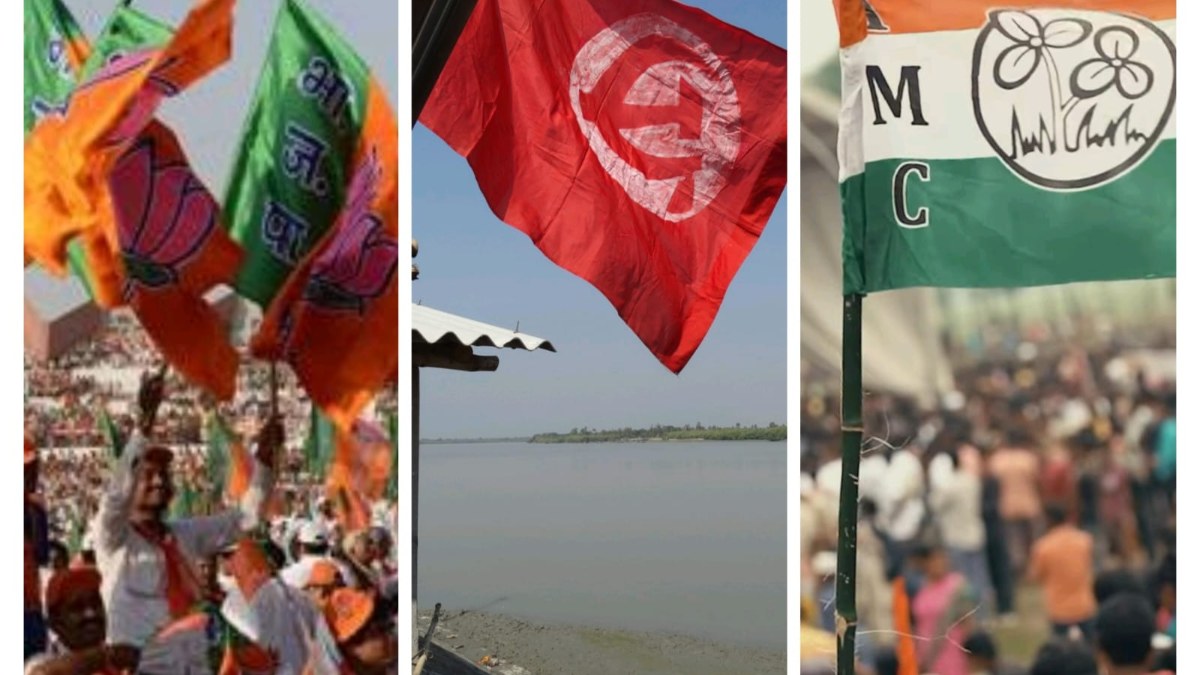
As voters in West Bengal await the final counting phase of the 2026 Assembly Elections on May 24, political discussions are almost entirely focused on the intense competition between the ruling Trinamool Congress and the Bharatiya Janata Party. Missing from this central contest is the Communist Party of India (Marxist). For thirty-four years, the CPI(M) successfully maintained the longest-serving democratically elected communist government in the world. Today, as the state prepares for its latest election results, the party’s presence is defined by its performance in 2021, where it failed to win a single seat.
This sharp drop from total governmental control to zero legislative representation provides a clear look into how even the most established political organizations can lose their connection with the public.
Peak of Political Dominance
Between 1977 and 2011, the CPI(M) functioned as the primary authority in West Bengal. The Left Front coalition managed state administration effectively without facing major electoral threats. To truly understand the scale of their later collapse, it helps to look at their highest point of success. During the 2006 assembly elections, just five years before they were voted out, the Left Front secured a massive 235 out of 294 seats, with the CPI(M) alone taking 176 of those. At that time, their voter base seemed incredibly secure, as they commanded nearly fifty percent of the total vote share across the state.
Securing Rural Loyalty Through Reform
The CPI(M) built this overwhelming majority through highly effective agricultural policies. Soon after taking office in the late 1970s, the government launched Operation Barga. Official records show that this program successfully registered over 1.4 million landless sharecroppers, giving them legal rights to the land they farmed and breaking down the older landlord system. At the same time, the government established the Panchayati Raj system, organizing local elections that gave administrative power to village councils. By securing land rights and setting up local representation, the party earned the deep loyalty of the rural working class. This created a highly reliable voting base that kept them in power for decades.
Economic Stagnation and Public Frustration
The eventual decline of the party was closely tied to long-term economic issues and government overreach. While their early agricultural policies were popular, the party’s strong support for frequent labor strikes created a tough environment for business growth. State economic data from the 1980s and 1990s shows many lost working days due to strikes organized by affiliated trade unions. This aggressive labor environment caused several major manufacturing companies to move their operations out of West Bengal. The resulting lack of industry led to a statewide economic deficit, leaving a growing youth population with very few private-sector job opportunities. On top of this, local party workers began interfering directly in civil disputes and administrative hiring, which slowly caused the public to grow tired of the bureaucracy.
Missteps in Land Acquisition
The turning point for the Left Front came in 2006 and 2007, when the government tried to fix the lack of industrial jobs. Chief Minister Buddhadeb Bhattacharjee pushed to acquire about 1,000 acres of farmland in Singur for a Tata Motors factory, followed by plans for a chemical hub in Nandigram. This move went directly against the party’s long-standing identity as the protector of farmers. Forcing the land acquisition sparked intense public protests. In March 2007, police fired on protesting villagers in Nandigram, resulting in 14 deaths. This specific tragedy severely damaged the CPI(M)’s credibility with agricultural workers. Mamata Banerjee organized protests across the state, tapped into this public anger, and successfully won over the rural voters who had previously supported the communists.
Tracking Electoral Defeats
After losing this vital rural support, the CPI(M) experienced a rapid electoral decline over just three assembly elections. In 2011, public anger resulted in a historic defeat, reducing the Left Front to just 62 seats, with the CPI(M) securing only 40. Their vote share dropped to roughly thirty percent, handing state power to the Trinamool Congress. Without control of the state government, the communist organization weakened significantly. By the 2016 elections, even after forming an alliance with the Indian National Congress, the CPI(M) vote share fell below twenty percent, giving them only 26 seats. Finally, in the 2021 assembly elections, a decade after losing power, their vote share collapsed to below five percent, resulting in exactly zero legislative seats.
Lessons for Current State Leaders
As West Bengal awaits the final results of the 2026 elections, the history of the CPI(M) serves as a practical warning for any political party. If current leaders rely only on their past achievements in social welfare without creating modern economic opportunities like youth employment, their voter base will eventually shrink. Furthermore, if a ruling party tries to push unpopular policies by using police force against its own core supporters, the public reaction can permanently dismantle its political structure. The quick electoral disappearance of the CPI(M) proves that voters will not hesitate to remove a government that ignores the immediate economic realities and concerns of the people.
Yeh article aapko kaisa laga?