
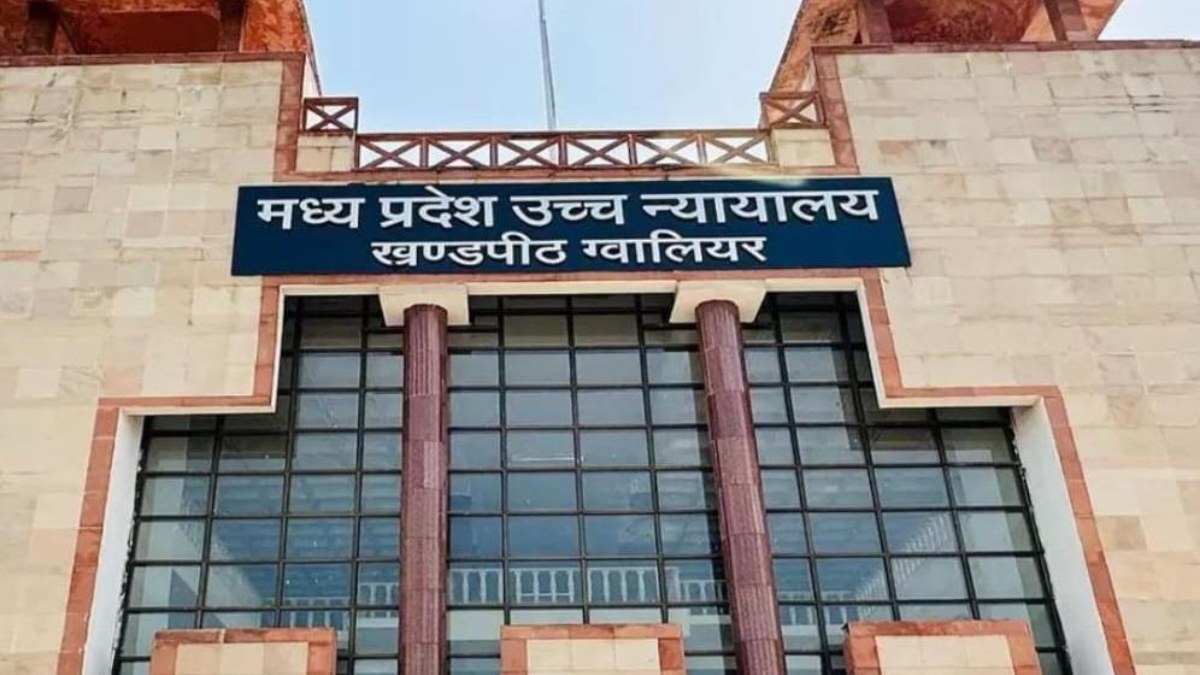
Photo: Gwalior bench of Madhya Pradesh High Court
In an important judgment related to reservation benefits and Scheduled Caste (SC) status, the Madhya Pradesh High Court has ruled that a person who migrates from one state to another cannot automatically claim Scheduled Caste benefits in the new state, even if the same caste is recognised as an SC category there as well.
The court observed that the recognition of a caste as a Scheduled Caste is linked to the social, educational, and economic backwardness faced by that community in a particular state. Since these conditions may differ from one state to another, reservation benefits cannot simply be transferred after migration.
The judgment was delivered by “Justice Anand Singh Bahrawat” of the Gwalior Bench of the Madhya Pradesh High Court while hearing a petition filed in connection with the appointment of an Anganwadi worker in Sheopur district.
What the Court Said
The High Court clearly stated that caste recognition is state-specific and depends on local conditions. The court said that even if a caste is listed as a Scheduled Caste in two different states, a person migrating from one state to another does not automatically carry the reservation benefits attached to that caste.
Justice Bahrawat, observed that social and educational backwardness in one state may not be identical in another state. Therefore, reservation benefits are given based on the circumstances prevailing in the home state.
The court further explained that Articles 341 and 342 of the Constitution define Scheduled Castes and Scheduled Tribes with reference to specific states and Union Territories. Because of this constitutional framework, a caste certificate issued in one state cannot automatically be used to claim reservation benefits in another state.
Background of the Case
The case involved a dispute over the appointment of an Anganwadi worker in Madhya Pradesh. The petitioner, Hemlata Arya, had applied for the post under the Scheduled Caste category.
Initially, another candidate was appointed to the post. Hemlata challenged the appointment before the Additional Collector in Sheopur. Later, another woman, Kriti Sharma, was appointed to the position, which again led to legal proceedings.
The Additional Collector eventually ruled in favour of Hemlata Arya and directed that she be appointed. However, Kriti Sharma challenged this order before the Additional Commissioner in Morena.
The Additional Commissioner set aside the earlier decision and ordered a fresh appointment process after hearing both parties properly. This order was then challenged before the High Court.
“Main Argument in Court”
The petitioner argued that her Scheduled Caste certificate, issued in Rajasthan, was valid throughout India. Her lawyer also claimed that she deserved higher marks in the selection process because of her SC category status.
However, the High Court did not agree with this argument. The court noted that Hemlata Arya had migrated to Madhya Pradesh from Rajasthan after marriage and possessed a caste certificate issued by Rajasthan authorities.
According to the court, this did not automatically entitle her to claim SC reservation benefits in Madhya Pradesh.
Reliance on Supreme Court Judgment
While delivering the judgment, the High Court relied on an important Supreme Court ruling in the case of Marri Chandra Shekhar Rao vs Dean, Seth G.S. Medical College (1990).
In that judgment, the Supreme Court had held that Scheduled Caste and Scheduled Tribe benefits are closely connected to the social disadvantages faced by communities in a particular state. Therefore, a person recognised as SC in one state cannot automatically claim the same benefits in another state after migration.
The Madhya Pradesh High Court reiterated this principle and clarified that only certain historic migrations that took place before 1950 may be treated differently.
Court’s Final Direction
After examining the matter, the High Court dismissed the petition filed by Hemlata Arya.
The court directed the authorities to conduct the appointment process for the Anganwadi worker post strictly on merit and without granting Scheduled Caste reservation benefits to the petitioner.
The court also instructed officials to provide both parties an opportunity for a personal hearing before making a final decision. Additionally, the authorities were asked to complete the process within three months.
Why the Judgment Is Important
• The ruling is considered significant because it once again highlights that reservation benefits under the Scheduled Caste category are not automatically transferable across state borders.
• Legal experts believe the judgment reinforces the constitutional principle that reservation policies are linked to the unique social and economic realities of each state.
• The decision may also impact similar cases involving people who migrate after marriage, employment, or other personal reasons and later seek reservation benefits in another state.
• At the same time, the judgment has sparked discussion on how migration and marriage affect access to reservation benefits, especially for women who move to another state after marriage.
• The case has once again brought attention to the complex relationship between domicile, caste identity, and reservation policies in India’s federal system.
Yeh article aapko kaisa laga?