
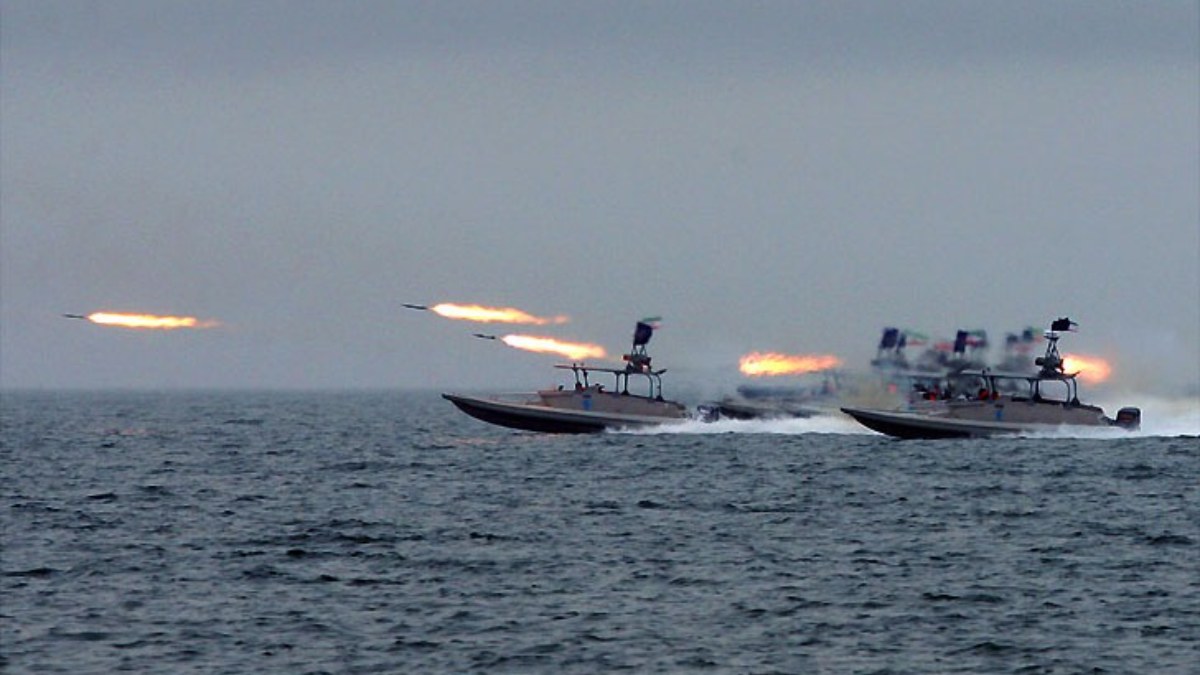
Photo: Navy of the Army of the Guardians of the Islamic Revolution commandos and missile boats in Great Prophet IX Maneuver in the general area of Strait of Hormuz, Persian Gulf by sayyed shahab-o- din vajedi, CC BY 4.0
When the public hears the word “blockade,” they usually picture an impenetrable wall of warships halting all global trade. But the reality playing out in the Strait of Hormuz in mid-April 2026 is far more sinister. The strait is not a closed door; it is a highly militarized checkpoint where survival depends entirely on whose flag you fly, how well you can hide, and how much you are willing to pay.
Before the military conflict between the United States and Iran erupted, the Strait of Hormuz was the busiest energy highway on earth. Over 130 ships passed through every single day, carrying roughly 21 million barrels of oil. Today, maritime intelligence firms are tracking a mere 9 to 11 ships attempting the crossing daily. The global flow of oil has been crushed to a dangerous trickle of roughly 1.5 to 2 million barrels a day.
Yet, that oil is still moving. It is not being carried by mainstream, heavily regulated Western shipping companies. Instead, the most dangerous waterway on the planet has been entirely taken over by a massive, highly lucrative black-market armada: the “shadow fleet.”
Ghost Ships
Standard shipping giants, terrified of sea mines and voided insurance policies, have completely abandoned the Persian Gulf. In their place, a network of older, unregistered, and often deteriorating oil tankers has stepped in. These “ghost ships” operate entirely outside the boundaries of Western regulations. They sail under flags of convenience from nations with loose maritime laws, they do not carry standard Western liability insurance, and most importantly, they routinely disable their Automatic Identification System (AIS) transponders.
By “going dark” on global tracking radars and frequently changing their registered names, these vessels become virtually untraceable. They are the perfect vehicles for smuggling oil through a warzone.
Navigating the Double-Layered Trap
These ghost ships are the only vessels capable of threading the needle between two opposing militaries enforcing two completely different sets of rules.
On one side is the United States Navy. The American blockade, directed by U.S. Central Command (CENTCOM), is specifically designed to choke off Iran’s economy by stopping any vessel attempting to enter or leave an Iranian port. On the other side is the Islamic Revolutionary Guard Corps (IRGC), which has declared the strait closed to “unfriendly nations,” heavily mining the transit routes and patrolling the skies with attack drones.
The shadow fleet survives by playing both sides. Because these ships “go dark” and use complex ship-to-ship transfers at sea, they can avoid directly docking at Iranian ports, theoretically keeping them off the U.S. Navy’s immediate target list.
Simultaneously, they navigate the Iranian threat through pure financial extortion. Iran has essentially set up an illegal toll gate in its territorial waters between Larak and Hormuz islands. The IRGC allows these shadow vessels to pass unharmed, provided they are heading to a “neutral” nation like China and pay a massive toll of upwards of $1 million per transit. Crucially, this toll is transacted entirely in Chinese Yuan, completely bypassing the reach of Western banking sanctions.
The Ultimate Winners and Losers
In this chaotic environment, the divide between those who are bleeding money and those who are printing it is massive.
The biggest losers are the Western economies. With mainstream shipping locked out by sanctions, sea mines, and astronomical insurance premiums, the West is facing severe supply shortages and skyrocketing inflation at the gas pump. India is also feeling the squeeze, as Washington recently pulled the plug on New Delhi’s temporary sanctions waivers, leaving Indian refiners scrambling for affordable crude.
The absolute winners of this crisis are China and the shadow fleet operators. Because mainstream shippers refuse to enter the Gulf, the freight rates for moving crude have exploded to historic highs. The operators of these rogue tankers are charging astronomical premiums for the risk of dodging sea mines and missiles. Meanwhile, Beijing’s aggressive diplomacy and willingness to transact in Yuan guarantees its energy security, keeping Chinese factories running while its Western economic rivals starve for fuel.
Ultimately, the U.S. and Iranian warships have not stopped the flow of oil in the Middle East. They have simply privatized the Strait of Hormuz by force, handing the keys to a multi-billion dollar shadow fleet willing to play the darkest game of geopolitical survival.
Yeh article aapko kaisa laga?