
 Siddhant Bijoliya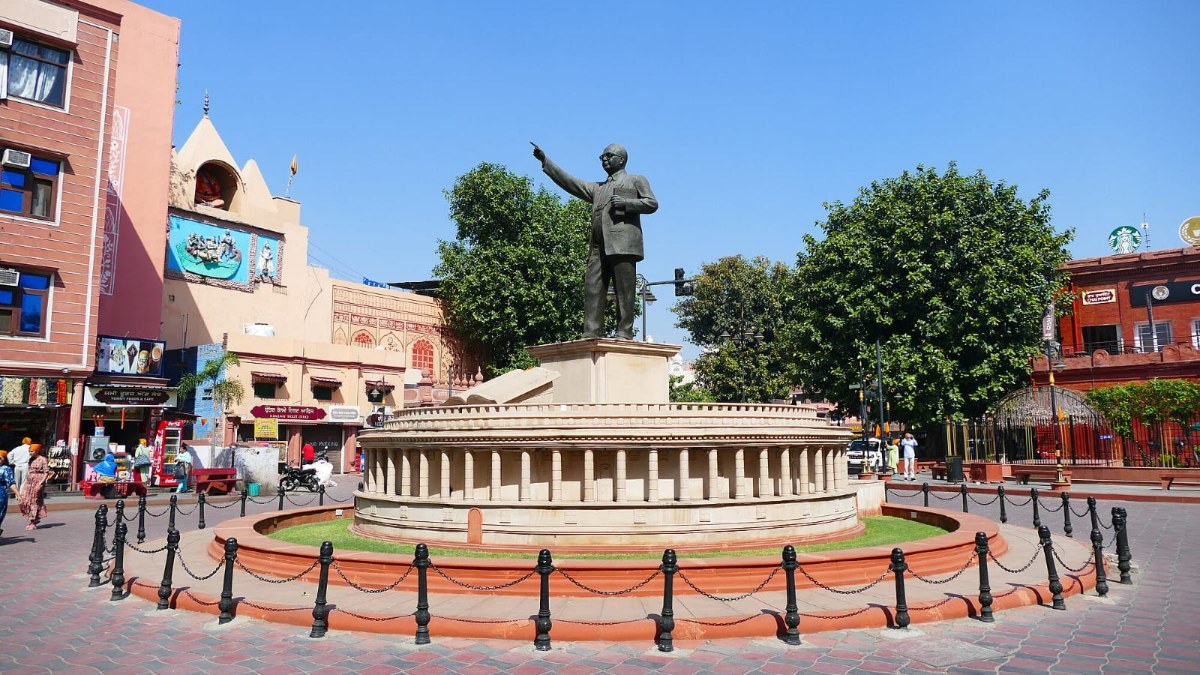
Photo: creative commons
As the world commemorates the 136th birth anniversary of Dr. Bhimrao Ramji Ambedkar on April 14, 2026, the resonance of his voice is louder than ever. Known as the “Father of the Indian Constitution” and a global icon of civil rights, Babasaheb was far more than a legal scholar; he was a social surgeon who attempted to excise the deep-seated cancers of caste and inequality from the Indian body politic.
His life story, transitioning from a marginalized child facing “untouchability” to a Columbia-educated polymath, serves as a blueprint for resilience and intellectual revolution.
A Triad of Reform: Social, Economic, and Political Thoughts
Dr. Ambedkar’s philosophy was never one dimensional. He understood that democracy is not merely a political arrangement but a “way of life” that must be anchored in Social, Economic, and Political justice.
Socially, he argued that the caste system was not just a division of labor but a division of laborers. He believed that as long as society was fragmented into thousands of endogamous Castes, national unity would remain a myth. His radical stance in Annihilation of Caste suggested that the spiritual and social foundations of inequality had to be dismantled for India to truly breathe.
Economically, Ambedkar was a visionary. Long before modern debates on land reform and state-led growth, he proposed “State Socialism” in his work States and Minorities. He advocated for the nationalization of land and key industries to ensure that the marginalized were not exploited by private monopolies. He understood that political liberty is hollow without economic security; a hungry man cannot exercise his right to vote effectively.
Politically, he championed the concept of “One Man, One Vote, One Value.” However, he warned that while the Constitution would provide political equality, the social and economic structures remained deeply unequal. He famously cautioned that if this contradiction were not resolved, those who suffer from inequality would eventually blow up the structure of political democracy.
A Champion for All: Women, Dalits, and the OBCs
While often pigeonholed as a leader of the “Untouchables,” Ambedkar’s work was universal. He was perhaps India’s first true feminist legislator. Through the Hindu Code Bill, he sought to grant women the right to inherit property, the right to divorce, and the right to guardianship. He famously remarked, “I measure the progress of a community by the degree of progress which women have achieved.” His resignation from the Cabinet when the Bill was stalled is a testament to his unwavering commitment to gender justice.
For the Depressed Classes (Dalits) and Other Backward Castes (OBCs), he secured the legal framework for reservation not as a “charity,” but as a compensatory mechanism for centuries of systemic exclusion. He visualized a society where merit was not the monopoly of the privileged. His advocacy for the OBCs was equally robust, as he pushed for the appointment of a commission to investigate their conditions, laying the groundwork for what would eventually become the Mandal Commission’s realizations decades later.

The Architect: Did He Really Write the Constitution?
A common debate arises: did Ambedkar “write” the Constitution alone? While the Constitution was the result of the collective wisdom of the Constituent Assembly, Ambedkar was the Chairman of the Drafting Committee. He was the “pilot” who steered the ship through the turbulent waters of conflicting interests.
He didn’t just pen words; he synthesized the best of global democratic traditions British parliamentary systems, American fundamental rights, and Irish directive principles into a unique Indian context. He personally defended every clause on the floor, answering thousands of amendments with surgical precision. To call him the “Chief Architect” is not an exaggeration; he provided the legal soul and the structural integrity to the newborn Republic. As we call him “Father of Indian Constitution”.
Intellectual Treasures: Famous Writings to Read
To understand the man, one must engage with his literature. His writings are characterized by a lack of sentimentality and an abundance of data-driven logic.
1. Annihilation of Caste: Originally a speech he was never allowed to deliver, it is a scathing critique of the caste system and remains the most influential text on social justice in India.
2. The Buddha and His Dhamma: His magnum opus on spirituality, written toward the end of his life, explaining why he chose Buddhism as a path of liberation.
3. The Problem of the Rupee: A foundational economic text that influenced the creation of the Reserve Bank of India (RBI).
4. Who Were the Shudras? A historical investigation into the origins of the caste hierarchy.
Why Every Citizen Must Read the Constitution
In the contemporary world, the Constitution is often viewed as a bulky legal document for lawyers. However, Ambedkar viewed it as a “living document.” People must read it because it is the only document that guarantees their dignity. It is the shield against the “tyranny of the majority.” In a diverse nation like India, the Constitution is the only common ground where a billionaire and a labourer stand as equals. Understanding it is an act of self-defence; it teaches citizens their rights, but more importantly, it outlines the limitations of the government’s power.
The Last Message: Educate, Agitate, Organize
On the evening of his life, Ambedkar’s message to the nation was simple yet profound: “Educate, Agitate, Organize.”
• Educate: He believed knowledge is the only weapon that can break the chains of mental slavery.
• Agitate: This was not a call to violence, but a call to mental stir. To agitate is to question, to be dissatisfied with injustice, and to demand better.
• Organize: He knew that individual voices are easily stifled, but a collective organization is a force of nature.
His final transition to Buddhism in 1956 was his ultimate act of defiance a search for a “Moral Order” based on Pradnya (understanding), Karuna (compassion), and Samata (equality).
Why the Youth are Drawn to Babasaheb
Today, we see a massive surge in the youth’s interest in Ambedkar. Why? Because the youth of the 21st century are looking for authenticity. Unlike many leaders of his time who relied on charisma or inherited status, Ambedkar’s power came from his brain.
Modern youth identify with his “outsider” status. In an era where “merit” is often debated, Ambedkar’s life proves that a person’s worth is not defined by their birth but by their contribution to humanity. His unapologetic stance on liberty and his “rationalist” approach to religion and tradition appeal to a generation that values logic over dogma. He is the ultimate symbol of intellectual rebellion.
As we celebrate his 136th year, we realize that Ambedkar is not a figure of the past; he is a beacon for the future. He remains the conscience of the nation, reminding us that as long as there is one person denied dignity, his work remains unfinished. We don’t just remember him; we need him.