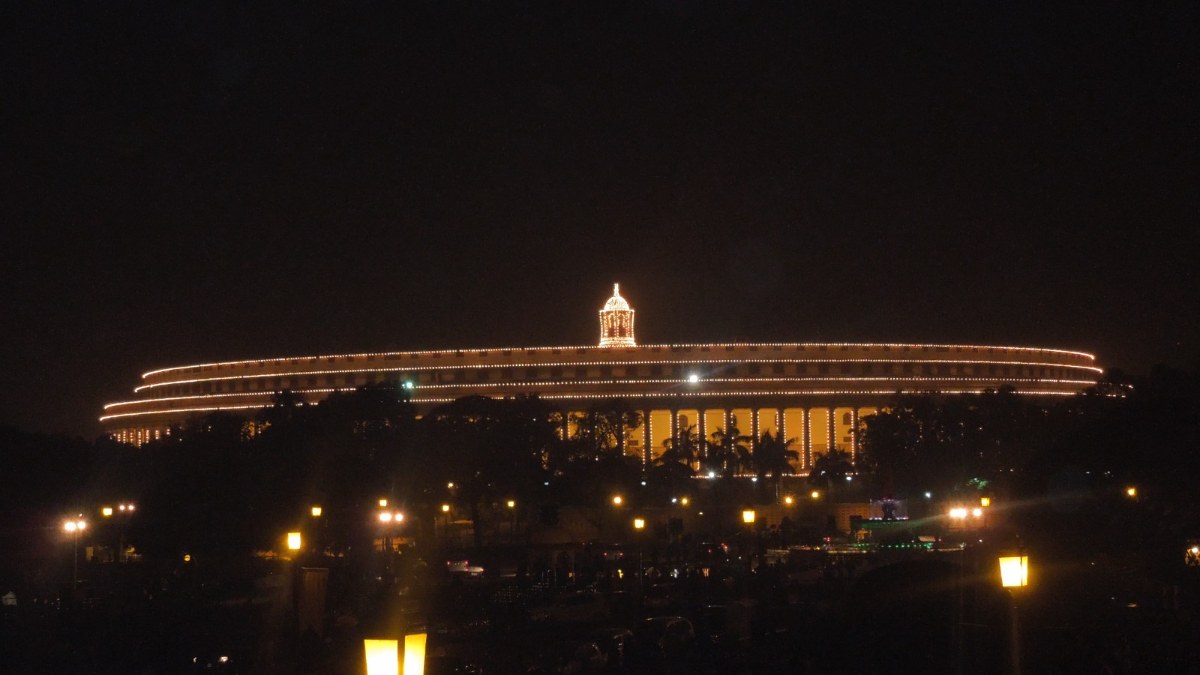
Photo- Parliament House, New Delhi : CC-BY-SA-4.0
In a move that could significantly reshape India’s parliamentary structure, the Union government has proposed a Constitutional Amendment Bill to increase the strength of the Lok Sabha from 550 to 850 members. The proposal does not merely expand numbers it reopens a long frozen constitutional question around representation, population, and political balance.
|Written by Hency Kushwah|
At the heart of the Bill lies a decision to remove the decades old freeze on delimitation based on the 1971 Census, paving the way for a fresh redrawing of constituencies using updated population data. The implications of this shift are far reaching, touching upon federal balance, regional representation, and the future of electoral politics in India.
Why the Lok Sabha Expansion Matters Now
The current cap of 550 seats in the Lok Sabha has remained unchanged for decades, even as India’s population has more than doubled. This has led to increasing disparities in representation, with some constituencies representing vastly larger populations than others.
The proposed expansion seeks to address this imbalance by aligning parliamentary representation more closely with present day demographic realities. In theory, this move strengthens democratic representation by ensuring that each elected member represents a more proportionate segment of the population.
However, the timing of the proposal is equally significant. With the next delimitation exercise constitutionally due after the first Census conducted post 2026, the Bill signals that the government is preparing for a major restructuring of electoral geography.
End of the 1971 Freeze: A Constitutional Turning Point
One of the most consequential aspects of the Bill is the removal of the freeze on delimitation based on the 1971 Census. This freeze was originally introduced to ensure that states which successfully controlled population growth were not penalised by losing parliamentary representation.
For decades, this arrangement maintained a delicate balance between population control and political representation. States in southern and western India, which saw slower population growth, retained their share of seats despite demographic shifts in northern states.
By lifting this freeze, the proposed amendment fundamentally alters that balance. Future seat allocation would be based on updated population data, potentially increasing representation for states with higher population growth while reducing relative influence for others.
This change is not merely technical, it is deeply political, with the potential to reshape the federal equilibrium.

Photo: Inside view of Lok Sabha chamber in New Parliament building, Wikimedia Commons, Press Information BureauGODL-India.
Delimitation and the Politics of Representation
Delimitation, the process of redrawing constituency boundaries, is at the core of the proposed reform. A fresh delimitation exercise based on the latest Census would determine how the additional seats are distributed across states.
This raises critical questions. Will representation strictly follow population numbers, or will there be safeguards to maintain regional balance? How will urbanisation, migration, and demographic shifts be factored into constituency design?
There is also the issue of political impact. States that gain seats will inevitably gain greater influence in national decision making, while others may see their relative voice diminished. In a federal system like India’s, such shifts can have long term consequences for policy priorities and governance.
Federal Concerns: North South Divide Revisited
The proposal has revived an old but unresolved debate the perceived imbalance between northern and southern states in terms of political representation.
Southern states, which have historically performed better on population control indicators, have expressed concerns that delimitation based purely on population could penalise them. The fear is that their share in the Lok Sabha may not increase proportionately, or could even decline relative to northern states.
This raises a fundamental constitutional question: should representation be purely population based, or should it also account for developmental achievements and governance outcomes?
The answer to this question will determine whether the amendment is seen as a corrective reform or a source of new political tensions.
Logistical and Institutional Challenges
Expanding the Lok Sabha to 850 members is not just a constitutional exercise it also presents practical challenges. Parliament infrastructure, including seating capacity, procedural management, and legislative functioning, would need significant upgrades.
A larger House may also affect the quality of debate and legislative efficiency. Managing discussions, ensuring participation, and maintaining order in a significantly expanded chamber would require procedural reforms alongside structural changes.
Additionally, the role of parliamentary committees may become even more critical in handling legislative workload effectively.
The Road Ahead: Reform or Redistribution of Power?
The proposed amendment represents one of the most significant structural reforms in India’s parliamentary history. While it aims to correct representational imbalances, it also redistributes political power in ways that are likely to be debated intensely.
The success of this reform will depend not just on its constitutional validity, but on how sensitively it addresses concerns of federal balance, regional equity, and democratic fairness.
As India prepares for the next phase of its electoral evolution, the question is no longer whether change is needed but how that change is designed.
Yeh article aapko kaisa laga?