
Image credit: Vivek Panwar/X
Introduction
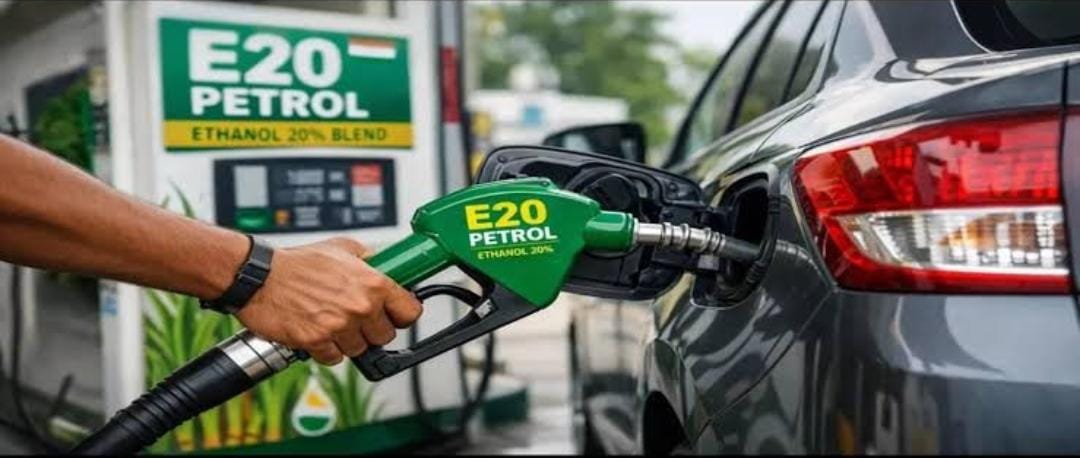
India’s determined changeover towards cleaner fuels has hit an unexpected roadblock. Amid growing public concerns over the nationwide rollout of E20 petrol a blend containing 20% ethanol, the Union government has initiated discussions with activists and stakeholders opposing the policy.
While the Centre continues to defend E20, since it is a crucial step towards reducing crude oil imports and lowering carbon emissions, critics argue that the transition has overlooked consumer concerns regarding vehicle compatibility, fuel efficiency, and implementation.
However, government’s decision to engage with protesters marks a significant shift in the debate. What began as a technical discussion on fuel standards has evolved into a broader conversation on environmental governance, along with public participation, and balancing climate goals with consumer interests.
Why India Is Promoting E20 Fuel
India imports nearly 85% of its crude oil requirements, making energy security a major policy concern. To reduce dependence on imported fossil fuels, the government launched the Ethanol Blended Petrol (EBP) Programme, encouraging ethanol primarily produced from sugarcane and food grains to be mixed with petrol.
The policy aims to reduce oil imports, lower greenhouse gas emissions, support farmers by creating demand for ethanol feedstock, and diversify India’s energy mix. Ethanol is also considered a cleaner-burning fuel that can contribute to India’s climate commitments under the Paris Agreement.
While these objectives have received broad policy support, the controversy lies not in the intention but in the execution of the programme.
Why Has E20 Triggered Public Opposition?
The backlash has largely come from motor owners, transport associations, and consumer groups questioning whether existing vehicles are fully compatible with higher ethanol blends.
Concerns include reduced mileage, increased fuel consumption, maintenance costs combined with spoiling of vehicle parts such as internal rusting and corrosion in the fuel tanks and the exhausts, with long-term impact on older vehicles. During a recent parliamentary discussion, Union Road Transport and Highways Minister Nitin Gadkari acknowledged that E20 fuel may reduce mileage by 2–6%, while clarifying that there is no evidence of engine damage in compatible vehicles. However, he noted that some older vehicles may require replacement of rubber components and certain fuel-system parts.
These statements further reinforced public concerns that the transition could impose additional costs on vehicle owners, especially those using older models. Critics argue that while environmental benefits are important, consumers should not bear disproportionate financial burdens without adequate preparation or compensation.
Government Opens Dialogue with Activists
In response to the growing opposition, the Centre has started discussions with activist groups and stakeholders demanding greater transparency and safeguards. This is a significant move because environmental policies are generally implemented through executive decisions backed by technical and scientific assessments, therefore, direct negotiations with protest groups on fuel standards are relatively uncommon.
The government’s willingness to engage suggests an acknowledgment that environmental reforms cannot succeed through regulation alone. Public confidence and stakeholder participation are equally important in ensuring smooth implementation. And thus, consultations are expected to address issues such as implementation timelines, consumer awareness, and measures to protect owners of older vehicles during the transition.
The Governance Challenge Behind the Debate
The E20 controversy highlights a larger governance lesson: environmental policies are most effective when accompanied by public consultation and transparency.
Climate action often requires citizens to change long-established behaviours. Whether the issue involves electric vehicles, renewable energy, or cleaner fuels, public acceptance frequently determines the success of government initiatives.
While governments have the authority to introduce reforms in the public interest, democratic governance also requires listening to citizens affected by those reforms. The Centre’s decision to open dialogue reflects an understanding that sustainable environmental policy depends not only on scientific evidence but also on public trust.
The Environmental Paradox of E20
The E20 controversy highlights a larger governance lesson: environmental policies are most effective when accompanied by public consultation and transparency. Climate action often requires citizens to change age-old behaviours. Whether the issue involves electric vehicles, renewable energy, or cleaner fuels, public acceptance normally determines the success of government initiatives.
While governments have the authority to introduce reforms in the public interest, democratic governance also requires listening to citizens and the stakeholders affected by those reforms. The Centre’s decision to open dialogue reflects an understanding that sustainable environmental policy depends not only on scientific evidence but also on public trust.
Bey
ond Fuel: A Test of Environmental Governance
The debate also shows the complexity of balancing environmental objectives with practical realities.
Supporters argue that ethanol blending reduces fossil fuel dependence, lowers emissions, and strengthens rural economies by increasing demand for agricultural feedstock, hence a sustainable way out.
Critics, however, point to reduced mileage, concerns over water-intensive sugarcane cultivation, and the environmental impact of expanding ethanol production. If vehicles consume more fuel to travel the same distance, questions naturally arise about the overall environmental gains which just frustrates the objective of the scheme.
This does not invalidate the policy, but it demonstrates why environmental reforms must be evaluated through a comprehensive life-cycle assessment rather than focusing solely on emissions at the tailpipe. Independent scientific studies, transparent data, and periodic policy reviews will be essential to ensuring that intended environmental benefits are actually realised.
Con
clusion
The E20 controversy is no longer merely about ethanol or fuel standards. It represents a broader shift in how environmental policies are evaluated in democratic societies.
Progressively, citizens expect governments not only to pursue climate goals but also to explain policy decisions, share scientific evidence, and address legitimate public concerns. Environmental governance today requires consultations, transparency, and accountability alongside ambitious sustainability targets. The concept of greenwashing is also in trend, which justifies the claims of the common people. Therefore, Centre’s engagement with activists is a sign that public participation is becoming an integral part of policymaking.
Similar expectations are likely to emerge in future debates surrounding electric mobility, hydrogen fuel, carbon markets, and renewable energy infrastructure. The success of India’s green transition will therefore depend as much on public confidence as on technological innovation.
Yeh article aapko kaisa laga?