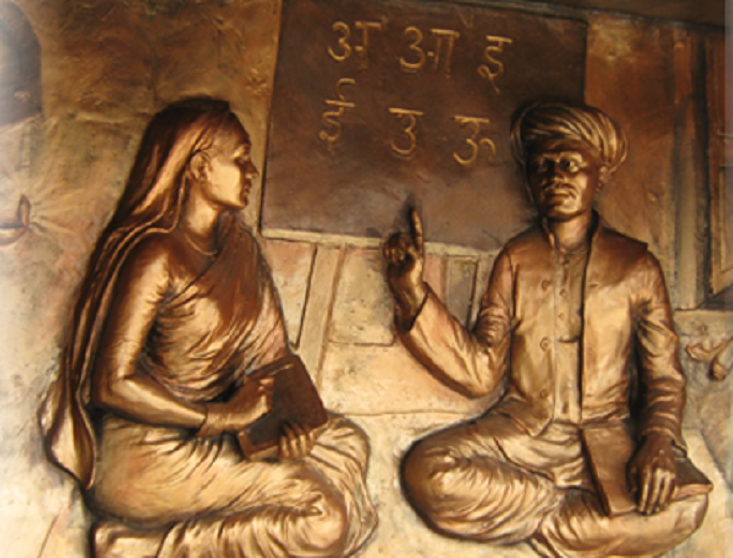
Image credit : swarajyamag.com/Savitribai with Mahatma Phule
People watched her with anger and disbelief. Some hurled insults. Others threw mud, stones, even cow dung in an attempt to shame her into retreat. Teaching girls was not merely unusual in that era but it was considered a direct rebellion against the social order.
There dared a person who refused to retreat, later came to be known as Kranti Jyoti Savitribai Phule
She would quietly wipe the filth from her saree, adjusted the books in her arms, and continue toward the classroom. For her, education was not simply about learning letters and numbers. It was a challenge to caste oppression, to patriarchy, and to a society determined to keep women in silence.
Early Life in a Rigid Social Order
Savitribai herself was married at the age of nine to Jyotirao Phule, who would later become one of India’s most influential social reformers. What made their partnership extraordinary was Jyotirao’s belief that education was the key to dismantling social injustice.
He began teaching Savitribai at home, an act that quietly challenged the norms of the time. Education, which society tried to keep away from women, soon became the foundation of her life’s mission.
India’s First Woman Teacher
This was revolutionary. At the time, the idea of girls, especially those from lower castes, attending school was seen as a direct threat to the social order. Yet the Phule’s persisted.
Within a few years, they had established several schools for girls and children from marginalized communities. Their curriculum included subjects such as mathematics, science, and social studies, such topics were rarely taught to girls at the time.
Education, in Savitribai’s vision, was not simply about literacy. It was about dignity, independence, and social change.
Courage in the Face of Hostility
People threw mud, stones, and cow dung at her. Instead of retreating, she prepared for it. Savitribai often carried an extra saree so she could change before entering the classroom and continue teaching.
Her resilience became legendary. In an era when women were expected to remain silent and invisible, Savitribai stood firm against both caste oppression and patriarchy.
This determination is why many historians describe her as the Iron Lady of the 19th century.
A Fighter Against Social Injustice
She and Jyotirao Phule worked actively against caste discrimination, advocating equality for Dalits and other marginalized communities. They also fought against practices that oppressed women, such as child marriage and the social isolation of widows. One of their most remarkable initiatives was the creation of Balhatya Pratibandhak Griha, a shelter for pregnant widows. At a time when widows faced severe stigma and often resorted to infanticide due to social pressure, this home provided care and protection.
Through these efforts, Savitribai challenged deeply entrenched social norms and offered practical solutions to human suffering.
Voice Through Literature
Her poetry collections, including Kavya Phule, reflected themes of social justice, education, and self-respect. Her writings encouraged oppressed communities to seek knowledge and challenge discrimination.
For Savitribai, literature was another instrument of empowerment. Words, like education, had the power to awaken society.
Leadership and the Final Act of Courage
Her life ended in an act that reflected the same compassion and courage she had shown throughout her career. During the plague epidemic of 1897 in Pune, Savitribai personally cared for infected patients. While helping a sick child reach a treatment center, she contracted the disease herself.
On 10 March 1897, Savitribai Phule passed away. She died as she had lived serving others.
A Legacy That Still Shapes India
Her life reminds us that education is not merely a privilege but a powerful instrument of social transformation.
Yet her story also raises an important reflection. The struggles she fought, gender inequality, caste discrimination, and barriers to education, have not entirely disappeared.
Remembering Savitribai Phule is not only about honouring history. It is about recognizing the unfinished journey toward equality.
Conclusion: Remembering the Iron Lady
She faced ridicule, violence, and social rejection, but she never abandoned her belief that education could transform society.
On her Punyatithi, the world remembers a woman who refused to accept injustice as destiny. Savitribai Phule was not merely a teacher. She was a revolution in a saree.
Yeh article aapko kaisa laga?