
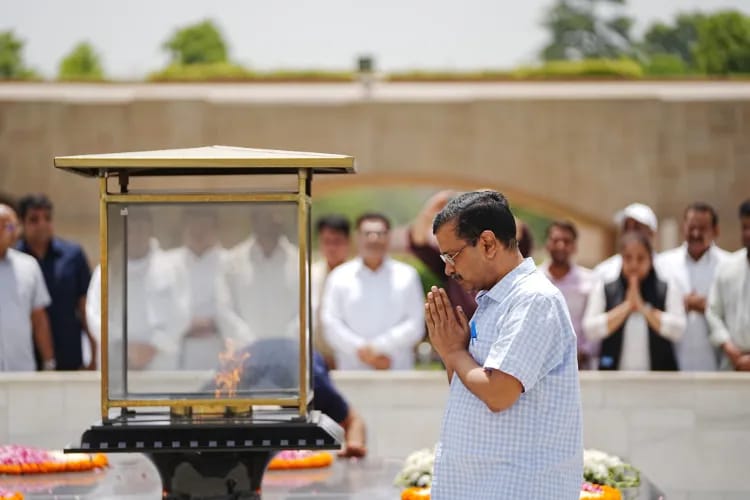
In a move that has sent shockwaves through India’s legal and political landscape, former Delhi Chief Minister Arvind Kejriwal recently took the unprecedented step of withdrawing himself from proceedings in the Delhi High Court. This wasn’t merely a procedural exit; it was a high-stakes act of defiance framed as a “Gandhian Satyagraha.”
By refusing to participate further in the CBI’s appeal against his acquittal in the excise policy case, Kejriwal has pivoted from a legal battle to a moral one, raising fundamental questions about judicial impartiality and the “perception” of justice.
The Breaking Point: A Loss of Faith
The core of this dramatic withdrawal lies in Kejriwal’s loss of confidence in the presiding bench. In a poignant video message and a formal letter addressed to the court in late April 2026, Kejriwal articulated a “shattered hope.” He argued that for a citizen to participate in a trial, they must believe the scales of justice are balanced.
“Justice must not only be done but must also be seen to be done,” Kejriwal remarked, citing a bedrock principle of law.
He claimed that the current atmosphere of the proceedings made it impossible for him to feel he would receive a fair hearing. This sentiment was echoed by his colleagues, including Manish Sisodia, who followed suit, effectively leaving the court to deliberate without the primary defendants or their legal counsel.
The Controversy of Conflict of Interest
At the heart of the friction is a specific allegation of conflict of interest. Kejriwal’s legal team had previously sought the recusal of Justice Swarana Kanta Sharma. The grounds for this request were deeply personal and controversial: the AAP leader alleged that the judge’s children were empanelled as lawyers for the Central Government, which is the very entity prosecuting him through the CBI.
Kejriwal argued that since the Solicitor General represents the Union of India, the familial links between the bench and the prosecution created a “reasonable apprehension of bias.” However, the High Court firmly rejected these claims, labeling them as “conjectures and insinuations.” Justice Sharma maintained that her oath to the Constitution is paramount and that a judge’s family members cannot be barred from their professional careers simply because of their parentage.
The “Satyagraha” Strategy
When the plea for recusal was dismissed, Kejriwal chose a path of non-cooperation. In his video statement, he described his decision as a “difficult one,” taken after a “clear conclusion” that the proceedings no longer satisfied the fundamental requirements of fairness.
By invoking the term Satyagraha, Kejriwal is attempting to frame his legal predicament as a struggle for truth against a “tilted” system. This is a classic political maneuver: if the court rules against him in his absence, he can claim the verdict was a foregone conclusion. If he wins, he can claim the truth was so self-evident it survived even a “biased” process.
The Legal Fallout and Risks
This boycott is not without significant risks. Legally, withdrawing from a proceeding does not stop the wheels of justice; it simply means the court will hear the CBI’s side without a rebuttal from the defense.
• Ex-Parte Proceedings: The court can proceed to hear the case and deliver a judgment based on the evidence presented by the prosecution.
• Contempt and Warrants: Refusing to appear or cooperate can lead to the issuance of warrants and potential contempt of court charges.
• Precedent: This sets a rare and potentially dangerous precedent where high-profile litigants bypass the judicial process by claiming “conscientious objection.”
The Delhi High Court has already taken a stern view of the situation, even ordering the takedown of video clips of the proceedings from social media, citing a breach of virtual court rules and an attempt to “malign the image of the institution.”
A Battle for the Narrative
Arvind Kejriwal’s exit from the High Court proceedings is a masterclass in political optics. By stepping away, he has shifted the spotlight from the technicalities of the liquor policy case to the integrity of the judiciary itself.
Whether this move is a genuine stand for “judicial purity” or a strategic retreat to gain public sympathy remains a point of intense debate. One thing, however, is clear: the road to a final verdict in the Delhi excise case is no longer just about files and evidence—it is now a battle over the very soul of the legal process. As the court prepares for its next hearing on May 4, 2026, the chair for the defense remains empty, but the echoes of Kejriwal’s “Satyagraha” will be loud and clear.
Yeh article aapko kaisa laga?