
Photo: X/NitinNabin
The Aam Aadmi Party is currently navigating a significant structural and political challenge. On Friday, April 24, 2026, the organization faced a major legislative reduction when seven of its ten Rajya Sabha members formally joined the Bharatiya Janata Party. This transition instantly removes the majority of the party’s representation in the Upper House of Parliament, creating a profound administrative crisis for its national leadership.
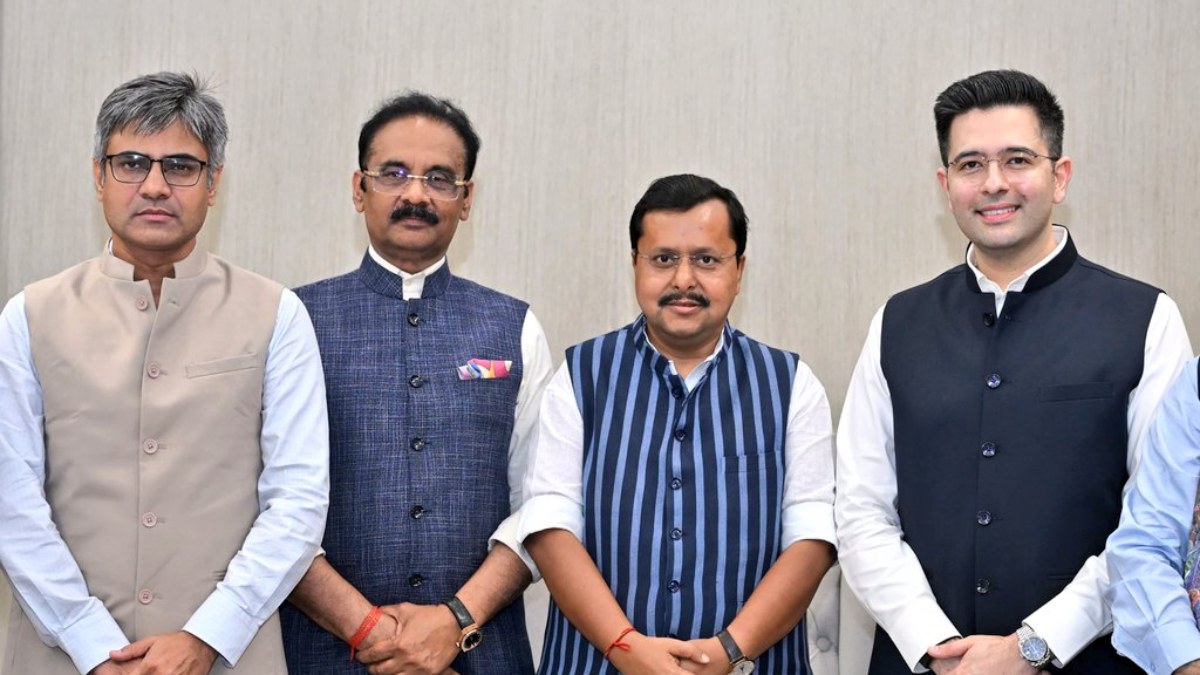
The group of departing members includes Raghav Chadha, Ashok Mittal, Sandeep Pathak, Harbhajan Singh, Rajinder Gupta, Vikram Sahney, and Swati Maliwal. To execute this move, the legislators utilized a specific provision within the Anti-Defection Law. The legislation generally disqualifies lawmakers who switch political affiliations, but it permits a legal merger if at least two-thirds of a party’s legislative block agrees to the shift.
By securing exactly seven signatures out of ten, the group bypassed immediate disqualification under standard parliamentary rules. Consequently, the Aam Aadmi Party is left with only three representatives in the Rajya Sabha, severely reducing its legislative voting power and federal influence.
The Rapid Exit of Ashok Mittal
The administrative crisis within the party is heavily illustrated by the recent trajectory of Ashok Mittal. His departure highlights the rapid internal changes and structural instability the organization is currently experiencing. Less than a month ago, the Aam Aadmi Party leadership demoted Raghav Chadha from his position as deputy leader in the Rajya Sabha following reported internal disagreements.
To stabilize their parliamentary strategy, the party officially promoted Mittal to fill this crucial leadership role. However, merely weeks after accepting the deputy leader position, Mittal stood at the ruling party’s headquarters to announce his resignation alongside Chadha.
The Shadow of Federal Scrutiny
Political analysts note that the timeline of Mittal’s transition is highly significant. Media reports indicate that his political shift occurred shortly after his properties faced scrutiny from federal investigation agencies.
In mid-April, the Enforcement Directorate reportedly searched his residence in Jalandhar and multiple business locations associated with his family, including the Lovely Professional University campus. Reports state these searches were connected to an investigation under the Foreign Exchange Management Act. The proximity of these federal searches to his subsequent political departure has drawn considerable attention from political observers evaluating the broader context of the crisis.
AAP Leadership Responds with Legal Threats
The remaining leadership of the Aam Aadmi Party has strongly contested the transition and moved to defend its political position. National convenor Arvind Kejriwal stated publicly that the ruling party engineered these movements to deliberately undermine opposition forces.
Furthermore, senior party leader Sanjay Singh announced that the Aam Aadmi Party intends to submit formal legal requests to the Rajya Sabha Chairman. Singh stated the party will demand the immediate disqualification of the departing members, arguing that their actions constituted a voluntary relinquishment of their original party membership before any formal merger was legally recognized by the chair.
Regardless of the pending legal arguments over parliamentary procedures, the immediate political reality presents a severe test for the Aam Aadmi Party. The organization has lost its senior strategists and prominent public defenders in a single day. The party leadership must now attempt to rebuild its parliamentary strategy while addressing the public perception of deep internal instability following the departure of its core legislative team.
Yeh article aapko kaisa laga?