

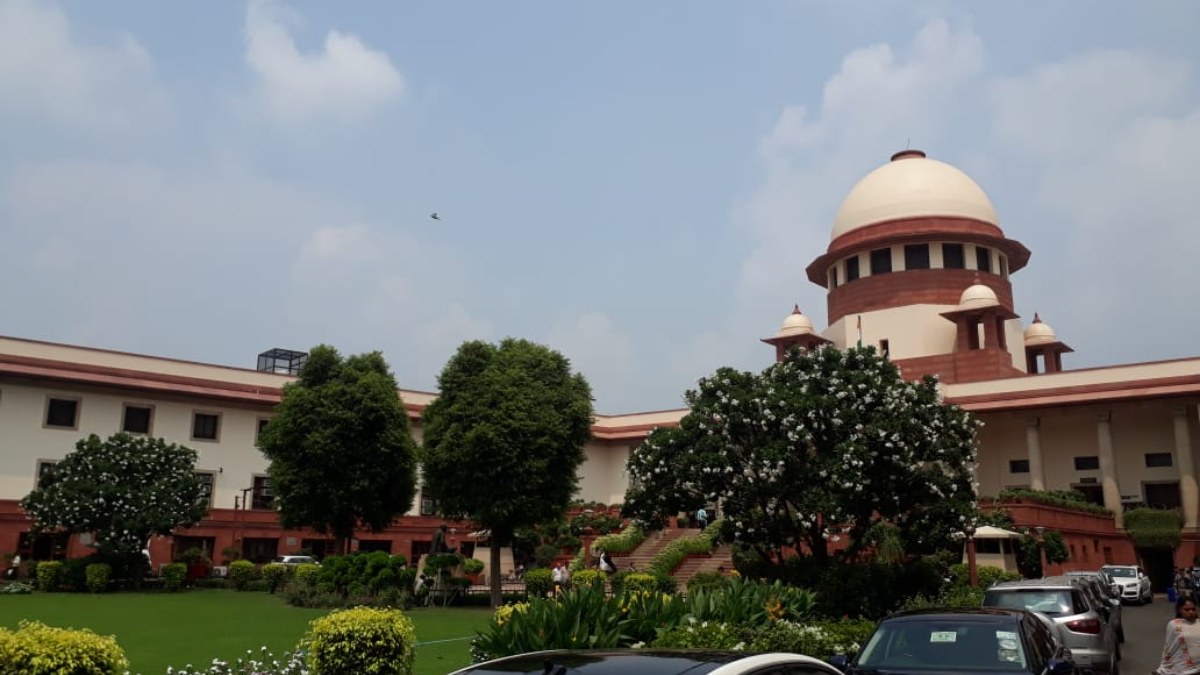
Photo: Inside the Supreme Court of India, Bhagwandas Road, New Delhi.
New Delhi: In a significant judgment that is set to impact bail jurisprudence across the country, the Supreme Court of India has clarified that stringent bail conditions under Section 480(3) of the Bharatiya Nagarik Suraksha Sanhita (BNSS) cannot be imposed in cases where the alleged offence is punishable with imprisonment of up to seven years.
The ruling came from a bench comprising Justice J.K. Maheshwari and Justice Atul S. Chandurkar, while deciding an appeal filed by an accused in a case involving alleged possession of illicit liquor under the Madhya Pradesh Excise Act, 1915.
Background: Bail Granted, Then Cancelled
The case revolved around an accused who was initially granted bail by the Madhya Pradesh High Court under Section 480 of the BNSS, which deals with the grant of bail in non-bailable offences.
However, while granting bail, the High Court imposed additional conditions under Section 480(3) of the BNSS. These conditions are typically stringent in nature and are meant to regulate the conduct of an accused person while out on bail.
Subsequently, the State moved an application seeking cancellation of bail. The prosecution argued that the accused had misused the liberty granted to him by allegedly committing a similar offence again. It was claimed that after being released on bail, the accused was found in possession of 72 bulk litres of unauthorized liquor, indicating a repeat offence under the same law.
Accepting this contention, the High Court cancelled the bail. It reasoned that the accused had violated the conditions imposed at the time of bail and demonstrated a tendency to commit similar offences, thereby justifying cancellation.
“Supreme Court Steps In”
Aggrieved by the cancellation of his bail, the accused approached the Supreme Court, challenging the High Court’s order. The primary argument raised was that the High Court had erred in imposing conditions under Section 480(3) in the first place.
The defence contended that the alleged offence carried a maximum punishment of only three years’ imprisonment, and therefore, it did not fall within the category of offences where such strict conditions could be applied.
The Supreme Court found merit in this argument :
Clear Interpretation of Section 480(3) BNSS
The Court undertook a careful reading of Section 480(3) of the BNSS and clarified its scope. It noted that the provision allows courts to impose stringent bail conditions only in specific situations, namely:
Where the offence is punishable with imprisonment of seven years or more, or
Where the offence falls under certain serious categories, such as offences against the State, public order, or property, including conspiracy or attempt to commit such offences
In contrast, the offence in the present case under the MP Excise Act, was punishable with a maximum sentence of three years, clearly placing it outside the ambit of Section 480(3).
“Conditions Not Imposable, Hence No Violation”
In a crucial observation, the Supreme Court held that since the conditions themselves were not legally applicable, they could not have been imposed at all.
The bench observed that:
If the very foundation of imposing conditions is flawed, then any alleged violation of such conditions cannot be used as a ground for cancelling bail.
The Court further emphasized that cancellation of bail is a serious matter and must be based on valid legal grounds. In this case, the High Court’s decision was found to be legally unsustainable because it relied solely on the alleged breach of conditions that should never have been imposed.
Understanding Section 480(3): What It Provides
Section 480(3) of the BNSS empowers courts to impose conditions such as:
• Requiring the accused to appear before authorities as per the bail bond.
• Directing the accused not to commit a similar offence.
• Restraining the accused from influencing witnesses or tampering with evidence.
• Imposing any other condition deemed necessary in the interest of justice.
While these conditions play an important role in serious criminal cases, the Supreme Court clarified that they are not universally applicable to all non-bailable offences.
Final Verdict: Bail Restored
After considering the facts and the legal position, the Supreme Court allowed the appeal and set aside the High Court’s order cancelling bail.
The accused was granted relief, with the Court holding that cancellation of bail solely on the basis of violation of inapplicable conditions was not justified in law.
Why This Judgment Is Important
This ruling carries significant implications for criminal law practice, particularly in bail matters under the BNSS:
• Clarity in Law: It clearly defines when Section 480(3) conditions can be applied, reducing ambiguity for courts and practitioners.
• Protection of Rights: It safeguards the rights of accused persons by ensuring that unnecessary or excessive conditions are not imposed.
• Judicial Discipline: It reinforces the principle that courts must act strictly within the framework of law while granting or cancelling bail.
• Guidance for Lower Courts: Trial courts and High Courts are now expected to exercise greater caution before imposing stringent bail conditions.
Case Details
Case Title: Narayan vs State of Madhya Pradesh
Yeh article aapko kaisa laga?