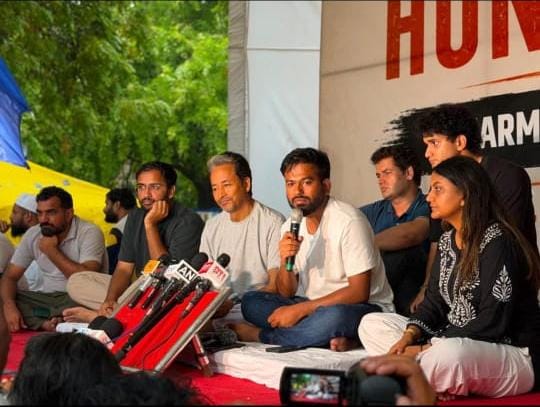
Photo credit: Cockroach is back/ hunger protest by X.
As the Monsoon Session of Indian Parliament approaches, New Delhi finds itself at a familiar yet profoundly altered crossroads of democratic expression. For nearly three weeks, Delhi’s Jantar Mantar has been the backdrop to an intense, youth led agitation spear headed by the Cockroach Janta Party (CJP). Now, after days of braving heavy rain and deteriorating health conditions under the open sky, the movement has announced a strategic shift: a peaceful, nationwide march to Parliament on July 20th.
The demonstration represents a significant escalation in the struggle for systemic accountability, functioning as both a direct appeal to the nation’s lawmakers and a critical turning point for India’s public education system.
Tracing the Roots of Discontent
The primary catalyst behind the CJP’s mobilization is a deep-seated crisis within the national competitive examination system. Triggered by widespread irregularities, systemic paper leaks, and the subsequent cancellations surrounding high-stakes tests like the NEET-UG medical entrance exam, the initial spark quickly grew into a broader movement.
For the young writers, editors, and students leading this charge, the issue goes far deeper than institutional mismanagement; it is an existential crisis. The protests highlight a painful human cost: the tragic loss of at least 20 students who died by suicide under the crushing weight of a compromised academic system. Consequently, the CJP’s demands have crystallized into three non-negotiable
points:
- The immediate resignation of Union Education Minister Dharmendra Pradhan.
- The dismantling or complete overhaul of malfunctioning testing bodies.
- The creation of a transparent, credible, and abuse proof examination framework.
Moral Weight of Hunger Strike
What elevates this upcoming July 20th march from a typical political rally to a profound moral appeal is the involvement of celebrated educationist and climate activist Sonam Wangchuk. Having entered his 11th day of an indefinite hunger strike alongside student leaders from the All India Students’ Association (AISA), Wangchuk’s deteriorating physical condition has added urgent gravity to the situation. Medical bulletins indicate he has already lost over seven kilograms, his vital signs carefully monitored as his fast continues.
From his makeshift cot at Jantar Mantar, Wangchuk issued an emotional video appeal via social media, urging citizens to move past passive support:
- “Thanks for all your messages to break my hunger strike, but that wouldn’t help the 20 students who died by suicide… If you really want to help, then do a little more than messages from comfy couches; come to Delhi and to Jantar Mantar on July 20.”
By framing the issue as a collective national responsibility rather than an isolated student problem, Wangchuk has broadened the movement’s appeal, explicitly linking structural educational failures to the wider health of India’s democratic and ecological future.
Structural Shifts and Broadening Coalitions
What began on June 20th as a localized student protest has rapidly evolved into a broad-based coalition. Over the past two weeks, the CJP has systematically built a network of support that crosses traditional socio-political boundaries. Delegations from the Samyukta Kisan Morcha (SKM) have visited the site to express wholehearted solidarity, explicitly connecting the structural vulnerabilities of rural youth to those of struggling agrarian families.
Simultaneously, members of parliament across various opposition parties have lent their support, promising to formally raise the issue on the floor of the House the moment the monsoon Session commences. This tactical alignment ensures thatwhile the physical march remains outside the gates of Parliament, its core arguments will be echoed directly inside the legislative chambers.
Looking Ahead to July 20th
The decision to march on July 20th is a calculated move designed to utilize the Parliament as the ultimate forum for structural reform. As CJP spokespeople have emphasized, the intent is not disruption, but heightened visibility. By initiating a strictly peaceful march from Jantar Mantar to the vicinity of the Sansad, the organizers seek to bypass bureaucratic stalls and force the political apparatus to confront the realities of a broken academic pipeline.
For a nation currently re-evaluating the efficiency of its public institutions, the outcome of this march will serve as a definitive benchmark. It tests whether peaceful, grassroots youth mobilization can compel a rigid administrative structure to accept accountability, or if the demands for structural integrity will be met with continued official silence. On July 20th, all eyes will be on Delhi to see how the state responds to the quiet, determined footsteps of its youth.
Yeh article aapko kaisa laga?