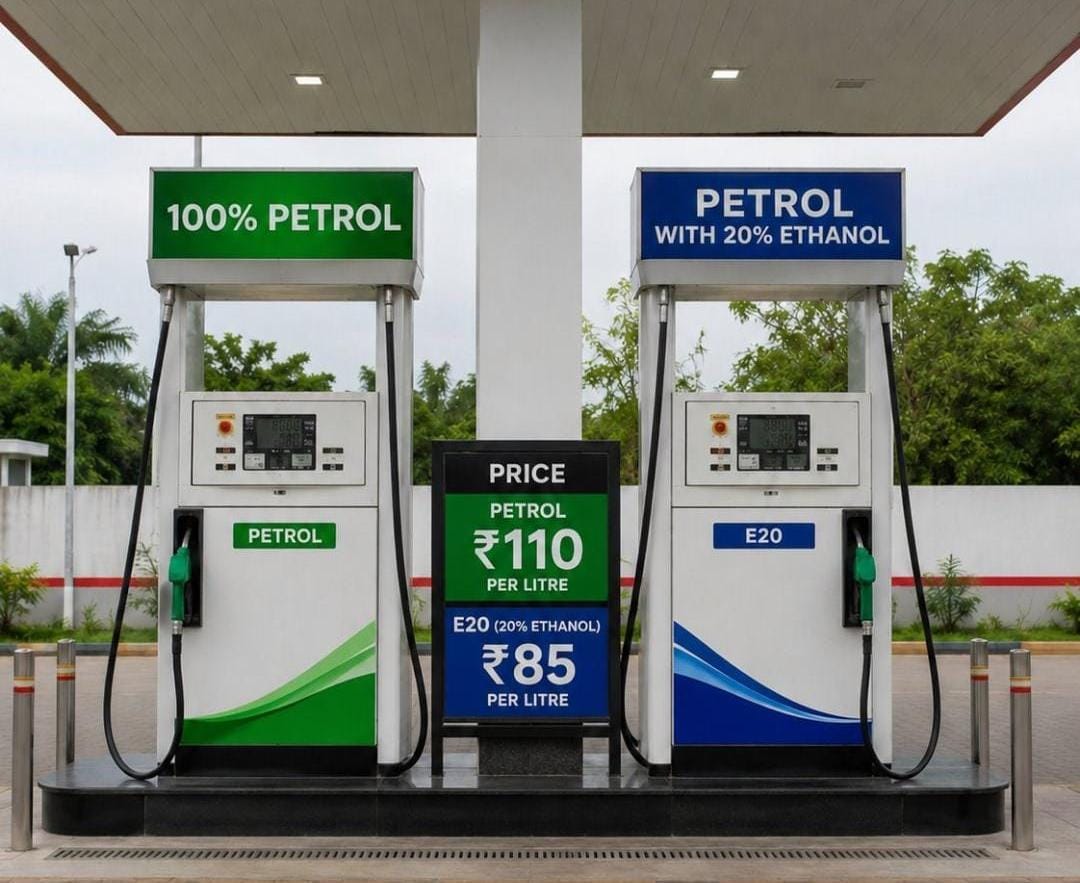
India’s E20 petrol program is one of the country’s most ambitious energy transition projects. By blending 20 per cent ethanol with petrol, the government hopes to reduce dependence on imported crude oil, strengthen energy security, create additional demand for agricultural produce, and lower carbon emissions. These are legitimate objectives, especially for a country that spends enormous sums on fuel imports every year. It is in this context that the government’s recent PIB “myth-busting” note sought to address growing public concerns surrounding E20 fuel. Yet a closer reading suggests that while several fears are dismissed, many important questions remain unanswered. The issue is not whether E20 has advantages. It clearly does. The issue is whether the public is being given the full picture.
The Mileage Debate and the Question of Compatibility
Take the debate over mileage. The PIB note states that “the 30 percent figure refers only to ethanol’s lower calorific value compared to petrol, not to a drop-in real world mileage” and argues that fuel efficiency depends far more on driving habits, tyre pressure, servicing, and air conditioner usage than on fuel type. That observation is correct as far as it goes. Anyone who drives regularly knows that vehicle maintenance and driving behavior affect mileage. But that is not the question many consumers are asking. The real question is much simpler: if all other conditions remain unchanged, does E20 deliver the same fuel economy as conventional petrol? Curiously, the government avoids making a direct claim that E20 provides identical mileage or improves it. Ethanol contains less energy per litre than petrol. Basic fuel science tells us that lower energy density generally results in lower fuel economy. The debate therefore should not be about whether tyre pressure affects mileage. It should be about whether E20 performs differently when tyre pressure remains unchanged. The relevant question is not whether some mileage loss exists, but how much.
A similar issue arises in the discussion on engine compatibility. The government points out that no widespread pattern of engine failure linked to E20 has been reported since rollout and notes that the fuel was approved only after extensive testing by industry bodies and manufacturers. It also cites data shared by Maruti Suzuki, according to which more than 1.5 crore vehicles older than three years were serviced during FY 2025-26 without any E20-related damage being identified. That is reassuring information, but it still leaves room for scrutiny. What exactly qualifies as an “old” vehicle in the Indian context? India’s roads are filled not only with three-year old vehicles but also with five-year-old, ten-year-old and even fifteen-year-old vehicles. Can conclusions drawn from relatively newer vehicles be confidently extended to the entire legacy fleet?
There is also a difference between the absence of evidence and evidence of absence. The fact that large scale failures have not yet been reported does not automatically establish long-term safety. Some effects emerge only after years of use. Assessing them may require five to ten years of observation, independent studies and detailed component level analysis. At the same time, many mechanics and vehicle owners continue to report concerns, particularly regarding older two wheelers. These include claims relating to carburetor cleaning, fuel line wear and degradation of rubber components. Such accounts should not be treated as proof of causation. They remain largely anecdotal and require systematic scientific investigation. Yet dismissing them entirely may be as unwise as accepting them without evidence.
Following the Money and Following the Emissions
The government’s case for ethanol also rests heavily on farmer welfare. Additional demand for agricultural produce, it argues, creates new opportunities for rural incomes. On the surface, that sounds reasonable. But additional demand does not automatically translate into higher farmer earnings. The more important question is who captures the economic value generated by the ethanol supply chain.
Between the farmer and the fuel pump stand sugar mills, distilleries and oil marketing companies. The chain is not simply farmer to consumer. It is farmer to sugar mill, sugar mill to distillery, distillery to oil company, and finally to the consumer. Which participant receives the largest share of the value addition? What proportion of ethanol-related profits actually reaches cultivators? Public discussions often celebrate rising ethanol production and higher blending percentages, but far less attention is paid to income distribution within the supply chain. If farmer welfare is one of the central justifications for the policy, then farmer income growth should be measured with the same enthusiasm as ethanol output.
Environmental claims deserve similar scrutiny. The PIB note argues that E20 reduces greenhouse gas emissions. That may well be true at the tailpipe. Yet environmental accounting cannot stop at the moment fuel is burned inside an engine. A complete assessment must examine the entire lifecycle of ethanol production, including land preparation, fertilizer manufacturing, irrigation, harvesting, transportation, distillation, storage and distribution. Each stage consumes energy and generates emissions. The relevant question is how much fossil fuel energy is used before ethanol finally reaches a vehicle’s fuel tank.
Reducing emissions at the point of combustion does not necessarily mean reducing emissions across the entire production cycle. Sometimes the environmental burden may simply be relocated rather than eliminated. In other words, the system risks robbing Peter to pay Paul. Cleaner emissions at one stage do not automatically guarantee lower emissions overall. A lifecycle analysis is therefore not a luxury. It is essential to understanding the true environmental cost of the transition.
The Water Question and the Octane Argument
The government’s response to concerns about water use focuses heavily on rice. It argues that only surplus rice is used for ethanol production and that the crop’s water footprint should not be attributed entirely to ethanol. Yet this discussion raises another question. Why does the response spend so much time discussing paddy while largely avoiding the role of sugarcane?
Sugarcane remains one of the major feedstocks for India’s ethanol program, and it is also among the most water intensive crops grown in the country. This is the elephant in the room. The debate over surplus rice cannot obscure the broader reality that significant quantities of water are consumed long before ethanol reaches the fuel tank. Whether rice is surplus or not does not change the fact that water was used during its cultivation. By concentrating on one feedstock while giving limited attention to another, the discussion risks addressing the symptom while overlooking the cause.
The PIB note also highlights ethanol’s ability to increase octane ratings. This is a genuine technical advantage. Higher octane fuels resist premature combustion, reduce engine knocking and are particularly useful in high compression engines. The science here is not in dispute. What deserves discussion, however, is the practical relevance of this advantage for the average Indian consumer.
Most commuter vehicles are designed primarily for affordability, efficiency and daily transportation rather than high performance driving. The benefits of higher octane depend heavily on engine design. A feature becomes a benefit only when the user actually needs it. For many ordinary commuter vehicles, higher octane may be more technically impressive than practically useful. The distinction matters because technical superiority does not always translate into meaningful everyday gains.
Did India Put the Fuel Before the Vehicle?
The government’s long term vision extends beyond E20 and points toward a future of flex fuel mobility. That objective may eventually prove transformative. Yet it also raises an uncomfortable policy question. Could the sequence have been different?
One possible approach would have been to first encourage widespread adoption of flex-fuel vehicles, then expand the compatible vehicle fleet, and only afterwards move aggressively toward higher ethanol blends. Instead, India appears to have pursued the reverse order. The fuel arrived first, while vehicle compatibility continues to catch up.
Did the country put the fuel before the vehicle?
In many respects, the policy resembles building the bridge after traffic has already begun crossing the river. That does not mean the bridge cannot eventually be completed. It simply means that the transition may impose adjustment costs on consumers who had little role in designing it.
None of this is an argument against ethanol blending. Reducing oil imports is a strategic necessity. Strengthening energy security is a legitimate national objective. Creating additional demand for agricultural produce can provide economic opportunities. These benefits are real and should be acknowledged.
But public policy cannot be judged solely by its intended objectives. It must also be evaluated through its hidden costs, its distributional consequences and its long-term sustainability. Healthy democracies do not advance by replacing myths with counter myths. They advance through open scrutiny, transparent evidence and honest accounting.
The real question is not whether E20 has benefits. It undoubtedly does. The real question is whether citizens are being presented with the complete balance sheet of those benefits and costs.
👋 Hi! Main hoon aapki Site Assistant Kuch bhi puchiye, main madad karungi!✕
Site Assistant AI se turant jawab
✕
Hi! I'm your AI Assistant for this website. I can chat in any language you prefer — just type your question to start! नमस्ते, मैं इस वेबसाइट की एआई असिस्टेंट हूँ। आप जिस भी भाषा में लिखेंगे, मैं उसी में जवाब दूँगी — बस अपना