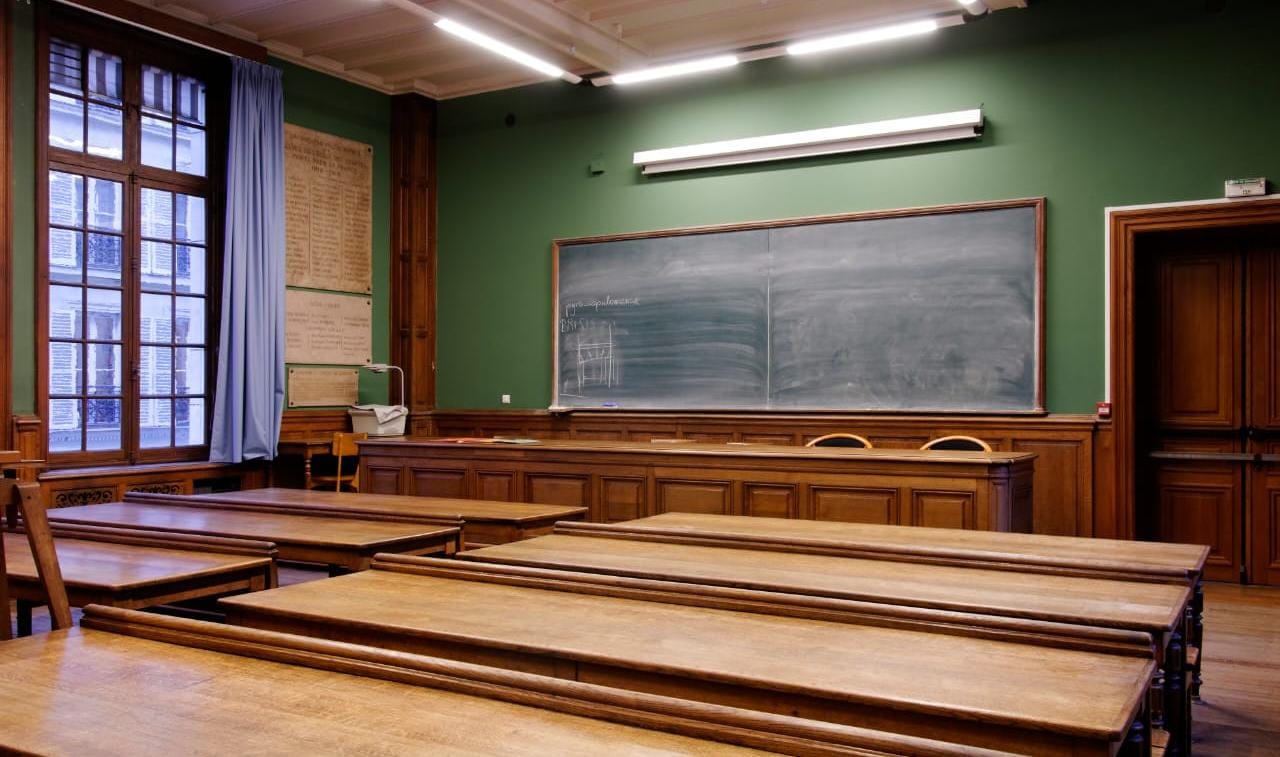
Image credit: Main room of the École nationale des chartes, Paris.
The Right to Education Must Mean the Right to Learn
“The cultivation of mind should be the ultimate aim of human existence,” Dr. B. R. Ambedkar reminded us. Few statements capture the true purpose of education more powerfully. Education is not merely about preparing young people for jobs or helping them earn a livelihood. It is about shaping citizens who can think independently, question authority, distinguish truth from misinformation, understand the values of the Constitution, and participate responsibly in a democracy. John Dewey once wrote that “Democracy has to be born anew every generation, and education is its midwife.” The wisdom of that observation is perhaps more relevant today than ever before. Every democracy eventually becomes the reflection of its classrooms. If schools nurture curiosity, societies become thoughtful. If they reward unquestioning obedience, democracies slowly become emotional, populist and easier to manipulate. India recognized the transformative power of education by making it a constitutional commitment through Article 21A, which guarantees every child the right to free and compulsory education. That promise has achieved remarkable success in expanding access. Yet access alone was never the destination. The larger constitutional promise was meaningful education, and that remains a work in progress. India has largely democratized access to education, but it has not yet democratized quality education.
No fair assessment of India’s education system can ignore its achievements. Literacy has improved significantly. School enrolment has expanded across the country. More girls are attending schools and colleges than ever before. Universities have multiplied, digital learning has entered classrooms, and higher education is now within reach of millions who would once have considered it impossible. These are accomplishments worthy of recognition. The challenge today is no longer persuading children to enter classrooms. It is asking a more uncomfortable question: what are they actually learning once they get there?
The Expanding Gap Between Degrees and Knowledge
India now produces millions of graduates every year. Yet employers across sectors repeatedly point to the same concerns. Many graduates struggle with communication, analytical reasoning, problem-solving, writing and practical application of knowledge. This presents a striking paradox. How can a country produce record numbers of degree holders while simultaneously facing widespread un-employability among educated youth? The answer may lie in a distinction that public debate often overlooks. Education is not the same as a degree, and learning is not the same as certification. A certificate may confirm that a course has been completed. It cannot, by itself, guarantee understanding.
Part of the problem appears to be the gradual dilution of academic expectations. This is not to romanticize the past or suggest that earlier generations were inherently more capable. The issue is that educational priorities seem to have shifted over time. Textbooks in many places have become simpler, conceptual depth has often given way to examination-oriented content, and success is increasingly measured through pass percentages rather than genuine understanding. Higher pass rates may be encouraging, but they do not necessarily indicate higher levels of learning. A student who scores well by memorizing answers has not necessarily acquired the ability to analyze new problems or think critically. Marks can measure performance in an examination. They cannot always measure intellectual growth.
This shift is closely linked to the changing character of education itself. Over the years, education has increasingly become an economic sector. Many institutions continue to uphold high academic standards and make valuable contributions to research and society. They deserve appreciation. The concern lies elsewhere. In too many places, the question “What should students learn?” is quietly replaced by “What course will attract the highest admissions?” New universities appear every year, glossy advertisements promise impressive placement figures, and expansive campuses become selling points. There is nothing wrong with modern infrastructure or financial sustainability. But when education becomes secondary to revenue generation, something essential is lost. A public good gradually begins to resemble a commercial product.
The Unequal Race Beyond School
Inside classrooms, another transformation has unfolded. Learning has increasingly become synonymous with preparing for examinations. Students spend years memorizing notes, reproducing model answers and practicing predictable questions. Curiosity, debate, independent reading and research often receive far less attention. Success is celebrated through marks rather than understanding. Yet the ability to recall information during a three-hour examination is only one small part of education. The ability to question assumptions, construct arguments, solve unfamiliar problems and learn continuously is what truly prepares an individual for life.
This gap becomes most visible when students step outside school and enter the world of competitive examinations. School education, particularly through NCERT and government curricula, aims to provide a broad conceptual foundation. Competitive examinations demand something much more intensive: deeper conceptual understanding, thousands of practice questions, specialized strategies and sustained coaching. Students from financially secure families often bridge this gap through expensive coaching institutes, online learning platforms and mock tests. Those who depend solely on school education frequently find themselves at a disadvantage despite studying the same textbooks. The result is a quiet but significant inequality. Education appears equal in principle, yet unequal in practice. Equal textbooks do not necessarily produce equal opportunities.
The consequences become evident in the labor market. Industries increasingly seek graduates who can adapt to changing technologies, understand artificial intelligence, communicate effectively, work collaboratively and solve real-world problems. Many universities, however, continue to produce graduates trained primarily for examinations rather than for rapidly evolving workplaces. This explains one of India’s most pressing contradictions. Vacancies exist. Graduates exist. Yet employers struggle to find suitable candidates while educated young people struggle to find meaningful employment. The gap is not always one of quantity. It is often one of preparedness.
The Road Back to Meaningful Education
The purpose of education extends far beyond producing employees. Its deeper responsibility is to produce citizens. A strong education system cultivates reasoning, ethics, scientific temper, constitutional values, empathy and creativity. These qualities cannot always be measured through examination scores, yet they are indispensable for a healthy democracy. Economic growth may build roads, industries and digital infrastructure. But without citizens capable of thinking critically and acting responsibly, democratic institutions themselves become fragile.
Criticism, however, is useful only if it points towards solutions. India does not need to abandon its educational achievements. It needs to build upon them. Public universities require greater academic and financial support. Teacher training must become a continuous priority rather than a one-time exercise. Assessment systems should reward understanding instead of memorization. Research culture deserves stronger institutional encouragement. School curricula and competitive examinations need closer alignment so that success depends less on private coaching and more on classroom learning. Universities must deepen collaboration with industry through internships, practical training and vocational integration, while schools should cultivate reading habits, discussion and intellectual curiosity alongside academic performance.
India’s greatest educational challenge is no longer getting children into classrooms. It is ensuring that classrooms produce thinkers rather than merely degree holders. The constitutional promise of education cannot be fulfilled simply by counting enrolments or distributing certificates. It will be fulfilled when education equips every student to reason independently, participate confidently in public life and adapt to a changing world. A democracy cannot thrive on certificates alone. It requires citizens capable of questioning, understanding and imagining a better future. Until education returns to that larger purpose, India’s demographic dividend risks becoming its greatest missed opportunity.
Yeh article aapko kaisa laga?