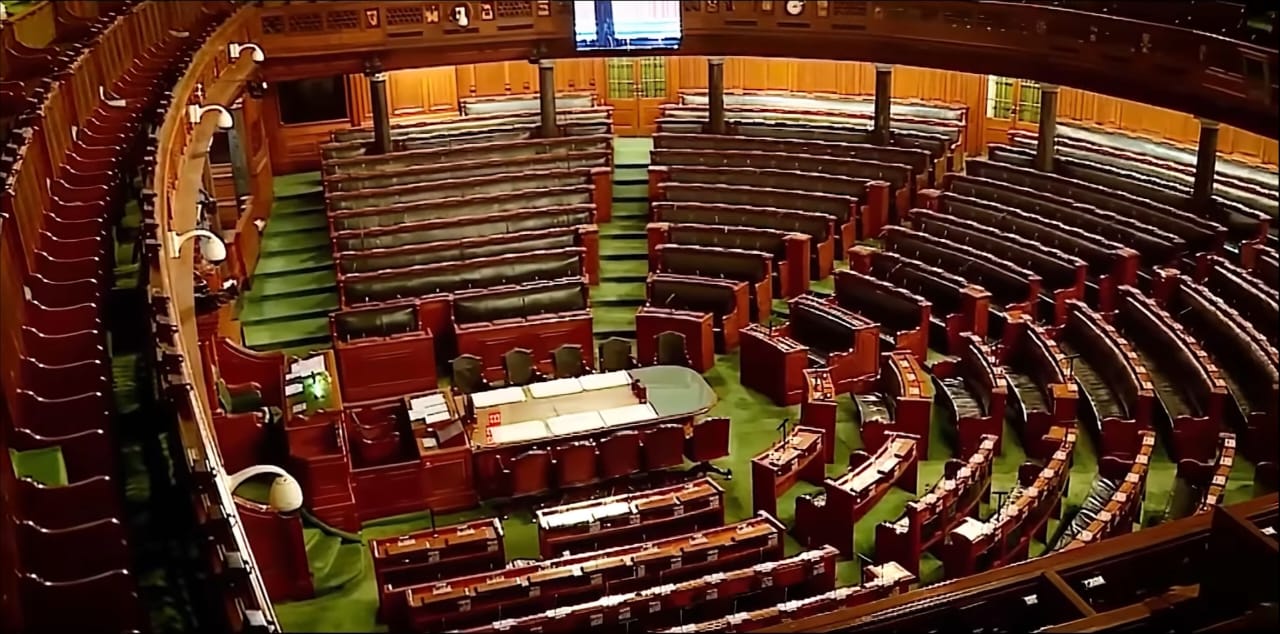
Image credit: Inside view of Parliament Lok Sabha, New Delhi
As the Parliament’s Monsoon Session prepares to commence in the second half of July 2026, the political atmosphere in New Delhi is charged with high-stakes anticipation. The ruling BJP-led National Democratic Alliance (NDA) is gearing up to push through two massive, generation-defining changes to the Indian Constitution: the 130th and 131st Amendment Bills.
Until recently, the government lacked the numbers to pass these sweeping laws. A constitutional amendment requires a “special majority”, the approval of two-thirds of the members present and voting in both Houses. However, following a controversial wave of defections in June 2026 involving rebel MPs from the Trinamool Congress and the Shiv Sena (UBT), the NDA now appears confident it has the numbers it needs.
The government packages these bills as historic milestones for women’s empowerment and anti-corruption. Yet, a deeper understanding reveals a far more concerning picture. Critics and Opposition leaders are warning that these amendments are a calculated attempt by the ruling party to permanently rewrite the rules of Indian democracy. Facing a widening governance deficit and the looming threat of anti-incumbency, they argue the NDA is building an institutional fortress to render itself politically undefeatable.
131st Amendment Bill: Redrawing the Electoral Map
The 131st Constitution Amendment Bill, which failed to pass in April 2026 but is making a forceful comeback, aims to fundamentally alter the size and shape of India’s Parliament.
The bill seeks to expand the maximum capacity of the Lok Sabha from its current limit of 550 seats to a staggering 850 seats (with up to 815 coming from the states and 35 from Union Territories).
Currently, the Constitution mandates that the redrawing of electoral boundaries (delimitation) is frozen until after the 2026 census. This bill removes that constitutional freeze, allowing the government to immediately use older 2011 census data to redraw the electoral map.
The government insists this expansion is the only way to implement the 33% women’s reservation quota. Addressing fears that Southern states will lose their political voice due to their smaller populations, Home Minister Amit Shah argued in Parliament that the government plans a flat “50% increase model.” Under this model, the current 543 seats would rise to roughly 816. Shah assured that Southern states would retain their ~24% share of the House, noting that Kerala’s seats would simply increase from 20 to 30, and Tamil Nadu’s representation would not decrease.
Opposition’s Alarm: A Structural Trap
Despite these verbal assurances, the actual text of the bill removes the constitutional obligation to use the latest census, declaring instead that Parliament can decide when to carry out delimitation and which census to use by a simple majority.
Critics argue this gives the ruling party dangerous flexibility to gerrymander constituencies. Furthermore, expanding the Lok Sabha to over 800 seats completely shatters the balance of power between the Lok Sabha and the Rajya Sabha (which remains capped at 250 seats). The ratio between the two Houses would shift from 2.2:1 to 3.3:1. This means in any joint parliamentary sitting, the Lok Sabha’s sheer numbers would effortlessly crush the Rajya Sabha, effectively silencing the voice of the states and centralizing absolute power in the hands of the national ruling party.
130th Amendment Bill: A Weapon Against Political Rivals
If the 131st Amendment manipulates the electoral board, the 130th Constitution Amendment Bill changes how players can be eliminated from the game.
What the Bill Proposes:
Introduced in late 2025 and recently reviewed by a Joint Parliamentary Committee, this bill mandates the automatic removal of any Prime Minister, Chief Minister, or Minister who remains in judicial custody (jail) for 30 consecutive days for any offense punishable by five or more years in prison.
The Government’s Justification:
The NDA defends this bill as a necessary moral cleansing of Indian politics. The Home Minister argued that it is fundamentally wrong for politicians accused of serious corruption to stubbornly run state governments from behind bars.
Guilty Until Proven Innocent?
Legal experts are concerned by this provision because it subverts the most basic principle of justice: the presumption of innocence. The bill shifts the standard for removing an elected leader from a judicial conviction (being proven guilty by a judge after a trial) to mere custody (being arrested by investigative agencies).
In India’s current legal climate, particularly under stringent laws like the PMLA (Prevention of Money Laundering Act), securing bail within 30 days is exceptionally difficult. The opposition warns that this clause is a weapon designed for political vendettas. By controlling central agencies like the CBI and the Enforcement Directorate, the ruling party could systematically arrest rival Chief Ministers, ensure their bail is delayed just past the 30-day mark, and legally topple democratically elected state governments, all without ever proving a single charge in court.
Shielding Against Failure
Why is the government rushing to alter the very foundations of the Constitution? Political analysts suggest the answer lies in a fear of the ballot box.
When a government faces rising challenges, such as economic distress, unemployment, or public anger over administrative failures, the democratic consequence is the threat of being voted out. However, rather than addressing this governance deficit, critics argue the NDA is attempting to change the rules so they cannot lose.
By pushing for structural changes that permanently tilt the electoral balance in their favor, and creating legal trapdoors to neutralize strong regional opposition leaders, the ruling alliance appears to be insulating itself from the actual will of the voters.
A Test for Indian Democracy
India has seen this before. During the Emergency era (1975-1977), constitutional amendments like the 39th and 42nd were rushed through to protect the ruling executive from legal and electoral challenges, severely damaging the democratic fabric.
A healthy democracy thrives on a level playing field, where power is retained by delivering good governance and earning public trust, not by altering the Constitution to perpetually shield the ruling party from political competition. As the Monsoon Session begins, citizens must look past the political packaging and closely watch whether these amendments are meant to serve the nation, or merely ensure the permanent survival of those currently in power.
Yeh article aapko kaisa laga?