
Photo: Prime Minister’s Office (GODL-India)
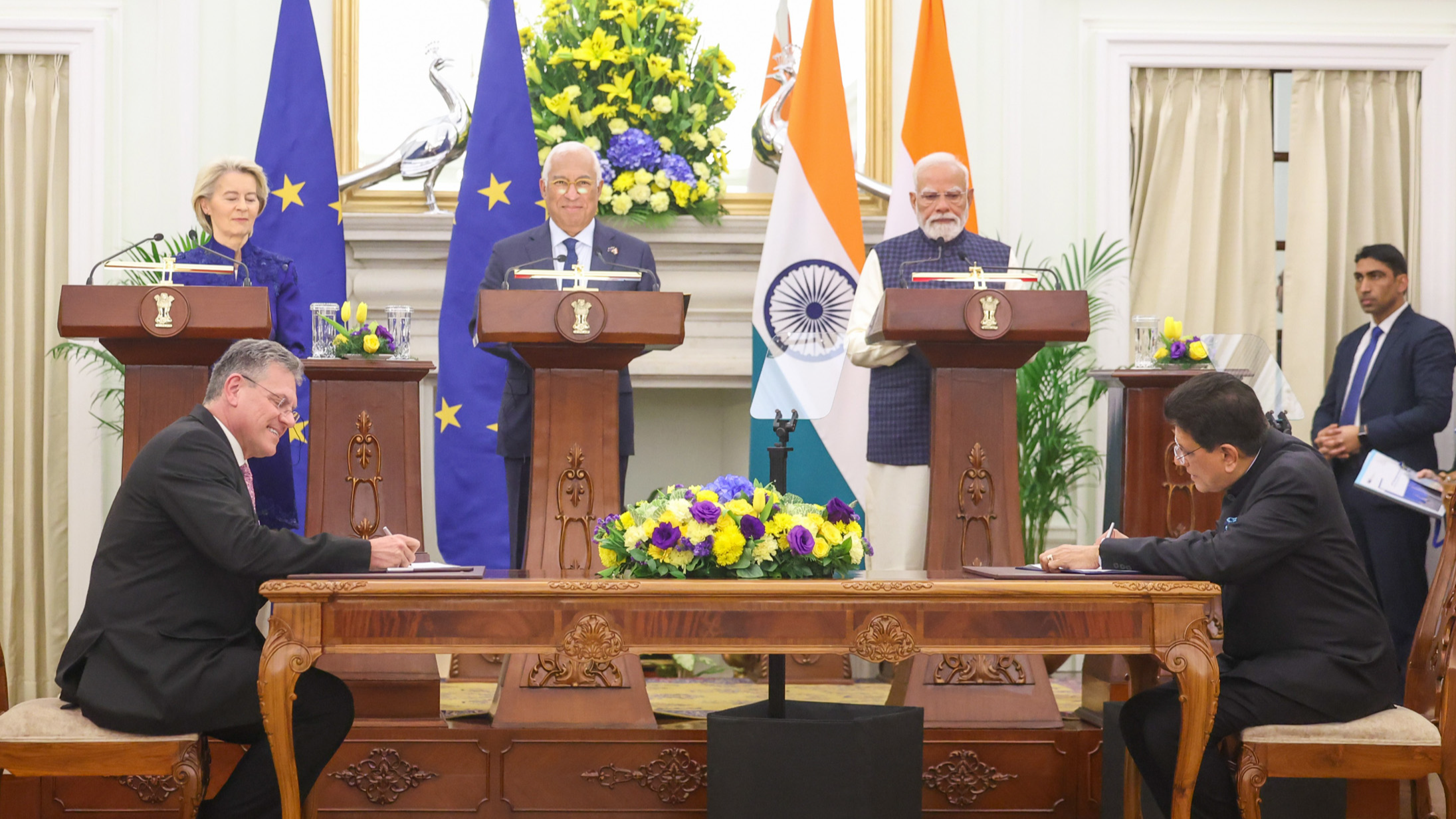
When Prime Minister Narendra Modi and European Commission President Ursula von der Leyen announced this historic milestone in 16th India-EU Summit, they were essentially declaring the formation of a new economic axis. Together, India and the EU command a quarter of the global GDP. Their union is born of a shared, sensible necessity. This analysis deconstructs the deal to understand its true impact on the Indian economy, the global order, and the daily life of the common citizen.
| Written by Ahad Khan |
Negotiations from the decades came to an end between a fastest growing economy (India) and a largest single market (EU). In a world increasingly of conflict and protectionism, the conclusion of the India-European Union Free Trade Agreement (FTA) marks a definitive turning point. It is not merely a commercial contract lowering tariffs on perfumes or cars; it is the strategic convergence of two distinct civilizations, the world’s most populous democracy and largest single market banding together to rewrite the rules of global engagement.
For decades, the global supply chain told one simple story: the West buys, and the East manufactures. However, the “East” in that story was almost always China. The India-EU FTA is the first major legal framework to make the “China-Plus-One” strategy a reality, moving it from a corporate plan to a geopolitical fact.
The size of the tax cuts is huge. The European Union has granted zero-duty (tax-free) access to over 99% of Indian exports by value. This is a massive change for India’s labor-intensive sectors. For years, Indian textiles, leather goods, gems, and marine products faced high taxes that made them harder to sell compared to goods from nations like Bangladesh or Vietnam. With this deal, approximately $33 billion worth of Indian exports from the workshops of Tiruppur to the tanneries of Kanpur will flow into Europe without paying extra duties.
This is not just about earning more money from exports; it is about creating jobs. These sectors are the largest employers of women and semi-skilled workers in India. By removing the tax barriers to the European market, the FTA encourages European retailers to buy from India. This brings capital directly into the local economy. It is a planned move to connect India’s vast network of small businesses (MSMEs) to the high-value European supply chain, moving India from a supplier of raw materials to a partner in making finished products.
The Death of the ‘Aspiration Tax’
For the Indian middle class, the FTA represents the dismantling of the “aspiration tax.” For generations, European luxury goods; from French wines and Italian fashion to German automobiles have been locked behind prohibitive tariff walls, often exceeding 100%. These duties turned standard global commodities into inaccessible luxuries.
The most visible symbol of this shift is the automotive sector. Under the new pact, India has agreed to a carefully calibrated reduction in import duties on European cars, slashing rates from a staggering 110% to just 10%. However, this is not a reckless opening of the market that would hurt domestic makers like Tata or Mahindra. The FTA applies to the vehicle cost more than €15,000, and does not applies to the Electric Vehicles for the first five years of the date of agreement.
Mercedes-Benz India MD and CEO Santosh Iyer said: “With more than 90 per cent of Mercedes-Benz India’s sales volume comprising ‘Made in India’ locally manufactured models, and only around 5 per cent of sales coming via CBU imports from the EU, we do not foresee any price reduction for Mercedes-Benz vehicles from the FTA, in the foreseeable future”.
He further said: “We will continue our focus on value addition to customers through local production and competitive pricing, making world-class vehicles in India, for Indian customers.”
Brain Chains over Supply Chains
While the trade in goods gets the headlines, the “Trade in Services” chapter is where the future of the India-EU relationship truly lies. Europe is facing an aging population; its workforce is shrinking, and its industries need skilled talent. India, on the other hand, is the talent factory of the world, adding millions of graduates to the workforce every year.
The FTA creates a “Future-Ready Mobility Framework” that makes the movement of this talent official. Unlike the difficult visa systems of other countries, the India-EU pact creates clear paths for “Contractual Service Suppliers” and “Independent Professionals.” The EU has offered access in 37 sectors for contract workers and 17 sectors for independent professionals.
This effectively creates “brain chains”, legal paths for Indian IT specialists, engineers, architects, and consultants to work on projects in Europe without the trouble of full immigration. In a culturally significant win, India also secured access for practitioners of Indian Traditional Medicine (Ayush). Yoga instructors and Ayurveda practitioners can now work under their home titles in EU member states where such practices are not strictly regulated.
The Red Lines
A trade deal between giants is also defined by what it leaves out. The negotiations, which began in 2007 and were stuck for years, were often held back by European demands for access to India’s dairy and agricultural markets. Showing great skill in negotiation, India held its ground.
The final text confirms that sensitive sectors specifically dairy, cereals, and agriculture have been completely kept out of the market access rules. The “Amul model” of cooperative dairy farming, which supports millions of small farmers, remains protected from the big business farming of Europe.
Furthermore, on the difficult issue of the Carbon Border Adjustment Mechanism (CBAM) essentially a tax on carbon-heavy goods, India refused to simply accept European standards. Instead, the deal sets up a system for “constructive engagement” and technical support. It recognizes that while India is committed to green transitions, it will not allow environmental rules to become a tool for Western protectionism. The approach adopted ensures that dialogue, not punishment, remains the main way to solve disputes on labor and environmental standards.
The Geopolitical Signal
Ultimately, the India-EU FTA is a signal to the rest of the world. By finishing this deal, Brussels has admitted that it cannot rely only on the United States for security or China for growth. It needs a third option. For India, the agreement is a crucial step in its “Viksit Bharat 2047” vision, a roadmap to becoming a developed nation. It confirms India’s status not just as a market, but as a leader.
The deal essentially states that the era of a world dominated by one or two superpowers is over. We have entered a multipolar age where independence is preserved through relying on each other. As Indian goods flow west and European technology flows east, the two unions have bet on each other to bring stability to a chaotic world. The giants have shaken hands, and the impact will be felt for decades to come.
However, the Negotiations for the India-EU FTA have been concluded and pending for approval by Indian Cabinet & European Parliament.
What do you think? Does this trade deal finally position India as a global manufacturing superpower, or do you think our domestic industries will struggle to compete with European standards? Share your views in the comments below.
Yeh article aapko kaisa laga?