
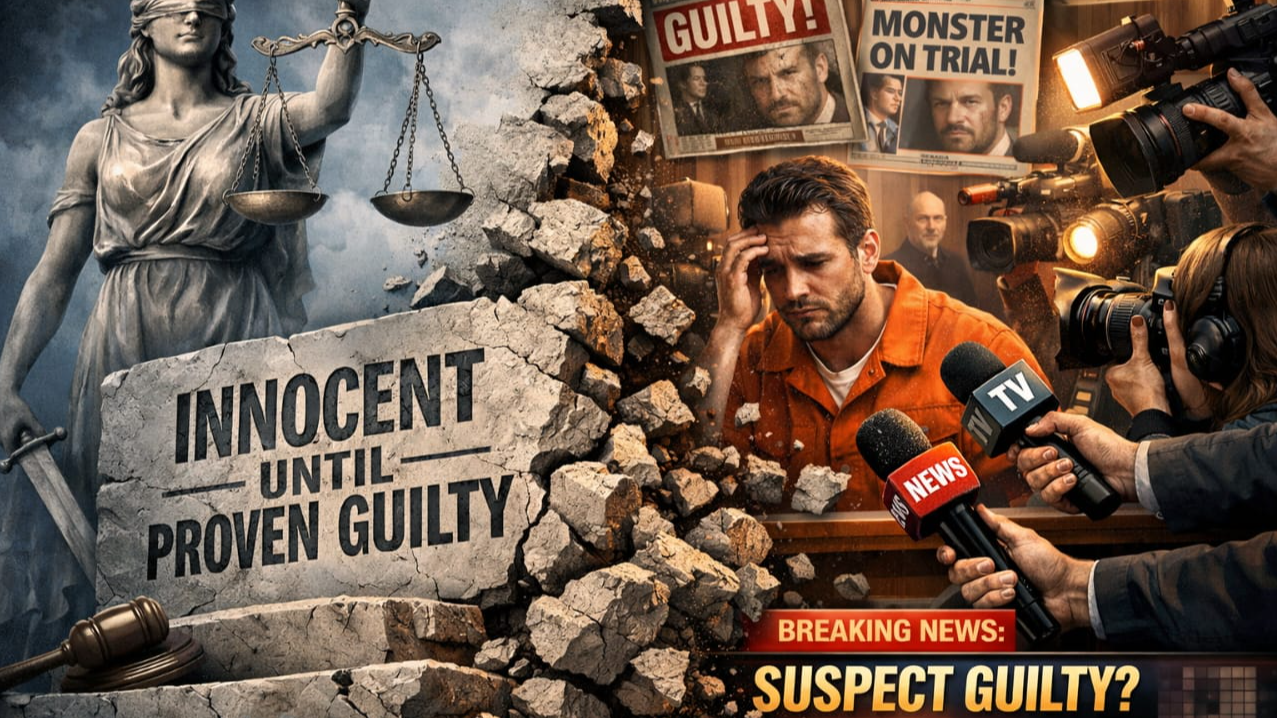
Photo: Image Created by AI
The presumption of innocence is a cornerstone of our justice system, but media trials can erode that foundation. Media trials represent a complex challenge in modern democracies, where the press plays a vital role in informing the public but can also undermine justice through sensationalism and bias. Curbing media trials in India does not require silencing the press but disciplining its power.
How Media is suppress Constitutional Rights in the shield of the constitutional Rights?
India is a constitutional democracy based on the principles of accountability, and rule of law. Besides the three formal organs Legislature, Executive, and Judiciary the media is often described as the “fourth pillar of democracy” because of its crucial responsibility of informing the public and ensuring transparency in governance. The constitutional basis which are freedom of press are not expressly mentioned but are but it is implicitly guaranteed under Article 19(1) (a), which provides for the freedom of speech and expression. Traditionally media acts as a check on abuse of power by working as an investigative journalism, informing the public and being a platform, which works as a catalyst for informed public debate, and hence promoting transparency and accountability.
However, in recent times, this traditional role has witnessed a troubling transformation. The rise of media trials and “janta adalats” has led to a direct encroachment upon the independence of the judiciary, the autonomy of judicial proceedings, and the fair administration of justice. High-profile cases, such as the R.G Kar Medical College rape case, illustrate how extensive media scrutiny and narrative building can compromise constitutional guarantees, including the right to a fair trial, presumption of innocence, and the rights of both the accused and the victim. This shift reflects a dangerous tendency of the media to overstep its constitutional boundaries by conducting parallel trials, often in the absence of adequate regulatory restraints. Consequently, what was once a democratic safeguard now poses significant challenges to the justice delivery system and societal faith in the rule of law. It is observed that media is nowadays more inclined toward the TRP game and this brings about significant negative impacts. Media Trials manipulates the Narrative? Media trials are not merely legal anomalies; they are social phenomena that deeply influence collective consciousness and individual behavior. When the media assumes the role of investigator, prosecutor, and judge, the consequences extend far beyond the courtroom reshaping societal norms, public morality, and psychological well-being.
1) Sociological analysis:
it is commonly said that the media of a country is the reflection of that nations society and that is significantly true because media does not merely report events; it actively constructs social narratives and through selective framing, repetition, and sensationalism because of TRP game, media trials create moral binaries of guilt and innocence, often before judicial determination. This phenomenon aligns with labeling theory, wherein individuals are publicly branded as “criminals” or “villains,” leading society to accept such labels as truth irrespective of legal outcomes. This fosters a culture of instant justice, where societal impatience overrides procedural safeguards, threatening the rule of law and democratic stability.
2) Psychological analysis:
media trial effect both accused and victim as well as the families of both in a very negative manner brings about financial, psychological and societal constrains. Media trials inflict profound harm on accused persons. Continuous exposure to hostile media narratives results in stigmatization, social isolation, and reputational destruction, often irreversible even after acquittal. The phenomenon of confirmation bias further exacerbates this harm, as audiences selectively consume information that reinforces the media-constructed narrative of guilt and this selectively results in “social death “.talking about victims excessive exposure can violate their dignity and privacy . Psychologically, victims may suffer from heightened stress, shame, and fear, particularly in cases involving sexual offences.
Justice System or Janta Adalat
Media trials are usually based on criminal cases; the basic principles of criminal cases involve impartial judgment, unbiased administration, justice to be served, independence of judiciary and most importantly to be granted fair trial. In a media trial all of which is thrown to dust. Judicial integrity should be strictly maintained by deciding according to the procedures established by law but this is not the case with media trial it clearly take this authority from judiciary and places this in hands of public and hence termed as janta-adalats , media works as a bridge which transports the judicial power in the hands of public .
Media trials pose a direct challenge to the independence and impartiality of the judiciary. It disrupt procedural fairness by influencing witness testimony, contaminating evidence, and pressuring investigating agencies to align their actions with public sentiment rather than legal standards. This compromises the integrity of trials and increases the likelihood of miscarriages of justices.
Media trail not only disrupts the process of fair trial and breaking the principles of natural justice but also hampers the working of law enforcement agencies like police and investigative bodies because of pressure by media, leading to hasty arrests, coerced confessions, and compromised investigations, undermining professional autonomy and due process.
Effect on legal professionals, by transforming advocates into media performers rather than officers of the court. Public commentary by lawyers on sub-judice matters risks ethical violations and erodes professional discipline. In addition, it influences the judge’s decisions and this takes away the right of accused of a free and fair trial.
Existing regulations on media
1) Contempt of courts act, 1971:
States that when a case has reached the court and is in pre-trial motion, no individual or publication is allowed to publish their own versions of the facts of the case, that is, the publication of any such fact which obstructs or interferes in the proceeding of the court which can harm the trial proceedings cannot be justified. Under Section 2(c) sub clause (iii) of the Contempt of Courts Act, 1971 states that – “No newspaper has a right to assume the role of an investigator and to suggest that the accused person against whom a proceeding is pending was or was not guilty of the offence. However only when a criminal or civil suit is ‘pending’ only then can it qualify as contempt.
2) Press council act, 1978:
Media houses today, have immense power, what it needs is a system of check that balances its power. The Press Council Act, 1978 was established with the aim to “preserve the freedom of the Press and to maintain and improve the standards of newspapers and news agencies in India”. The Council has various powers, the supreme power that the Council has is to censor. It is vital to note that the Council can censor or direct for an apology only once the news has been published, that is the harm has been done, once a news is published it is read by millions of people, a retraction in the next new cycle does not undo it, the people blindly follow the news. Further, the Council cannot give a harsh punishment. Thus, as there is no harsh punishment, the reports fail to adhere to the ethics of journalism.
K.M. Nanavati v. State of Maharashtra (1956): A Classic Illustration of the Dangers of Media Trial
The K.M. Nanavati case reveals how media driven public sentiment can overshadow legal reasoning, ultimately compelling systemic reform to protect the sanctity of judicial proceedings. This case involves a naval officer accused of murdering his wife’s paramour, received unprecedented media attention. Newspapers and magazines sensationalized the narrative, portraying Nanavati as an honorable naval hero driven to crime by emotional betrayal, while simultaneously casting the victim in a morally questionable light. The portrayal of media influenced the public opinion and which bought significant pressure on the jury system prevalent in those times and that resulting in “not guilty “ verdict by jury which was later overturned by Bombay high court and the jury decision was critised heavily .
The Nanavati case exposed how media trials can distort facts, manipulate emotional narratives, and compromise judicial neutrality, particularly in cases involving public figures. The case became a decisive factor in abolishing jury trials in India, marking a constitutional shift towards judge-centric adjudication to safeguard fairness and independence in criminal proceedings.
In essence, the Nanavati trial illustrates that while media scrutiny can enhance transparency, unchecked sensationalism poses a serious threat to due process, judicial independence, and the credibility of verdicts making it a foundational precedent in debates on media trials in India.
Delhi Ka Darinda
The case of Sarvjeet Singh vs. State (2015) is a perfect example of how the media can destroy a life before the law even hears the facts. In 2015, a simple traffic argument turned into a national spectacle when a woman posted a photo of Sarvjeet Singh on Facebook, accusing him of harassment. Within hours, the post went viral. TV news channels did not wait for a police investigation.
They immediately branded Sarvjeet as “Delhi ka Darinda” (The Predator of Delhi). Anchors shouted at him on prime-time television, and politicians praised the accuser for her “bravery.” The media declared him guilty instantly. As a result, Sarvjeet lost his job and faced severe public shame. This was a “Social Death”, he was treated like a criminal by society, even though he had no criminal record.
The truth, however, was very different. It took four years for the courts to decide the case. In 2019, a Delhi court acquitted Sarvjeet Singh of all charges. The judge noted that the accuser’s testimony was not trustworthy and that she had skipped court hearings multiple times. The law proved him innocent, but the media had already punished him. This case proves that when the media acts as a judge, it often delivers injustice, not justice.
Beyond the TRP Game
The obsession with Television Rating Points (TRP) is often just a mask for a deeper problem: political control. Many media houses today are not just chasing views; they are acting as tools for political parties. Instead of questioning power, they often protect it. This turns the newsroom into a platform for agendas rather than facts.
This bias is driven by money. A large portion of revenue for news channels comes from government advertisements. As reports from the Reuters Institute show, this financial dependency forces editors to align their stories with the government’s interests to keep the funding flowing. The Election Commission of India (ECI) has also flagged the issue of “Paid News,” where politicians secretly pay for favorable coverage to bypass the Representation of the People Act, 1951.
The courts have recognized this danger. In the Sudarshan News case (2020), the Supreme Court of India strictly warned against media content that targets specific communities to serve a political narrative. The Court noted that such “aggressive journalism” harms the nation’s integrity. When the media prioritizes political loyalty over the truth, it stops being a watchdog and becomes a weapon against the very people it is supposed to inform.
The Scrutiny
In India media often justifies its actions under the shield of freedom of speech and expressions and this leads to the hindrance in the process of fair trial. India does have regulations and guidelines but contempt and self-regulation struggles to keep pace with fast-moving social platforms. No dedicates statute for media trails and inconsistent enforcement of existing provisions that results in significant legal loopholes. However, this can be catered by mindfully upholding the balance between freedom of press and fair trail procedures.
“sub judice rules”
2. Empowering regulatory bodies:
the existing bodies that are PCI (press council of India) & NBDA (News broadcasting standards authority) can be empowered to impose fines and penalties. Theses bodies can be granted an independent status to work without any political influence that helps to maintain accountability. This can be effectively done through regulatory independence, which must ensure to prevent executive overreach and censorship.
3. Promoting public awareness and strengthening ethical media literacy :
by introducing incentives and awards for ethical media coverage this will encourage the coming generation in a positive manner to remain honest toward their job. By actively conducting public awareness campaigns regarding principles of fair trial and explaining long term negative impact of media trials on society as a whole .
Do you believe that Trial by Media is dangerous than we think? If yes, what can be done to prevent such misuse of Freedom of Speech? Comment down your opinions below.
Yeh article aapko kaisa laga?