
Image credit : X/@NCMIndiaa
The Supreme Court stayed the implementation of UGC’s 2026 regulations in Jan 2026, citing confusion and potential misuse. The controversy centers on how caste-based discrimination is defined and whether it aligns with constitutional equality principles. Until the next hearing, the 2012 anti-discrimination rules remain in force. The case highlights the need for clarity in law when regulating rights and campus governance. It also underscores the delicate balance between educational regulation and civil liberties.
New UGC Regulations Hit the Headlines
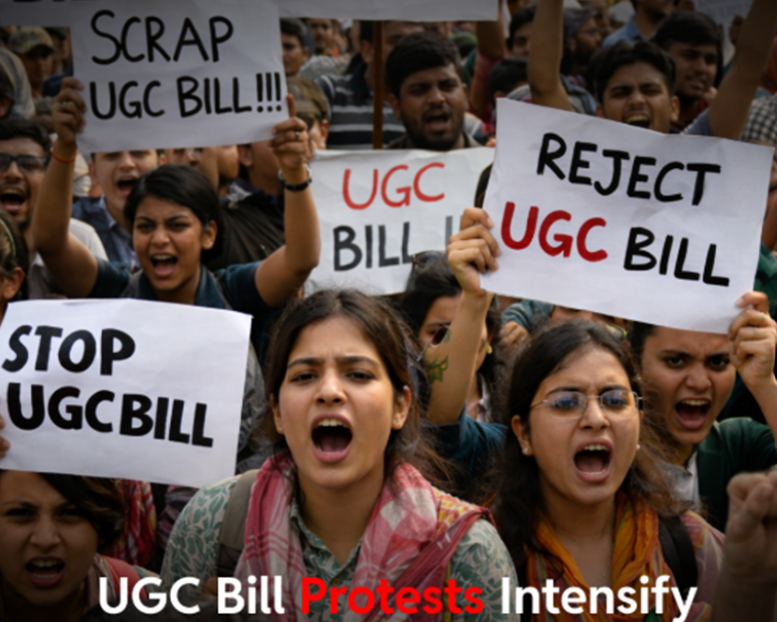
In early 2026, the University Grants Commission (UGC) found itself at the center of a legal storm after notifying new regulations on caste-based discrimination and campus conduct. What was intended as a reform of grievance mechanisms quickly escalated into a nationwide debate involving universities, student groups, lawyers, and civil society, raising questions about academic autonomy, free speech, and regulatory overreach.
The UGC (Promotion of Equity in Higher Education Institutions) Regulations, 2026, notified on 13 January 2026, were challenged within weeks through protests, public campaigns, and multiple petitions before the Supreme Court of India. On 29 January 2026, a three-judge Bench led by Chief Justice Surya Kant, along with Justice Joymalya Bagchi and Justice V. Ramasubramanian, stayed the implementation of the regulations, citing provisions that were “vague,” “ambiguous,” and “capable of misuse.” The Court warned that unchecked enforcement could have serious consequences for campus governance and freedom of expression, and directed that the 2012 UGC anti-discrimination regulations would continue to operate until further orders.
The dispute now sits at the intersection of the constitutional “golden triangle” under Articles 14, 15 and 19, the UGC’s statutory mandate, and ongoing debates over equality and regulation in higher education.
Background: UGC, Campus Etiquette and Regulation
The University Grants Commission is a statutory body established under the UGC Act, 1956, tasked with maintaining standards of higher education, allocating grants, and overseeing universities across the country. Over the years, UGC has issued a series of regulations on admission, fees, anti-ragging, and student conduct.
Until 2026, regulations dealing with discrimination and harassment on campus were governed by the UGC (Prevention of Harassment and Discrimination) Regulations, 2012. These rules provided procedures for redressal of complaints related to gender discrimination, harassment and more.
In January 2026, the UGC introduced the UGC Promotion of Equity in Higher Education Institutions Regulations, 2026, which proposed updated standards for handling caste-based discrimination alongside other forms of differential treatment.
Root of Dispute: What’s in the New UGC Rules?
The controversy surrounding the new regulations does not arise from the idea of regulating discrimination on campuses, that objective has existed for over a decade. The legal conflict lies in how the 2026 Regulations redefine discrimination, restructure grievance mechanisms, and alter the scope of protection available to students and faculty. At the heart of the controversy is how the 2026 draft defines caste-based discrimination.
For the first time, the UGC attempted to officially define “caste-based discrimination” within a regulatory instrument. However, the definition explicitly tied protection to students and staff belonging to Scheduled Castes (SC), Scheduled Tribes (ST), and Other Backward Classes (OBC). Petitioners argued that this formulation excludes individuals from the general category who may still face caste-linked prejudice or social targeting.
Another dispute arises is that the language of the regulations. Several clauses use broad and undefined expressions such as “conduct undermining equity,” “hostile environment,” or “acts affecting dignity” without laying down objective standards. Before the Supreme Court, petitioners contended that such vagueness could allow subjective interpretation by campus authorities, leading to arbitrary or inconsistent outcomes. The Court itself flagged that vague regulations governing speech and behaviour on campuses can have a chilling effect.
Other issue here is the changes to Grievance Redressal Mechanisms where the 2026 regulations proposed a restructured complaint mechanism, altering the composition and powers of institutional committees. Critics argued that the revised framework centralised decision making and reduced procedural safeguards for the accused, raising concerns related to natural justice and due process. Importantly, the regulations did not clearly spell out, evidentiary standards, safeguards against false or malicious complaints, or appellate mechanisms beyond institutional control.
The Flip Side
Those defending the regulations point to following points:
A Targeted Response to Persistent Inequality. A repeated observations by parliamentary committees, UGC-appointed review panels, and academic studies indicating that students from Scheduled Castes (SC), Scheduled Tribes (ST), and Other Backward Classes (OBC) experience disproportionate academic marginalisation, social exclusion, and bias within universities. Several high-profile student deaths over the past decade and with institutional defensiveness has intensified calls for stronger grievance mechanisms.
Why Specificity, Not Generalisation
As critics describe the definition as narrow but the supporters describe it as precise and advocate that clarity is essential. A caste-neutral definition, they caution, could blur the focus of enforcement and reduce protections to procedural formalities. When every interpersonal dispute risks being labelled discrimination, the distinct harms faced by historically disadvantaged groups may be diluted.
In this sense, the regulation is likened to be targeted welfare legislation, structured to protect groups for whom the risk of harm is evidently higher. Further it is argued that, explicitly naming SC, ST and OBC communities in the definition of caste-based discrimination is not exclusionary but historically grounded. The objective is not to rank suffering, but to recognise empirically identifiable vulnerability.
The Institutional Power Imbalance
Supporters point out the structural imbalance in university leadership where institutional heads and committee nominees often belong to socially dominant categories. They contend that this reality strengthens the case for centralised, binding regulations. Without uniform standards, grievance redressal has historically depended on administrative discretion and institutional will, which often turned out to be biased on ground level. The 2026 Regulations, supporters argue, seek to reduce that discretion by formalising procedures.
Conclusion
As of now the Supreme Court intervened to stay implementation and insisted on retaining the older 2012 rules until a fuller review. The Court’s interim order noted that ill-defined terms can be weaponised and cause confusion on campuses, which thrive on expressive freedom and debate under Article 19(1)(a) of the Constitution.
The UGC controversy is more than a dispute over campus rules. It underscores how law and policy must operate within constitutional boundaries, especially when they affect fundamental freedoms and equality. While regulators seek reform, courts remind us that legal clarity and constitutional compatibility are prerequisites for legitimate governance. The issue is ongoing, and the final outcome will likely shape future campus regulation and how equity is understood in Indian higher education.
Why does the law fail to establish the balance in a society which is homogenous in culture, language, religion and race, since centuries? Comments below!
Yeh article aapko kaisa laga?