
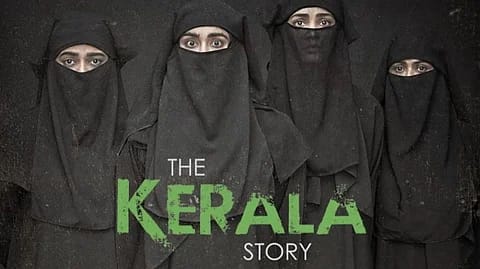
Photo: Courtesy- IMDb: The Kerala Story
The makers of The Kerala Story 2 were preparing for the release this week. Instead, they are preparing for the court.
With just days left before the film hits theatres on February 27, the sequel has landed before the Kerala High Court, where its very certification is being questioned. What was meant to be a commercial rollout has turned into a legal standoff. Petitions filed before the court argue that the film’s title and promotional material risk projecting Kerala in a misleading and socially sensitive light. During today’s hearing, the bench openly questioned whether the certification process had sufficiently considered the possible impact on communal harmony.
The film is directed by Kamakhya Narayan Singh and produced by Vipul Amrutlal Shah and stars Ulka Gupta, Aditi Bhatia, and Aishwarya Ojha. Whose lives allegedly take dark turns after relationships with Muslim men in Rajasthan, Madhya Pradesh, and Kerala. Scheduled for release on February 27, 2026.
| Written by Team LexHour |
How the Dispute Reached the Court
The controversy reached the Kerala High Court after petitions were filed challenging the certification granted by the Central Board of Film Certification (CBFC). The petitioners argue that the film’s title and promotional material risk presenting Kerala in a way that could distort its social fabric and potentially inflame communal tensions. Their central question is straightforward but weighty, ‘When a film uses the name of a state in a politically sensitive narrative, does it carry a higher burden of responsibility?’ Much of the debate in court has revolved around the title itself. If the story is not confined exclusively to Kerala, petitioners ask, why foreground the state so prominently? Titles are not neutral, they frame perception long before audiences buy a ticket. Critics contend that linking a state’s name to themes of extremism or social conflict can have reputational consequences, particularly in a country where identity and politics are deeply intertwined. During the hearing, the bench appeared less concerned with artistic taste and more with the implications for public order. It questioned whether the certification process had sufficiently examined these potential impacts and whether the portrayal risks painting an entire region with a broad brush. At the same time, the filmmakers are understood to have defended their choice as an exercise of creative freedom, arguing that cinema must retain the space to depict narratives inspired by events without being accused of targeting communities. That tension between artistic liberty and collective sensitivity now sits at the heart of the dispute. What unfolded in court was not panic, but caution, not dismissal, but scrutiny. And in that measured tone lies the real complexity of the case- this is not merely a dispute over a movie title, but a balancing act between expression and responsibility.
What Happened in The Court: Its Impact & Producer’s Stance
During the hearing, Justice Bechu Kurian Thomas observed that Kerala is widely regarded for its social harmony and secular coexistence, and questioned whether the film’s portrayal risks creating a misleading impression. The bench reportedly noted that the trailer appears to suggest that the incidents depicted are widespread across the state – a perception that could shape public opinion regardless of the film’s full narrative context. The court also examined whether the Central Board of Film Certification had adequately assessed potential public order implications before granting clearance. At one point, the judges indicated that they may view the film themselves before arriving at a final decision, a rare but telling move that underscores the seriousness of the scrutiny. The concern, as it emerged in court, is not about personal taste or cinematic merit, but about impact.
Much of that impact, petitioners argue, begins with the title itself. If the incidents portrayed are not confined to Kerala, why foreground the state so prominently? Titles frame perception long before audiences encounter nuance or context. In a country where regional identity carries political weight, attaching a state’s name to themes of coercion or extremism can have reputational consequences. The filmmakers, however, maintain that the title reflects continuity with the earlier film and is part of creative storytelling rather than targeted messaging. Producer Vipul Amrutlal Shah has publicly defended the project, describing Kerala as “God’s Own Country” and insisting that the film does not seek to malign the state but to address broader national concerns. Supporters echo this position, arguing that cinema must retain the space to explore sensitive issues without being accused of communal intent.
Bigger Than a Movie
This dispute stretches beyond one sequel or one production house. When a film invokes the name of a real state that is particularly in connection with themes of radicalisation, coercion, or communal conflict, it raises questions that are larger than narrative structure. States are not fictional landscapes; they are living, political, and social entities. Attaching a state’s name to sensitive themes inevitably amplifies consequences. That leads to a difficult question- Should filmmakers carry a higher responsibility when their titles and marketing involve real communities or regions?
At the same time, cinema has historically addressed uncomfortable themes. Political violence, social injustice, and radicalisation are not invented issues. If storytelling is forced to avoid controversial subjects altogether, does that weaken artistic freedom? This is where judicial scrutiny enters the picture. Supporters of court intervention argue that it protects democracy by preventing inflammatory material from escalating into real-world tension. Critics warn that frequent judicial examination may create a chilling effect, encouraging self-censorship and discouraging bold storytelling.
India’s film history be it Padmavati, or Udaypur Files or others, shows that cinema rarely exists in isolation. It influences, provokes, shapes perceptions, and sometimes polarises. That power is precisely why it becomes legally sensitive.
Because in India, cinema is rarely just cinema. And sometimes, it is the courtroom, not the theatre, that determines how far a story can go.
What Happens Next?
As of this evening, The Kerala Story 2 continues to hold its CBFC certification. There is no blanket stay on its release, yet. But the matter remains under active judicial consideration, and that is where the uncertainty lies. The High Court’s next steps could take multiple directions.
If the bench is satisfied that the CBFC applied its guidelines properly and that the film does not cross into material capable of disturbing public order, the release could proceed without interference. Courts in India have historically leaned toward protecting certified films unless there is clear and compelling evidence of harm. However, the court may also examine whether specific scenes, dialogues, disclaimers, or promotional materials require modification. In past film disputes, courts have recommended clearer disclaimers, contextual notes, or limited cuts rather than outright bans.
Another possibility is the court issuing clarificatory observations, not necessarily altering the film, but laying down reasoning that defines the boundaries between expression and responsibility. Such remarks often influence future certification disputes. If the judges decide to screen the film themselves, that signals deeper scrutiny. A judicial viewing is rare and indicates that the court wants to assess the substance directly rather than rely solely on trailers or submissions. What the bench sees, tone, emphasis, and messaging may shape the final order.
In short, the film’s immediate fate depends less on public noise and more on how the court evaluates impact versus intent. For now, Kerala Story 2 stands at an unusual intersection- it is a movie awaiting release and a live example of how cinema can enter constitutional debate.
Yeh article aapko kaisa laga?