
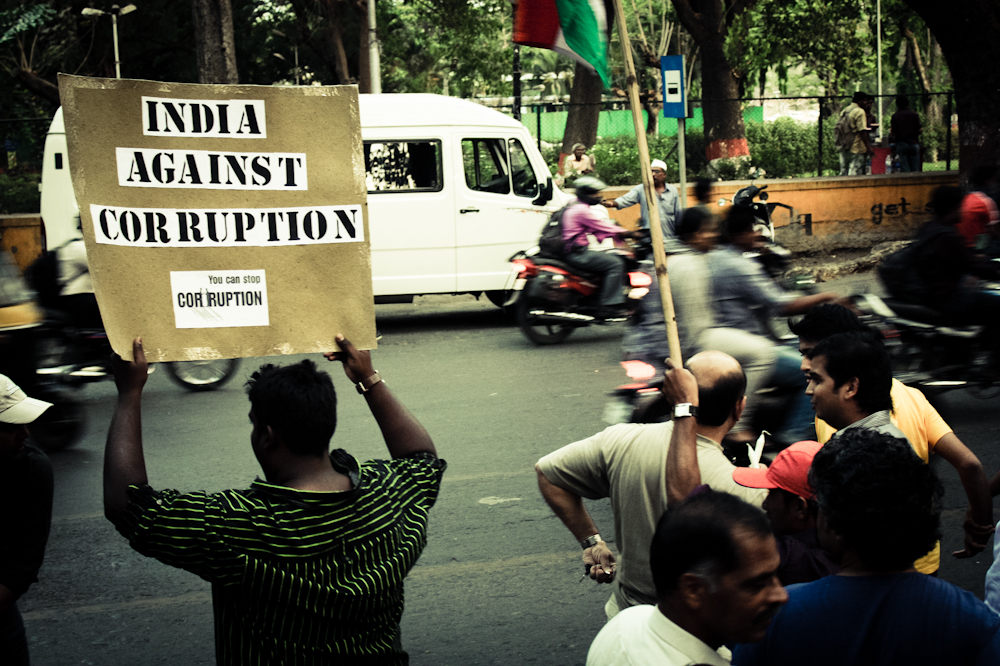
Photo: IAC-Protestor in Pune, India Nirzardp, CC BY-SA 3.0
“Corruption is a cancer: a cancer that eats away at a citizen’s faith in democracy, diminishes the instinct for innovation and creativity, already-tight national budgets, crowding out important national investments. It wastes the talent of entire generations.” This profound statement captures the exact crisis India is facing today. We often talk about corruption as a moral failing, but it is far worse than that it is an economic parasite. It drains resources meant for the poorest citizens, destroys investor confidence, and forces the youth to navigate a rigged system.
Despite a decade of heavy political rhetoric promising a “clean” government, digital governance platforms, and Direct Benefit Transfers (DBTs), the hard data reveals a deeply uncomfortable truth: the cancer of corruption in India is not shrinking. According to global monitors, it is spreading.
The Math: A Failing Grade on the Global Stage
To understand the true scale of the problem, we have to look at how the rest of the world views India’s governance.
According to the highly respected 2024 Corruption Perceptions Index (CPI) published by Transparency International, India scored a dismal 38 out of 100. In academic terms, that is a failing grade.
But what is more alarming is the trajectory. India is actively slipping backwards on the global stage.
- In 2022, India ranked 85th out of 180 countries.
- By 2023, the rank dropped to 93rd.
- By 2024, India plummeted to the 96th position, firmly cementing its status as a nation plagued by persistent, high-level corruption.
Why the Corrupt Do Not Fear the Law?
Why is corruption so hard to kill in India? The answer lies in the total paralysis of the justice system. The law is only effective if the corrupt actually fear being punished. In India, that fear does not exist because justice is endlessly delayed.
According to late-2024 data compiled by Chambers Global Practice Guides, the Central Bureau of Investigation (CBI) India’s premier investigating agency has over 7,072 corruption cases pending trial in courts across the country.
Even more shocking: over 606 of these corruption cases have been pending for more than 20 years. When public servants know they can tie up a bribery or embezzlement case in court for two decades, the legal deterrent completely evaporates.
This administrative rot is visible everywhere. In 2023 alone, the Central Vigilance Commission (CVC) received a staggering 74,203 graft complaints against public officials, with thousands of cases remaining perpetually unresolved, according to NEXT IAS reports.
Systemic Rot vs. Digital Band-Aids
The state has tried to fight back. The government has heavily pushed digital governance and DBTs to bypass corrupt middlemen. Yet, the core machinery remains deeply flawed.
· Sectoral Leaks: The Open Government Data Platform highlights consistent, massive reports of corruption, leaks, and diversion in critical infrastructure, notably within the Food Corporation of India (FCI) during food storage and transit.
· Broken Grievance Systems: Why don’t more citizens speak up? Reports from the RMN Foundation clearly show that grievance redressal systems at both the state and central levels are so slow, cumbersome, and ineffective that they actively deter citizens from reporting bribery.
· Audit and Delivery Failures: The Comptroller and Auditor General (CAG) of India consistently highlights massive procedural lapses and accountability gaps in public expenditure, while the World Bank warns that this systemic corruption continues to brutally undermine basic service delivery and foreign investor confidence.
A Glimmer of Legal Hope?
There are, however, aa few recent legal victories that could shift the momentum. In a landmark move, the Supreme Court of India recently ruled that a preliminary inquiry is not mandatory under the Prevention of Corruption Act (PCA) to initiate cases against public servants, according to legal trackers at Monday.
This crucial ruling strips away a major layer of bureaucratic red tape, theoretically making it much easier and faster to prosecute corrupt officials without waiting for internal departmental approvals.
The Final Verdict: A Call to the Youth
India has laid down the digital and legal foundations to fight this cancer, but foundations are useless without enforcement. Digital apps cannot replace the need for institutional independence, swift judicial trials, and raw political will.
“The duty of youth is to challenge corruption.” It is the younger generation, the ones whose futures are being stolen by delayed projects, leaked exam papers, and rigged public contracts, who must demand accountability. We must raise our voices to actively promote transparency and ethical governance, because a nation that accepts corruption as “normal” will never become a true global superpower.
Do you think digital platforms like UPI and direct transfers are enough to slowly kill corruption in India, or is the judicial system too broken to ever truly hold the corrupt accountable? Drop your thoughts in the comments below!
Yeh article aapko kaisa laga?