
Image credit: Nilesh Waghela by X
A Landmark Resignation at a Historic Institution
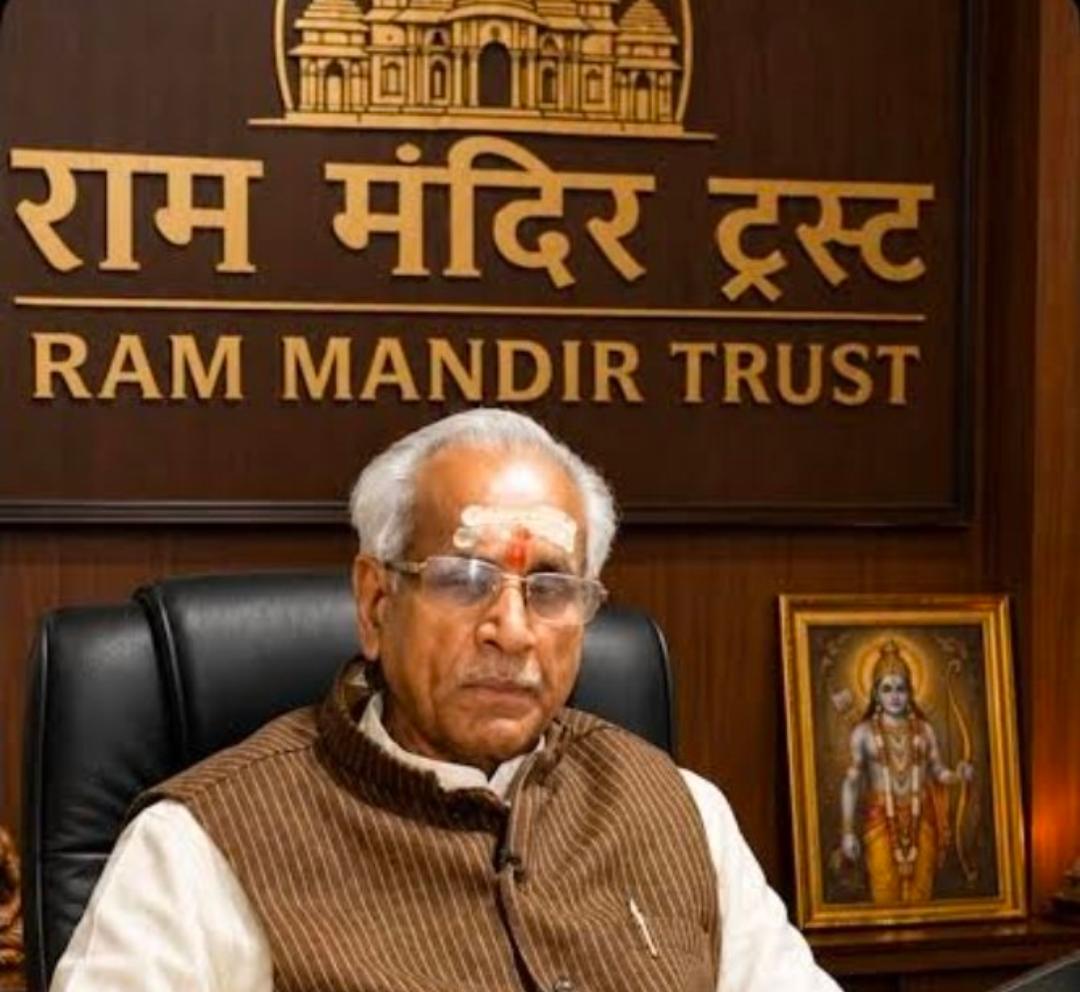
In a significant development that has sent ripples across India’s religious and political landscape, Champat Rai has resigned as the General Secretary of the Shri Ram Janmabhoomi Teerth Kshetra Trust following the emergence of an investigation into alleged irregularities involving donations received at the Ram Temple in Ayodhya. His resignation comes in the wake of an FIR and the arrest of eight individuals allegedly connected to the theft and misappropriation of devotees’ contributions.
Although Champat Rai has not been named as an accused in the investigation, his decision to step down has been widely viewed as an attempt to uphold institutional credibility and allow investigators to conduct an independent inquiry without questions over administrative influence. The resignation also coincides with that of trustee Anil Mishra, marking one of the most consequential administrative changes since the trust was constituted in 2020.
“From RSS Pracharak to Ram Temple Administrator”
Born in 1946 in Bijnor, Uttar Pradesh, Champat Rai’s public life spans several decades of organisational and social work. After beginning his career as a chemistry lecturer, he dedicated himself to full-time service as an RSS pracharak before moving into the Vishva Hindu Parishad (VHP), where he eventually became one of its senior leaders.
His association with the Ram Janmabhoomi movement made him one of the most recognizable organisational figures behind the scenes known for his extensive documentation and involvement in the legal and administrative aspects of the temple movement, Rai played an important role throughout the prolonged court proceedings that ultimately culminated in the Supreme Court’s 2019 verdict paving the way for the construction of the Ram Temple.
Following the verdict, the Union government constituted the Shri Ram Janmabhoomi Teerth Kshetra Trust, appointing Rai as its General Secretary. In that capacity, he oversaw several key aspects of the temple’s administration, including coordination of construction activities, financial management, and donor relations during one of India’s largest public funded religious projects.
The Donation Dispute and the Investigation
The controversy surfaced after allegations emerged that cash and valuables donated by devotees had been siphoned off during collection and counting operations. Responding to concerns, the trust itself requested an investigation, prompting the Uttar Pradesh government to constitute a Special Investigation Team (SIT).
The SIT’s preliminary findings reportedly led to the registration of an FIR under relevant provisions of the Bharatiya Nyaya Sanhita dealing with theft and criminal breach of trust. Subsequently, eight individuals associated with the donation handling process were arrested. Among them was Ram Shankar Yadav, who had previously served as Champat Rai’s driver before taking up responsibilities within the temple administration.
Importantly, investigators have not publicly accused Rai of direct involvement in the alleged financial irregularities. Nevertheless, as the senior-most executive overseeing the institution’s daily operations, questions regarding administrative oversight inevitably intensified.
Resignation Reflects Institutional Responsibility
In his resignation letter addressed to Trust Chairman Mahant Nritya Gopal Das, Rai reportedly maintained his innocence while stating that stepping aside was necessary to safeguard the sanctity of the Ram Temple and ensure a fair, impartial, and transparent investigation.
Such a move carries considerable symbolic importance. In high-profile institutions where public faith is deeply intertwined with governance, leadership accountability often extends beyond personal legal culpability. By relinquishing his post voluntarily, Rai has attempted to separate the ongoing investigation from the functioning of the trust, allowing authorities to proceed without allegations of interference.
His resignation may also help preserve public confidence in the investigative process at a time when the matter has attracted intense political scrutiny.
Political Reactions Intensify
Predictably, the development has generated sharp political responses. Opposition parties have demanded a comprehensive inquiry into the trust’s financial management and have called for structural reforms to strengthen accountability mechanisms.
On the other hand, senior leaders associated with the temple movement have defended Rai’s integrity, highlighting his decades of organisational service and asserting that individual misconduct, if established, should not overshadow the broader institution or the temple project itself.
The Uttar Pradesh government has reiterated its commitment to a thorough investigation, emphasising that the law will take its course irrespective of an individual’s position. Authorities have also cautioned against politicising the matter before the investigation reaches its conclusion.
“The Positive Outcomes of a Difficult Episode”
While the allegations have undoubtedly cast a shadow over one of India’s most revered religious institutions, the unfolding developments also present several constructive outcomes.
First, the trust’s decision to seek an investigation demonstrates an institutional willingness to address allegations rather than ignore them. Such proactive action strengthens public confidence in governance.
Second, the swift registration of an FIR and subsequent arrests indicate that investigative agencies are treating financial accountability within religious institutions with seriousness. This reinforces the principle that transparency must apply uniformly across all public institutions.
Third, Champat Rai’s resignation, despite not being named as an accused, reflects a broader culture of moral responsibility in public administration. Whether viewed as symbolic or practical, such decisions help protect institutional credibility while investigations continue.
Finally, the controversy may encourage the adoption of stronger financial safeguards, including improved auditing systems, enhanced surveillance of donation-counting procedures, greater digitisation of donations, and more frequent independent audits. These reforms could ultimately strengthen the governance framework of the Ram Temple Trust and serve as a model for other major religious institutions across the country.
Looking Ahead
The Ram Temple remains a symbol of immense religious significance for millions of devotees. As investigations continue, the focus will remain on establishing facts through due legal process rather than speculation.
For Champat Rai, whose public life has been closely associated with the Ram Janmabhoomi movement for decades, this marks perhaps the most challenging chapter of his career. Whether his resignation ultimately comes to be seen as an act of accountability or merely a temporary administrative measure will depend on the findings of the ongoing investigation.
For the trust, however, the episode presents an opportunity to emerge stronger through greater transparency, improved governance, and renewed public confidence. If meaningful reforms follow, this difficult period may ultimately reinforce rather than weaken the institution entrusted with managing one of India’s most significant religious landmarks.
Yeh article aapko kaisa laga?