
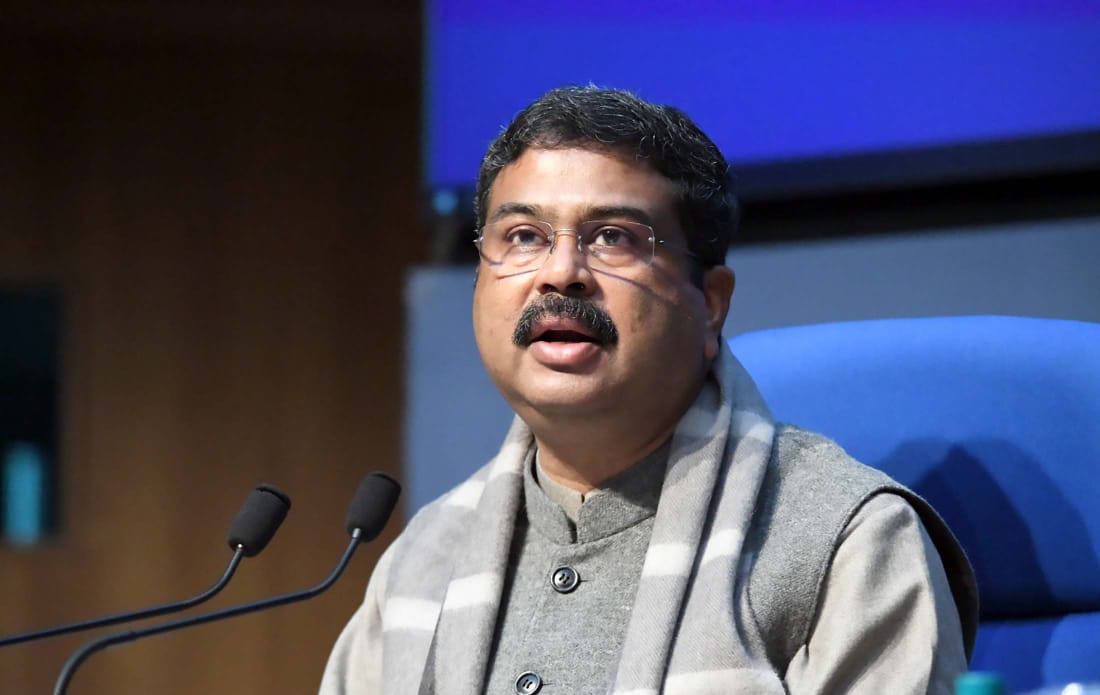
Image credit: The Union Minister for Petroleum & Natural Gas and Steel, Shri Dharmendra Pradhan holding a press conference on Cabinet Decisions, in New Delhi on December 30, 2020.
Introduction
In a rare political development, Union Education Minister Dharmendra Pradhan resigned after the Union government accepted the key demands raised by the Cockroach Janata Party (CJP) following weeks of nationwide student-led protests over alleged examination irregularities.
The protests, which began as a demand for accountability in India’s competitive examination system, soon transformed into one of the most significant youth-led movements witnessed since the 2024 General Elections. With the government conceding to several demands and appointing senior BJP leader Pralhad Joshi as the new Education Minister, the episode has become a landmark moment in India’s democratic and political landscape.
More importantly, it has reopened debates on ministerial accountability, public trust in institutions, and the power of peaceful democratic mobilisation.
How the Movement Gathered Momentum
The protests originated over allegations of irregularities in major national examinations. Students and activists argued that repeated controversies surrounding recruitment and entrance examinations had seriously undermined confidence in India’s education system.
The movement, spearheaded by the Cockroach Janata Party (CJP), demanded structural reforms rather than temporary administrative measures. Among its principal demands were comprehensive examination reforms, compensation for affected students, withdrawal of cases registered against protesters, and greater institutional accountability.
Social media played a decisive role in expanding the movement beyond university campuses. Thousands of students, educators, and civil society groups joined demonstrations across multiple cities, transforming what initially appeared to be an education-related issue into a broader campaign for transparency and governance reforms.
Government Accepts Demands, Education Minister Steps Down
Following fresh rounds of negotiations, the Union government accepted the major demands raised by the protesters.
Soon afterwards, Dharmendra Pradhan submitted his resignation, which was accepted by the President under Article 75(2) of the Constitution, acting on the advice of the Prime Minister.
The government simultaneously appointed Pralhad Joshi to take charge of the Ministry of Education in addition to his existing ministerial responsibilities.
The swift transition indicates the government’s attempt to restore confidence in the education sector while ensuring administrative continuity. However, the resignation itself has become the defining political event of the episode.
Why the Resignation Matters
Ministerial resignations are relatively uncommon in Indian politics, particularly in response to sustained public protests.
In parliamentary democracies, resignation symbolises the principle of ministerial responsibility, under which a minister assumes political accountability for the functioning of the department, even without direct personal culpability.
For this reason, Dharmendra Pradhan’s resignation carries significance beyond the Education Ministry. It signals that public pressure when organised, sustained, and peaceful can still influence executive decision-making.
The development also reflects the increasing political weight of India’s youth, whose concerns over examinations directly affect education, employment, and social mobility.
A Test of Democratic Accountability
The movement has been viewed by many as a demonstration of democracy functioning through constitutional means.
Rather than resorting to violence, protesters relied on peaceful demonstrations, public campaigns, and negotiations to press for institutional reforms. Their success suggests that democratic participation remains capable of influencing governance when supported by sustained public engagement.
At the same time, the episode raises important questions about governance.
Should governments wait for nationwide protests before addressing institutional failures? Or should accountability mechanisms be strengthened sufficiently to prevent such crises from emerging?
These questions are likely to shape future discussions on public administration and policy reform.
The Road Ahead for the Education Ministry
The appointment of Pralhad Joshi now places considerable responsibility upon the Ministry of Education.
Restoring public confidence will require more than a change in leadership. Long-term reforms must focus on strengthening examination security, improving transparency, modernising digital systems, ensuring institutional accountability, and rebuilding trust among millions of students.
Without structural reforms, leadership changes alone are unlikely to resolve the concerns that triggered the protests.
Political Repercussions: A Shift in BJP’s Accountability Narrative?
Perhaps the most politically significant aspect of this episode lies in its broader implications for ministerial accountability.
In previous years, senior BJP leader and Defence Minister Rajnath Singh had publicly remarked that “resignation is not the culture of the BJP,” emphasising corrective governance over symbolic exits.
Against that backdrop, the resignation of a sitting Union Cabinet Minister represents a notable departure from that narrative.
It suggests that political accountability may increasingly be shaped not only by parliamentary opposition but also by organised public opinion and sustained civic mobilisation.
The episode also demonstrates the growing influence of digitally connected youth movements. Social media has evolved beyond being merely a communication platform; it is now capable of organising nationwide campaigns that place direct pressure on policymakers.
Whether this becomes a lasting shift or remains an exceptional case will depend upon how future governments respond to public demands for institutional accountability.
Yeh article aapko kaisa laga?