
Image credit: MarioNawfal / X
Education Is More Than an Exam
For millions of young people in India, education is not just about getting good marks. It is a hope for a better future. Every year, students spend months and even years preparing for competitive examinations like the National Eligibility-cum-Entrance Test (NEET), believing that hard work alone can change their lives. Many families invest their savings, time, and emotions in this dream.
That is why repeated reports of examination paper leaks have created deep disappointment across the country. The issue is no longer limited to one examination or one group of students. It has become a question of trust in the country’s education system and the institutions responsible for conducting these examinations.
“Why Students Are Protesting ?”
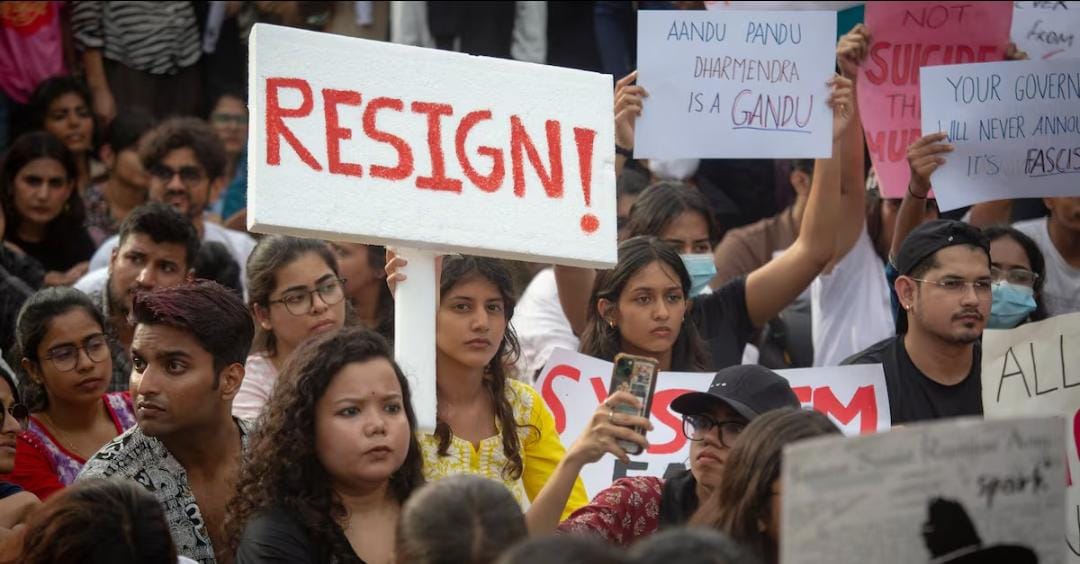
The recent protests over the alleged NEET paper leak have brought thousands of students and parents together. Many believe that if question papers are leaked before an examination, honest students are placed at an unfair disadvantage. Those who spend years preparing sincerely may lose opportunities because of the actions of a few people involved in cheating and corruption.
Students argue that competitive examinations should reward talent, discipline, and hard work. When paper leaks occur, they feel that the value of their efforts is reduced. This has created frustration and anger among many aspirants who now demand greater transparency and accountability from examination authorities.
The uniqueness of the present movement is that it represents one of the strongest aspirations of modern India the belief that education is the most reliable path to social and economic progress. When this belief is shaken, the impact goes far beyond a single examination.
A Battle of Trust
Every major public protest eventually becomes a battle over public confidence. The NEET controversy has reached that stage.
Students are not only asking whether a paper was leaked. They are asking whether they can continue to trust the system that decides their future. Parents are also worried because they see education as the foundation of their children’s careers.
Trust is difficult to build but easy to lose. Even if only a small number of people are involved in malpractice, repeated incidents create doubts about the fairness of the entire examination process. For students who prepare honestly, these doubts can be emotionally exhausting.
“Government Responds”
Amid growing public concern, Prime Minister Narendra Modi addressed students and their families, assuring them that the government is committed to protecting the integrity of competitive examinations.
He announced that the government would introduce a strict law to deal with examination paper leaks. The proposed legal framework aims to impose severe punishment on those involved in leaking question papers or manipulating examination processes.
The Prime Minister also announced the establishment of fast-track courts to ensure that such cases are investigated and decided quickly. The objective is to prevent long delays in delivering justice and to send a strong message that those responsible for cheating will face strict legal consequences.
The government believes that stronger laws and faster judicial action can help restore confidence in the examination system.
The Bigger Challenge ;
However, experts believe that strict punishment alone may not completely solve the problem. Paper leaks often involve organised networks that exploit weaknesses in the examination process.
To prevent future incidents, authorities may need to strengthen security at every stage from preparing question papers and transporting them safely to conducting examinations under strict supervision. The use of advanced technology, better monitoring systems, stronger digital security, and regular audits can also reduce the chances of malpractice.
Transparency during investigations is equally important. Students expect clear communication from authorities whenever allegations arise. Prompt action and honest updates can help reduce confusion and restore public confidence.
Why Institutional Integrity Matters ?
Competitive examinations are among the most important public institutions in India. They decide admissions to medical colleges, engineering institutes, universities, and many government jobs. Their credibility directly affects the future of millions of students every year.
If students begin to believe that success depends more on unfair practices than on merit, confidence in public institutions may gradually decline. Such a situation can discourage hardworking students and weaken faith in equal opportunity.
Institutional integrity means ensuring that every candidate competes under the same rules and receives a fair chance. Protecting this principle is essential for maintaining public trust.
The Road Ahead
The NEET controversy has reminded the country that examination reforms are not only about preventing paper leaks. They are about protecting the dreams of millions of young people who believe that education can transform their lives.
Strong laws, effective investigations, secure examination systems, and transparent administration must work together to ensure fairness. Students should never feel that their future depends on anything other than their own dedication and ability.
The current protests are therefore about much more than one examination. They reflect a larger demand for honesty, accountability, and institutional integrity. Restoring trust will require consistent action, not just promises. Only then can India’s competitive examination system continue to inspire confidence and remain a genuine gateway to opportunity for every deserving student.
Yeh article aapko kaisa laga?