
Image credit: Cockroach Janta Party/Facebook
Introduction
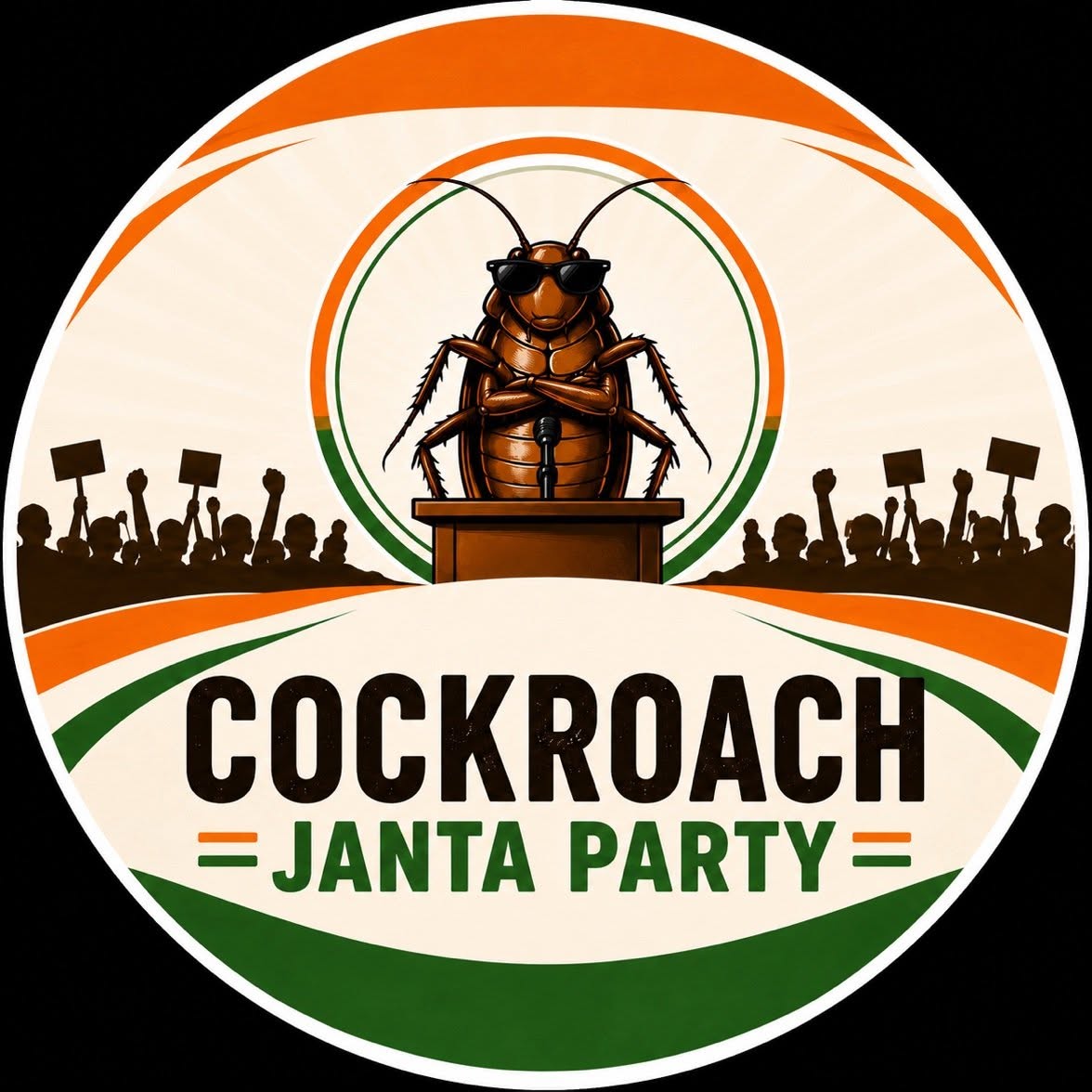
Indian politics has traditionally been shaped through rallies, party cadres, door-to-door campaigns, and grassroots mobilization. However, the rapid expansion of social media has given rise to a new political phenomenon digital-native political party. Groups such as the Cockroach Janta Party (CJP), Digital Political Party (DPP), and National Parasitic Front (NPF) have emerged primarily through online platforms, attracting millions of followers within weeks.
At first glance, these formations appear to be internet jokes or meme communities. Yet their popularity reflects something much deeper: growing frustration among India’s youth regarding unemployment, examination scandals, inflation, political alienation, and declining trust in traditional institutions. Their rise raises an important constitutional and democratic question can digital communities evolve into meaningful political actors, or are they merely temporary expressions of online discontent?
Why Are Digital Political Parties Rising?
The emergence of digital-native political parties is closely linked to India’s demographic reality. With one of the world’s largest youth populations, India has millions of young citizens who are politically aware but increasingly dissatisfied with conventional political structures. Many feel that mainstream parties engage with them only during elections while failing to address concerns such as employment, education quality, and economic uncertainty.
Social media has provided an alternative space for political expression. Unlike traditional parties that require extensive funding and organizational networks, digital movements can be launched with minimal resources. A single viral post, meme, or hashtag can reach millions within hours. Consequently, political participation is no longer confined to party offices or public rallies; it now takes place on Instagram, X, Discord, Telegram, and YouTube.
The success of these movements also reflects a growing distrust of established political actors. By using satire and humour, digital parties communicate criticism in a format that is relatable, shareable, and less intimidating than conventional political discourse.
How Do These Movements Operate?
Unlike traditional political parties, digital-native movements function primarily as online communities. Their organizational model revolves around content creation, social media engagement, and digital participation.
Membership is often acquired through online forms, social media campaigns, or community platforms. Their manifestos combine humour with genuine policy concerns. For instance, alongside satirical promises, many of these groups advocate electoral reforms, greater accountability, transparency, and stricter standards for public representatives.
Their communication strategy relies heavily on memes, short-form videos, and viral campaigns. This allows them to convert political frustration into collective identity. Followers do not merely consume content; they participate in creating and spreading it, making political engagement interactive rather than passive.
Technology has further lowered the barriers to entry. Artificial intelligence, graphic design tools, and automated content systems enable small groups to achieve levels of visibility that previously required significant financial and organizational resources.
The Challenge of Offline Politics
Despite their online popularity, digital-native parties face significant obstacles when entering the offline political sphere.
Indian electoral politics remains heavily dependent on grassroots organization. Winning elections requires local leadership, booth-level workers, fundraising networks, voter outreach mechanisms, and long-term community engagement. Online followers do not automatically translate into votes.
The experience of several emerging political formations demonstrates this challenge. While digital visibility can generate attention, electoral success depends upon sustained organizational capacity. Most digital parties currently lack district-level structures, trained volunteers, and institutional mechanisms necessary for contesting elections.
Furthermore, many of these movements continue to define themselves as platforms or satirical campaigns rather than formal political parties. This ambiguity attracts supporters but limits their ability to evolve into serious electoral alternatives.
As a result, their current influence is largely discursive rather than electoral. They shape conversations, highlight neglected issues, and pressure mainstream parties to respond, but they have not yet demonstrated an ability to convert online support into electoral power.
Democratic Potential and Risks
The rise of digital-native parties presents both opportunities and dangers for Indian democracy.
On the positive side, these movements have successfully engaged a generation often portrayed as politically apathetic. They encourage discussion on governance, accountability, employment, and public policy. By lowering participation barriers, they allow citizens who might never attend a political rally to become involved in political conversations.
However, their dependence on social media creates significant vulnerabilities. Digital platforms prioritize engagement rather than deliberation, which may encourage sensationalism over substantive policy debate. Movements built on viral content can disappear as quickly as they emerge.
There are also concerns regarding misinformation, regulatory intervention, platform censorship, and the absence of transparent funding structures. Since most of these groups operate outside traditional political frameworks, questions regarding accountability and governance remain unresolved.
Most importantly, there is a risk of confusing online popularity with political legitimacy. Democratic change requires organization, institution-building, policy development, and sustained public engagement tasks that cannot be accomplished solely through hashtags and memes.
The Way Forward
Digital-native political parties should not be dismissed as internet trends. Their popularity reflects genuine social and political anxieties among India’s youth. Nevertheless, long-term relevance will require a transition from digital activism to institutional engagement.
If these movements seek lasting influence, they must develop coherent policy platforms, establish local organizational networks, and engage with citizens beyond social media. Equally, democratic institutions should recognize that political participation is increasingly occurring online and adapt accordingly.
The future of these movements will depend on whether they remain viral communities or evolve into participatory political organizations. Their success will ultimately be measured not by follower counts but by their ability to translate public frustration into meaningful democratic action.
Conclusion
The rise of digital-native political parties marks a significant shift in the nature of political participation in India. They represent the intersection of youth discontent, technological innovation, and evolving democratic engagement. While their electoral relevance remains uncertain, their emergence signals that a new generation is seeking alternative ways to engage with politics.
Whether these movements become serious political actors or fade as temporary internet phenomena, they have already achieved one important objective: they have forced Indian democracy to acknowledge the political voice of the digital generation.
Yeh article aapko kaisa laga?