Image credit: my life by X
New Delhi | July 15, 2026
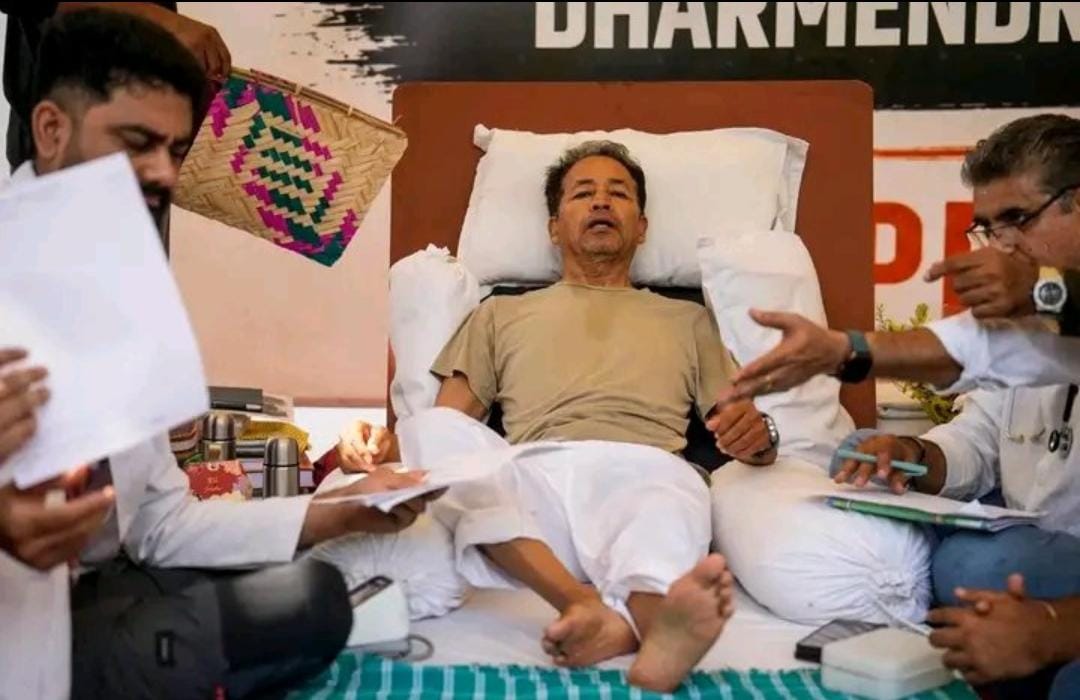
Social activist and education reform campaigner Sonam Wangchuk completed the 18th day of his indefinite hunger strike on Wednesday, with doctors warning that his health has become increasingly fragile. As concerns over his condition continue to grow, supporters and several opposition leaders have intensified their demand for the Central government to begin a dialogue with the activist and address the issues raised by the protesters.
According to the latest medical bulletin released by the Cockroach Janta Party (CJP), Wangchuk remains under 24hour medical supervision. Doctors stated that although he is conscious and mentally alert, his physical condition has weakened significantly. His weight has dropped to 57.15 kilograms, reflecting a loss of nearly 8.9 kilograms since the hunger strike began. In the last 24 hours alone, he lost another 400 grams. His blood pressure was recorded at 105/76 mmHg, blood sugar at 80 mg/dL, oxygen saturation at 97 percent, while hydration levels were described as fair.
Medical experts monitoring him have advised continuous observation, warning that prolonged fasting can cause serious complications even when vital signs appear relatively stable.
“Government Silence Draws Sharp Criticism”
The continuing silence from the Central government has become one of the biggest talking points surrounding the protest. CJP founder Abhijeet Dipke accused the government of ignoring a peaceful democratic movement and questioned why there had been no official dialogue despite Wangchuk’s deteriorating health.
In a social media post, Dipke said the activist had chosen to risk his life to seek justice for students affected by repeated examination failures and alleged paper leaks. He argued that instead of debating political reactions or opposition support, attention should remain focused on the government’s responsibility to respond to the protesters’ demands.
Dipke also questioned why Prime Minister Narendra Modi had not initiated talks with Wangchuk and why Union Education Minister Dharmendra Pradhan had not been held accountable over the examination related concerns raised during the protest.
Protest Focuses on Education Reforms
Although Wangchuk has been associated with several public campaigns over the years, the current hunger strike centres primarily on education reforms. Protesters are demanding a transparent examination system, stricter measures against recurring paper leaks, greater accountability within educational institutions, and the resignation of the Union Education Minister.
The movement reflects growing frustration among students and parents over repeated controversies involving competitive examinations in recent years. Many candidates have argued that paper leaks and irregularities undermine years of hard work and weaken public trust in recruitment and admission processes.
To expand public participation, the CJP has announced a one day mass hunger strike on July 16 at Jantar Mantar. The organisation has also called for a “Chalo Sansad” march on July 20, urging citizens from across the country to join the demonstration in support of examination reforms. According to the organisation, more than 1.3 lakh people have already registered support through its missed-call campaign.
“Wider Political and Public Support”
Support for Wangchuk has steadily grown beyond activist circles. On Tuesday, leaders from several opposition parties including Mamata Banerjee, Akhilesh Yadav, Uddhav Thackeray, and Arvind Kejriwal appealed to him to end his fast while simultaneously urging the government to open negotiations.
Veteran actor Zeenat Aman also requested the Centre to begin constructive discussions with the activist. Former Gujarat Chief Minister Shankersinh Vaghela visited the protest site to express solidarity, while actor Swara Bhaskar joined the demonstration. Congress MP Shashi Tharoor also extended his support to the movement.
Meanwhile, members of the All India Students’ Association (AISA) Neha, Manish, and Aameen continued their own hunger strike despite reports of declining health. A delegation of prominent academics, including Nivedita Menon, Aditya Nigam, Anuradha Chenoy, and Radha Kumar, visited the student protesters to express solidarity.
A Test for Democratic Engagement
The ongoing protest has evolved into more than an individual hunger strike. It has become a wider debate on the government’s responsiveness to peaceful democratic protests and the need for institutional reforms in India’s education system.
While governments are not obliged to accept every demand made by protesters, democratic governance depends on meaningful communication, especially when public concerns involve education, employment, and the future of young people. Dialogue often helps reduce tensions and creates opportunities for negotiated solutions before situations become more serious.
As Sonam Wangchuk enters the nineteenth day of his fast, the coming days are likely to be crucial. With his health steadily declining and nationwide support continuing to expand, pressure is mounting on the government to decide whether it will remain silent or initiate talks to address the growing concerns surrounding India’s examination system and educational accountability.
Yeh article aapko kaisa laga?