
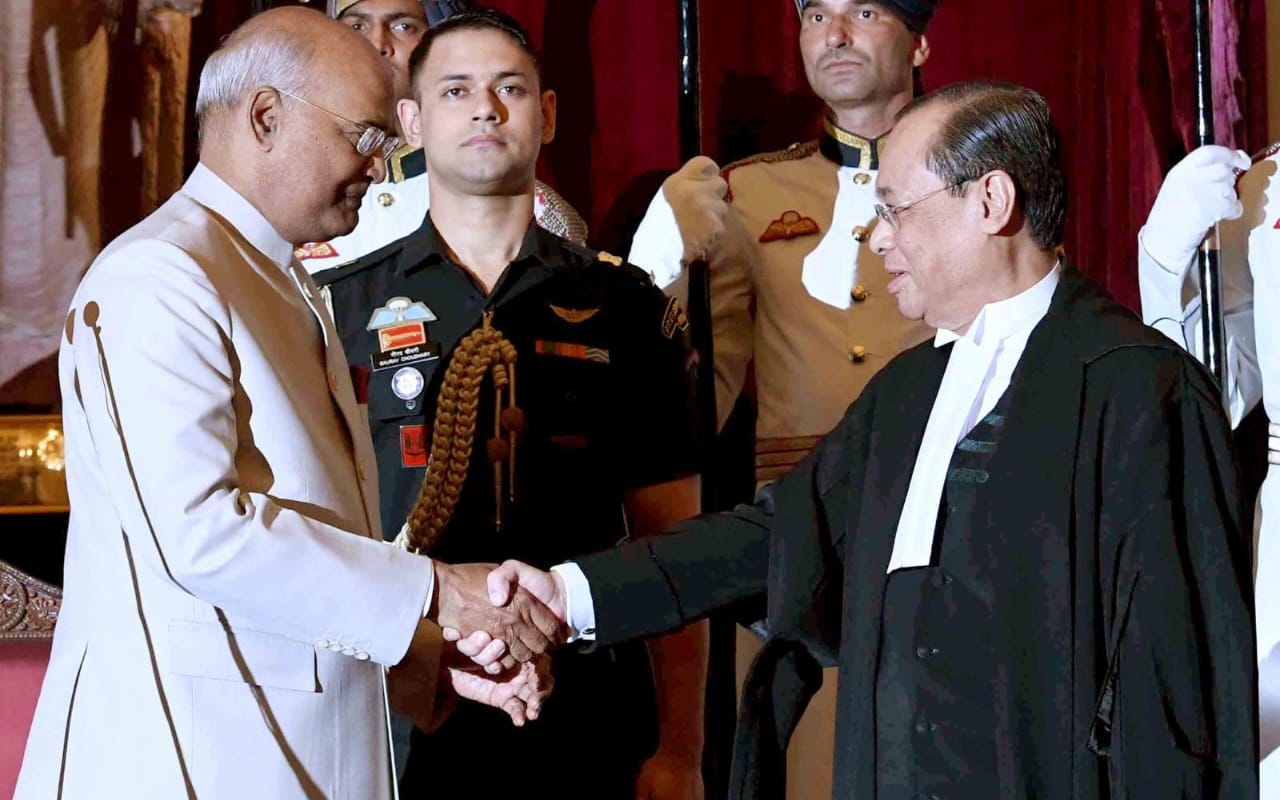
Photo: The President, Shri Ram Nath Kovind greets the 46th Chief Justice of India, Shri Justice Ranjan Gogoi, after administering the oath of office to him, President’s Secretariat, GODL-India.
As former Chief Justice Ranjan Gogoi publicly stated in 2021: “The judiciary is ramshackled… going to court is useless.” Here is how the Indian judicial process itself has become the ultimate punishment, and the specific structural failures driving it.
When a 24-year-old law student hurls case files at a Supreme Court bench, repeatedly calling the judges “judicial servants”, as happened in Courtroom No. 13 on July 10, 2026 the legal establishment immediately decries the loss of decorum. The student, Prabal Pratap, was promptly arrested and remanded to 14 days in judicial custody.
On paper, this is a clear cut case of contempt. But if we interpret this event contextually, these outbursts are not isolated acts of madness; they are the distress signals of a public suffocating under procedural tyranny. The social contract dictates that citizens surrender their right to settle disputes personally, trusting the State to resolve them fairly. But in India, fighting a legal battle means forfeiting your youth and your life savings.
Why is there a 50-Million Case Backlog?
The standard defense for judicial delay is a mathematical one: India simply does not have enough judges. The 245th Law Commission Report in 2014 recommended a baseline of 50 judges per million citizens. Today, India operates with just 21 per million.
Blaming the backlog strictly on a “judge shortage” is an institutional smokescreen that hides the biggest culprit in the room: the State itself. According to 48th Chief Justice of India N.V. Ramana remarks and even established by the Union Ministry of Law and Justice and data tracked by the government’s own Legal Information Management & Briefing System (LIMBS), the Government is responsible for nearly 50% of all pending litigation in India.
While general estimates place the government’s share of national litigation at 50%, the reality at the highest court is far worse. Legal scholars Aparna Chandra, Sital Kalantry, and William H. J. Hubbard demonstrate in their recent book, Court on Trial, that a staggering 73% of all the appeal are filed by the accepted by the Supreme Court of India involve the government as a litigant.
This massive volume of government litigation is not driven by the pursuit of justice, but by bureaucratic cowardice. In the Indian administrative framework, civil servants operate under the constant shadow of the Central Vigilance Commission (CVC), the Comptroller and Auditor General (CAG) audits, and the Prevention of Corruption Act. If a department head uses their discretion to approve a citizen’s legitimate claim, whether it is a contractor’s delayed payment, a tax refund, or a retired clerk’s pension recalculation, they risk being flagged by an audit for causing a “loss to the exchequer” or facing a vigilance probe for alleged favoritism.
Bureaucrat defaults to the safest career option: rejecting the claim and forcing the citizen to sue. The bureaucracy has effectively outsourced its decision-making to the courts. When the citizen inevitably wins in a lower court, the department does not concede. Instead, it mechanically files appeals up to the High Court and Supreme Court using limitless taxpayer funds.
Supreme Court itself has repeatedly fined government departments for this behavior, noting the absurdity of the State spending ₹1 lakh in public money on litigation fees just to contest a ₹10,000 payout to a low-level employee. The State has weaponized the judiciary, using the courts as an expensive shield to avoid doing its own administrative job, while bleeding the private citizen dry in the process.
Government’s Deflection: Digitizing the Mess is Not Fixing It
When confronted with their role in choking the justice system, the government’s official response is staggering deflection. In a December 2025 press release information given by the Ministry of Law and Justice, and Ministry of Parliamentary affairs regarding the “Speedy Disposal of Court Cases,” explicitly washed its hands of the crisis, declaring on parliamentary record: “The disposal of cases is within the exclusive domain of the judiciary”.
To justify its stance, the Ministry proudly pointed to the ₹7,210 crore outlay for Phase-III of the eCourts Project, boasting about virtual hearings and the digitization of over 579 crore pages of court records. The government’s official posture is simple: we gave the courts better technology, so the backlog is now their problem.
Why This is a Smokescreen:
The Ministry is technically correct that disposing of cases is the judiciary’s constitutional job. But filing half of those cases is the State’s doing.
Bragging about eCourts and digitization completely ignores the root cause of the pendency. A digitized frivolous government appeal is still a frivolous appeal. Giving the judiciary better computers, video conferencing software, and digital ledgers to process a 50 million case backlog does absolutely nothing to stop the government from pouring millions of new, unnecessary service and tax disputes into the funnel every single year. You cannot fix a flooding house by buying a high-tech mop while refusing to turn off the faucet. Until the government takes statutory accountability for its own compulsion to litigate, these technological upgrades are just a faster, more efficient way to record the system’s total collapse.
Crisis of Undertrial Prisoners: Criminalizing Poverty
A nation’s commitment to liberty is measured by its prisons. According to the National Crime Records Bureau (NCRB), nearly 75% which is nearly 3.9 million of all inmates in India are “undertrials”, legally innocent citizens awaiting the conclusion of their trials.
While Indian jurisprudence preaches that “Bail is the rule, jail is an exception,” the system operates on a financial binary. If a wealthy individual commits a crime (e.g., the 2024 Pune Porsche case), high-priced legal teams secure bail within hours. But over two-thirds of India’s undertrials belong to marginalized and poor communities. They are incarcerated not because they are flight risks, but because they cannot afford the ₹50,000 required for a surety bond.
Furthermore, lower court magistrates are terrified of media backlash and High Court disciplinary action if a suspect flees, frequently adopt a “safe” posture. They mechanically reject bail applications, essentially telling the accused to appeal to the High Court. This bureaucratic shift of responsibility protects the magistrate’s career while destroying the life of the poor.
To understand the horrific extreme of this apathy, one only needs to look at the case of Machal Lalung. Arrested in Assam in 1951 on a minor assault charge, Lalung was transferred to a psychiatric institution and effectively forgotten by the State. He spent 54 years in detention without ever facing trial, finally released in 2005 at the age of 77. While Lalung is an extreme case, he is the chilling embodiment of a system where the process outlasts the punishment.
“Uncle Judges”: Judicial Aristocracy and Collegium
While the lower courts are starved of resources, the Supreme Court and High Courts operate as a protected aristocracy. India remains the only major democracy where judges exclusively appoint other judges through the secret “Collegium” system.
The defense of the Collegium is the necessity of “judicial independence”, insulating courts from political manipulation. However, by completely excluding the executive and the public from the appointment process, accountability was sacrificed. Because there are no open applications, the selection process relies heavily on the internal networks of sitting judges. This birthed the “Uncle Judges” syndrome, where the relatives of senior advocates and former judges are disproportionately elevated.
Because this club is self appointing, it is fiercely self-protecting. The police cannot even file an FIR against a sitting judge without the CJI’s explicit permission. This was glaringly obvious in the early 2025 “cash-at-home” scandal involving High Court Justice Yashwant Varma. The Supreme Court refused to urgently hear a plea seeking an investigation. Instead, deflecting from its own scandals, the Court took suo motu cognizance of a Class 8 NCERT textbook because it contained a chapter discussing “judicial corruption,” decrying it as a “deep rooted conspiracy.” When an institution polices middle school textbooks but shields its own, it loses its moral authority.
Solutions: A Blueprint for Institutional Survival
Digital filing systems and temporary “Lok Adalats” are mere band-aids on a severed artery. If the judiciary is to survive the escalating public frustration, it requires radical, legislative reforms. Here is what actual reform looks like:
Enforcement of the National Litigation Policy (NLP)
The 2010 National Litigation Policy (NLP) promised to stop the government from filing endless, frivolous appeals. But it was a phantom policy. As the Law Ministry officially admitted in a 2021 parliamentary reply, the NLP was never actually implemented.
Because it was merely an advisory draft and not a binding law, government departments ignored it. Instead of stopping unnecessary appeals, the State simply started tracking its massive backlog on the LIMBS (Legal Information Management & Briefing System) portal. Monitoring the mess does not fix it.
To actually clear the courts, the government must pass a revised NLP as a binding statute (a Litigation Act) with three non-negotiable rules:
1. Statutory Financial Caps:
1. Statutory Financial Caps:
Expand the model currently used for tax disputes (where the CBDT bans appeals below a certain monetary limit) to all civil and service matters. If a case’s financial stake falls below the threshold, the law must legally bar the government from appealing. Compliance becomes automatic.
2. “Substantial Question” Mandate:
2. “Substantial Question” Mandate:
Bureaucrats cannot appeal just because they dislike a verdict. The law must require an independent legal committee to certify in writing that the appeal involves a genuine “substantial question of law.”
3. Departmental Penalties:
3. Departmental Penalties:
If a court rules a government appeal is frivolous, the court-imposed fines must be deducted directly from that specific department’s operational budget, not the general taxpayer exchequer.
Enact the All India Judicial Service (AIJS)
First proposed by the 14th Law Commission in 1958, and legally enabled by Article 312 of the Constitution, the AIJS has been stalled for decades because High Courts and State Governments refuse to surrender their control over local judicial appointments.
Currently, lower judiciary recruitment happens state-by-state, resulting in massive delays, chronic vacancies, and highly variable judge quality. The Central Government must push through the AIJS, a national, UPSC-style competitive exam to recruit Judges in Lower Courts. This would create a centralized, highly professional cadre of judges drawn from top national legal talent, standardizing the lower courts and filling the thousands of vacancies that state-level commissions have failed to address.
Dismantle the Secret Collegium
Judges hiring judges is a global anomaly that breeds nepotism.
India must establish an independent National Judicial Appointments Commission (NJAC), but one that balances power properly (unlike the struck down 2014 version). Modeled partially on the UK system, the commission must include judicial representatives, the executive, and independent civil society/legal academics. Vacancies must be publicly advertised, and elevations must be based on a transparent, publicly available scoring matrix of a judge’s past disposal rates, legal acumen, and diversity representation, rather than backroom consensus.
End the “Adjournment Culture”
Lawyers routinely use endless adjournments as a tactic to harass the Opposite parties, dragging cases on for decades. While the Civil Procedure Code (CPC) explicitly limits adjournments to three per case, lower court judges frequently ignore this rule because they are terrified of offend the Bar.
Structural Solution: Madhya Pradesh High Court Model
Forced disposal and financial penalties for delay tactics are not theoretical; they are highly practical, and we know exactly what happens when they are deployed. The Madhya Pradesh High Court (MPHC) set a powerful precedent by launching the “25 Oldest Cases” disposal scheme. The High Court issued strict circulars directing all subordinate district courts to identify and dispose of their 25 oldest pending cases every quarter. If the Judge fails to hit the target the Cases are shift to Next Judge.
To meet these targets, lower court judges finally started enforcing the law: they refused routine adjournments, imposed heavy costs on delaying advocates, and passed ex-parte orders if parties failed to appear.
However, this move by the MPHC was highly opposed by the State Bar Council of Madhya Pradesh, the State Bar Council of Madhya Pradesh called a massive, statewide lawyers’ strike in March 2023 to protest the fast-track disposal scheme, contending that this rigid and time-bound disposal scheme will compromise the quality of justice. The High Court, however, stood its ground, initiating contempt proceedings against the striking lawyers, forcing the Bar Council to eventually issue an unconditional apology in late 2024 to have the contempt charges dropped and the High Court continued to enforce variants of this strategy aligning with the National Action Plan for Arrears Reduction.
To scale this success nationally, the Supreme Court must issue a binding directive adopting the MPHC’s aggressive posture. Any adjournment requested beyond the statutory CPC limit must trigger an automatic, non-negotiable financial penalty. Crucially, this fine must be payable directly to the opposing litigant to compensate for their lost wages and travel, shifting the financial pain of delay from the victim back to the perpetrator.
Justice delayed is no longer just justice denied; it is a life destroyed. Until these structural reforms are forced through the legislature, the constitutional promise of justice in India remains an illusion, and the courtroom disruptions we see today will become the norm of tomorrow.
Yeh article aapko kaisa laga?