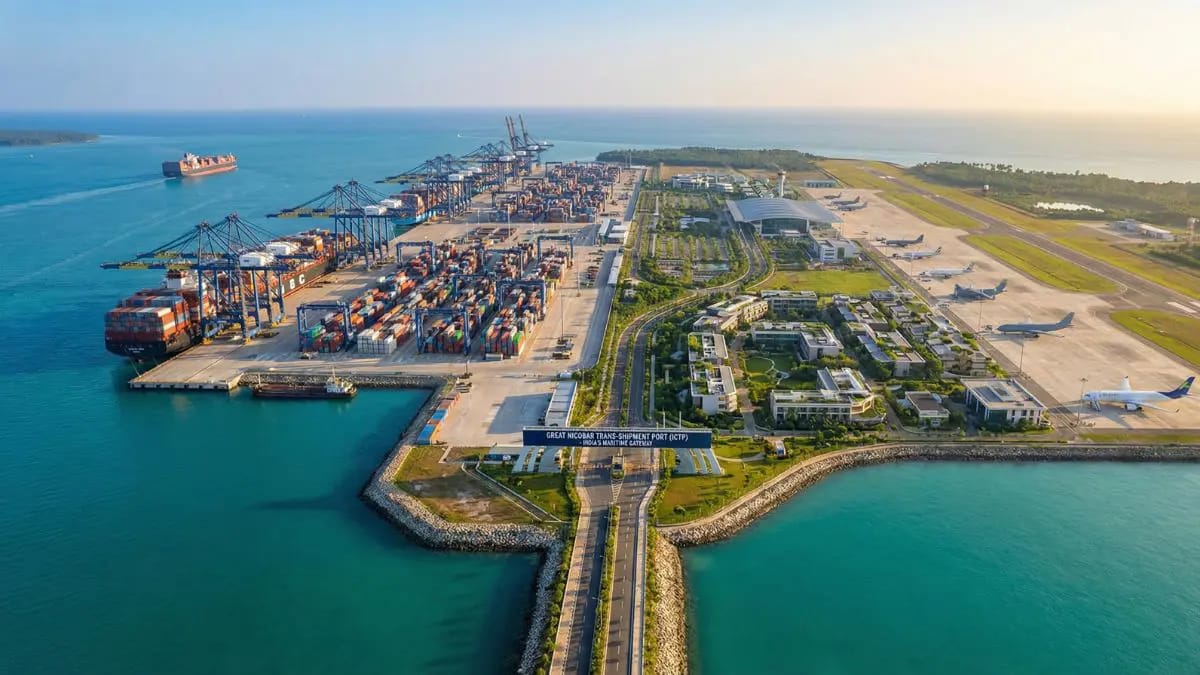
Photo: Great Nicobar Project
Introduction: A Paradise at the Crossroads
Far away from the bustle of mainland India lies Great Nicobar Island, one of the country’s most ecologically rich and culturally unique regions. Home to dense tropical rainforests, endangered wildlife, coral reef ecosystems, and indigenous tribal communities, the island has long remained relatively untouched by large scale industrial development.
Today, however, Great Nicobar stands at the centre of one of India’s most significant environmental debates. The proposed Great Nicobar Infrastructure Project (GNIP), valued at approximately ₹72,000 crore, seeks to transform the island into a major maritime, economic, and strategic hub. Supporters view the project as a crucial step towards strengthening India’s presence in the Indo-Pacific region and enhancing its maritime capabilities. Critics, on the other hand, warn that the project could fundamentally alter an ecosystem that has evolved over thousands of years.
The controversy is therefore not simply about a development project. It is about how a nation balances economic ambition with environmental responsibility.
A Strategic Vision for the Future
The Great Nicobar Infrastructure Project is designed as a multi-component development initiative comprising an international container transshipment terminal, a greenfield airport, a power generation facility, and an integrated township.
Government planners argue that the island’s proximity to the Malacca Strait, one of the world’s busiest shipping corridors gives India a unique strategic advantage. A modern transshipment hub could reduce dependence on foreign ports, strengthen maritime trade, create employment opportunities, and reinforce India’s geopolitical influence in the Indian Ocean region.
From a national security perspective, the project is also viewed as an opportunity to improve logistical capabilities in a strategically sensitive area. Policymakers have therefore presented the project not merely as an economic venture, but as a long-term investment in India’s maritime future.
Yet while the strategic rationale may be compelling, the ecological realities of the island present a far more complex challenge.
The Environmental Cost of Large-Scale Development
The primary concern raised by environmental experts relates to the scale of ecological transformation that the project demands.
Large portions of pristine tropical rainforest are proposed to be diverted for infrastructure development. These forests are not ordinary stretches of vegetation; they form part of a globally significant biosphere reserve that supports numerous endemic and endangered species. Environmental groups have warned that the diversion of thousands of hectares of forest land and the felling of a vast number of trees could permanently alter the island’s ecological character.
Equally concerning are the potential impacts on marine ecosystems. The proposed port development at Galathea Bay requires dredging and extensive coastal modification. Scientists fear that such activities could damage fragile coral reef systems that support marine biodiversity and act as natural barriers against coastal erosion.
Particular attention has been drawn to the Giant Leatherback Sea Turtle, one of the world’s largest marine turtles, which uses the beaches of Great Nicobar as an important nesting ground. Conservationists argue that increased human activity, artificial lighting, industrial operations, and habitat disruption may adversely affect the species’ breeding patterns.
The environmental concerns extend beyond biodiversity alone. Forests and coral ecosystems serve as natural carbon sinks and climate regulators. Their destruction could undermine broader climate resilience efforts at a time when environmental sustainability is becoming increasingly critical.
Tribal Communities and the Question of Consent
The Great Nicobar debate is also a debate about people.
The island is home to the Shompen community, classified as a Particularly Vulnerable Tribal Group (PVTG), as well as the Nicobarese people. For generations, these communities have maintained a close relationship with the forests and natural resources of the island.
Activists and tribal rights advocates have raised concerns that the project could adversely affect traditional habitats and customary ways of life. Questions have also been raised regarding compliance with legal protections available under the Forest Rights Act, 2006, and other safeguards designed to protect indigenous communities.
At the centre of the controversy lies the issue of informed consent. Critics argue that communities likely to be affected by the project must have a meaningful role in decision-making processes rather than merely being informed of decisions already taken.
The debate therefore goes beyond environmental conservation and enters the realm of constitutional governance, participatory democracy, and social justice.
Can Development and Conservation Coexist?
The Great Nicobar controversy illustrates a challenge that India is increasingly confronting across multiple sectors: how to pursue economic growth without compromising ecological sustainability.
Supporters of the project argue that modern engineering and environmental safeguards can mitigate many of the concerns being raised. They contend that strategic infrastructure is essential for national progress and that development cannot be indefinitely delayed because of environmental objections.
Critics respond that certain ecosystems are simply too fragile and too valuable to absorb large-scale industrial intervention. They advocate alternative development models centred on ecological conservation, scientific research, sustainable tourism, and low-impact economic activities that preserve rather than transform the island’s natural character.
The debate is therefore not a choice between development and stagnation. Rather, it is a disagreement over the form that development should take and the limits that environmental realities impose upon economic ambition.
Conclusion: A Defining Test for Sustainable Development
The Great Nicobar Project has emerged as one of the most significant environmental governance debates in contemporary India. It forces policymakers, environmentalists, and citizens alike to confront difficult questions about progress, sustainability, and responsibility.
Infrastructure can be built elsewhere. Economic opportunities can be recreated. Ancient forests, coral ecosystems, and indigenous cultures, however, cannot be easily restored once lost.
As India seeks to strengthen its maritime position and expand its economic horizons, the challenge will be to ensure that development does not come at the cost of irreplaceable ecological heritage. The future of Great Nicobar may ultimately become a test of whether India can successfully reconcile strategic aspirations with environmental stewardship in the twenty-first century.
Yeh article aapko kaisa laga?