

Photo: Pavel Durov, TechCrunch, CC BY 2.0
On June 16, 2026, the Ministry of Electronics and Information Technology (MeitY) invoked Section 69A of the IT Act to temporarily block Telegram across the entire country. To understand why a democratic nation had to resort to blocking a major utility app used by over 150 million citizens just to protect an administrative exam, we have to look at the dark side of digital privacy.
NEET Paper leak Row
Following the cancellation of the initial NEET-UG exams due to actual paper leak allegations, the National Testing Agency (NTA) scheduled a massive re-test for June 21, 2026. Sensing the desperation of over 22 lakh students, cyber-fraudsters went to work on Telegram. Groups with names like “PAPER LEAKED NEET,” “Re-NEET 2026,” and “Private Mafia” began demanding lakhs of rupees for “advance access” to the new paper.
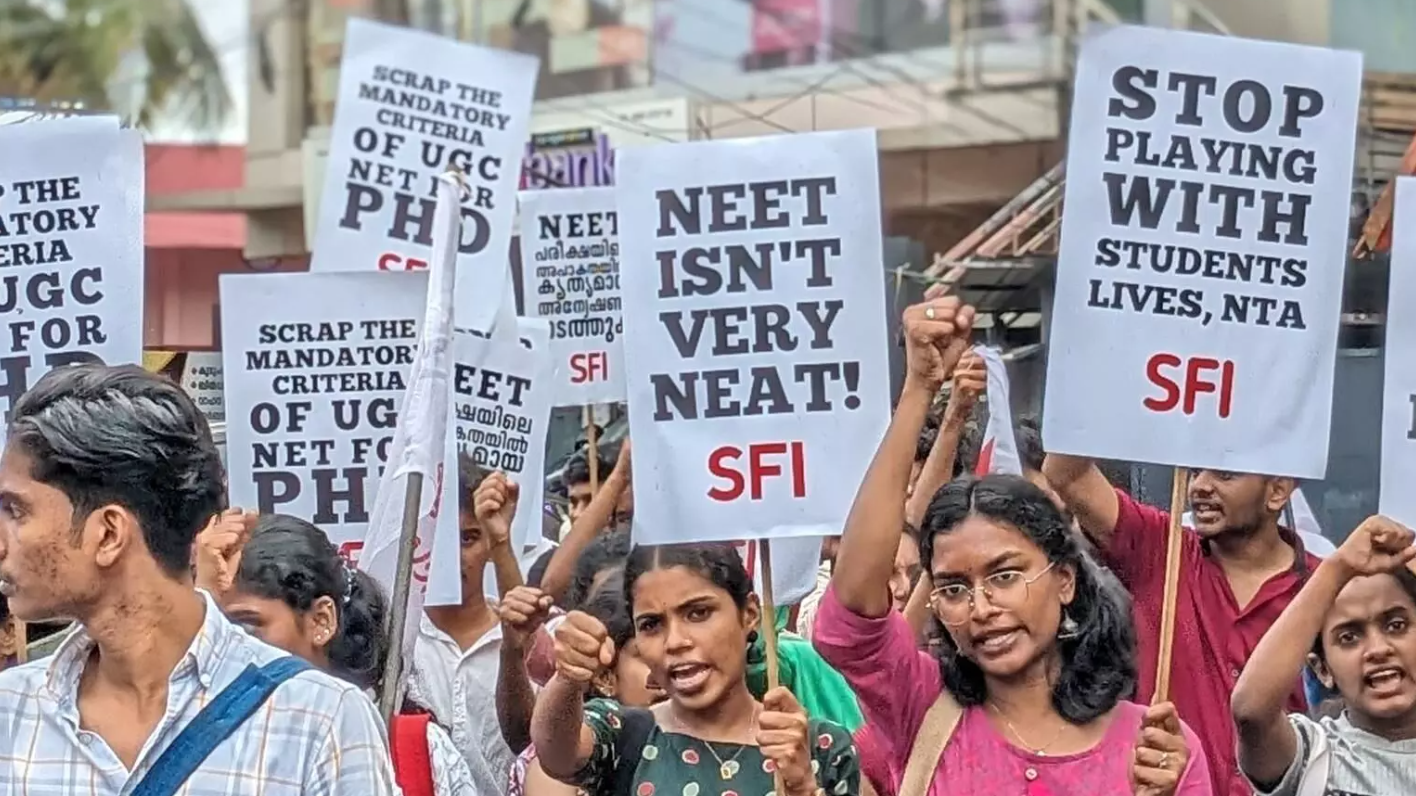
Photo: SFI Protest Over NEET Paper Leak, 2024, X
But how did they convince students they actually had the paper? They weaponized Telegram’s “Edit Message” feature.
As demonstrated by IIT Madras director V. Kamakoti, the scammers would post an innocent, random PDF file days before the exam. Once the exam concluded and the real question paper became public, the channel administrators would simply edit that old message, swapping the harmless PDF for the real question paper.
Because Telegram retains the original timestamp, it created a flawless optical illusion. It looked exactly as if the real paper had been sitting in the group chat days before the test. This fabricated “evidence” fueled nationwide panic and allowed the scammers to extort massive sums of money from terrified parents and candidates.
Unable to track down the hidden administrators fast enough, the Indian government took a “measure of last resort.” They ordered internet service providers to block all access to Telegram from June 16 to June 22. Crucially, MeitY also ordered Telegram to completely disable its message editing feature in India until June 30 to shut down the timestamp fraud once and for all.
Telegram is Untouchable
For an average user, Telegram is just another messaging app, slightly better than WhatsApp for sending large files or joining massive community groups. But to cyber-security experts, Telegram has effectively become the “alternative Dark Web.”
Some very features designed to protect free speech and privacy under dictatorships make the platform a paradise for organized crime. Scammers can operate entirely anonymously using virtual phone numbers. They can broadcast messages to hundreds of thousands of victims instantly because Telegram allows unlimited subscribers in its “Channels.”

Photo: Telegram Logo
When serious offenses happen, whether it is drug trafficking, financial fraud, or selling pirated data, governments find themselves completely helpless. Unlike Meta (which actively polices WhatsApp and Facebook with heavy AI moderation), Telegram takes a highly hands-off approach. By the time local police infiltrate a scam group, gather evidence, and convince Telegram to take the channel down, the criminals have already moved their victims to a backup channel. The platform moves too fast, and the criminals are too well-hidden, for traditional law enforcement to keep up.
History of Global Chaos
India is not the first country to clash violently with the app. Telegram’s refusal to moderate its platform or hand over user data has kept it at the center of massive global controversies for years.
ISIS Safe Haven [2015 – 2019]
Telegram faced severe global backlash after it became the primary communication and recruitment tool for the terrorist group ISIS. The group exploited encrypted “Secret Chats” and massive broadcast channels to claim responsibility for attacks, while the platform initially refused to intervene.
Russian Ban [2018 – 2020]
The Russian government officially banned Telegram because CEO Pavel Durov refused to hand over encryption keys that would allow the state security services to monitor citizens. The ban was eventually lifted when millions simply bypassed it using VPNs.
Deepfake Epidemic [2023 – 2024]
The platform became the epicenter for automated AI deepfake pornography. Millions of users utilized automated Telegram “bots” to strip clothing off photos of women and underage girls, operating openly for months due to the app’s lack of moderation staff.
Arrest of Pavel Durov [August 2024]
French police arrested Telegram’s billionaire founder and CEO, Pavel Durov, in Paris. Authorities charged him with being “complicit” in drug trafficking, money laundering, and the spread of illegal material, arguing that his refusal to moderate the app made him legally responsible for the crimes happening on it.
Tech behind Telegram
Why couldn’t the Indian Cyber Crime Coordination Centre (I4C) just track down the NEET scammers instead of banning the app? The answer lies in how Telegram is fundamentally built.
Unlike standard apps that use conventional network architecture, Telegram operates like a cryptographic fortress:
Telegram does not use standard internet encryption. It uses a proprietary code called MTProto. To government network scanners, malicious data being sent over Telegram just looks like unreadable digital static. When data is stored on Telegram’s cloud, it is physically split into pieces and scattered across servers in entirely different countries. The decryption key is also split. An Indian court order is virtually useless because the data and the key to unlock it are never stored in the same legal jurisdiction.
Scammers rarely type messages themselves. They write code on offshore, anonymous servers and connect it to Telegram via automated bots. Even if the government bans a specific scam bot, the criminal’s actual computer server remains untouched, allowing them to spin up a new bot in seconds.
Collateral Damage
Telegram CEO Pavel Durov heavily criticized the move, stating that New Delhi was punishing over 150 million ordinary Indian users just to catch a few bad actors. He bluntly noted on his personal channel, “The ban hasn’t stopped anything. The leaks just moved to other apps.” Digital rights groups like the Internet Freedom Foundation echoed this, calling it a “band-aid solution” that externalizes the government’s failure to secure its exams onto the citizens. .
However, from the government’s perspective, protecting the integrity of a national exam for 22 lakh future doctors left them with no other option. Because the platform’s architecture makes surgical arrests impossible, blunt-force shutdowns are the only tool left in the state’s arsenal.
Yeh article aapko kaisa laga?