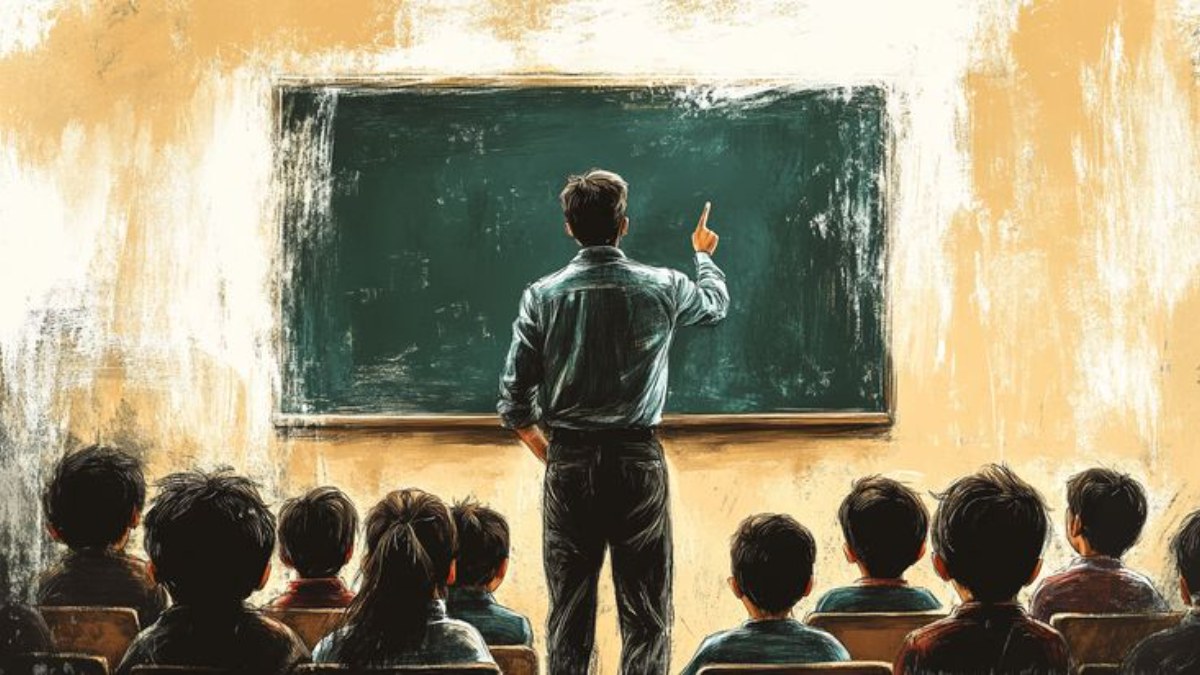
Photo: Shpakova Design
Excerpt: According to the 2025-26 Economic Survey, while 98% of children are in schools, nearly 50% of Grade 5 students struggle to read a Grade 2 level text.
In 2026, India stands at a paradoxical crossroads. While the country boasts near-universal primary enrolment and the world’s third-largest higher education system, the “Learning Poverty” crisis remains its Achilles’ heel.
The National Education Policy (NEP) 2020 has introduced ambitious reforms shifting from rote learning to competency-based education yet the ground reality is marred by a massive “Quality Gap.” This gap isn’t just between the rich and poor, but between Degrees and Deliverables. With graduate unemployment hovering near 40%, the system is churning out “degree-holders” rather than “skilled professionals.”
The Divergent Paths: Why China Succeeded
China’s development was built on a “bottom-up” strategy. In the 1950s and 60s, China prioritized universal primary education and vocational training. They recognized early on that a massive manufacturing-led economy required a literate, disciplined, and technically skilled workforce. By the 1990s, China had achieved nearly 100% literacy among its youth, long before it began aggressively funding its “Ivy League” style universities.
China’s Strategic Leap: A Critical Analysis
China’s transformation from a semi-literate agrarian society to a global STEM powerhouse wasn’t accidental; it was a disciplined, state-led overhaul. While India adopted a “Top-Down” approach (focusing on elite IITs while neglecting primary schools for decades).
1. The “Vocational” Pivot
Unlike India’s cultural obsession with white-collar degrees, China integrated vocational training into the mainstream. Approximately 25% of Chinese secondary students are in vocational streams, compared to less than 5% in India. This created the “World’s Factory” by ensuring a steady supply of high-precision technicians.
2. The Double First-Class Initiative
China didn’t just expand higher education; It “industrialized” excellence. Programs like Project 211 and the Double First-Class Initiative concentrated massive funding into select universities to force them into global Top 100 rankings.
3. Compulsory Nine-Year Law
Enforced since 1986, China’s law ensured that even rural children received standardized, rigorous math and science training, creating a high “human capital floor” that India is still struggling to build.
The Indian Struggle: Why the System Stagnated
India, conversely, adopted a “top-down” approach. Influenced by its colonial past, India invested heavily in elite institutions like the IITs and IIMs to produce world-class administrators and engineers. While this created a successful global diaspora and a thriving service sector, the foundation primary and secondary schooling was neglected for decades.
Critics point to several systemic failures:
• Learning Poverty: According to the 2026 Economic Survey, while enrolment is near 100%, nearly half of Grade 5 students cannot read Grade 2 text.
• The “Degree” Obsession: The system prioritizes certificates over skills, leading to a “jobless growth” phenomenon where graduates lack industry-ready competencies.
• Teacher Crisis: With over 100,000 single-teacher schools and high absenteeism, the public sector remains paralyzed.
To surpass China in education, India must move beyond its “enrolment success” and fix the “learning vacuum” that exists within its classrooms. While China has successfully industrialised its education system to feed its manufacturing and tech sectors, India’s path to 2026 and beyond requires a radical shift toward quality, vocational parity, and research-led innovation.
Everyone criticise but not comes with solution, that’s my attempt to surpass china in education. Here are the critical solutions required for India to leapfrog China:
1. Universalize Foundational Literacy (The NIPUN Bharat Goal)
China’s advantage began with universal literacy. India’s priority must be the NIPUN Bharat Mission ensuring every child can read and do basic math by Grade 3. Without this foundation, higher education remains a “filter” that only elites pass through.
2. Radical Mainstreaming of Vocational Education
In China, vocational tracks are a prestigious choice, not a “fallback” for failures. India must erase the social stigma attached to blue-collar and technical skills.
Action: Fully implement the National Credit Framework (NCrF), allowing students to switch between “academic” and “vocational” tracks seamlessly. As of 2026, the goal should be to ensure 50% of all learners have access to vocational training by 2030, integrated into high school curricula.
3. Shift from “Degree Factory” to “Innovation Hubs”
India currently ranks second to China in Asia’s university rankings. To take the top spot, Indian universities must stop being “teaching-only” institutions and become “research-first” entities.
Action: Triple the current research spending (currently hovering near 0.7% of GDP) to match the 2%+ seen in China and the West. Incentivize Industry-Academia collaboration through “Professors of Practice” where industry leaders teach in classrooms.
4. Leverage the “Digital Public Infrastructure” (DPI)
India’s unique advantage over China is its open-source digital architecture. While China’s system is closed and rigid, India can use Digital Infrastructure for Knowledge Sharing (DIKSHA) and the National Digital University to scale quality education to the remotest villages without waiting for physical buildings.
5. Fixing the Teacher-to-Mentor Pipeline
China has high-quality, standardized teacher training. India needs to move away from “B.Ed. degree-holders” to “digitally fluent educators.”
Action: Use the PM-SHRI school model as a blueprint to upgrade 14,500+ schools into “exemplar” institutions that mentor surrounding rural schools, creating a ripple effect of quality.
Critical Verdict: India will not surpass China by copying its “industrial-era” model. Instead, India must leverage its Demographic Dividend by focusing on Agile Learning the ability for students to reskill themselves throughout their lives in an AI-dominated world.
The Verdict: From Schooling to Learning
The “Reality Check” for India is simple: Schooling is not Learning. India has mastered the art of building classrooms, but it is failing in the art of building minds. To replicate or surpass the Chinese model, India must move beyond the “degree-factory” mindset and aggressively fund Teacher Training and Vocational Parity.
The demographic dividend is a ticking time bomb; without a drastic shift from “quantity” to “quality,” India risks a generation of over-educated but under-employed youth.
Yeh article aapko kaisa laga?