Image credit: Yaqutali /X
Introduction: A Protest That Has Moved Beyond One Individual
What began as an indefinite hunger strike by climate activist and education reform advocate Sonam Wangchuk has now evolved into a larger national conversation about democratic dissent, public examinations, accountability, and the State’s response to peaceful protests.
The controversy intensified after Wangchuk was hospitalised following more than twenty days of fasting. His removal from the protest site at Delhi’s Jantar Mantar triggered a political and public debate, with supporters alleging forceful intervention and authorities maintaining that the decision was taken due to medical concerns and in compliance with legal obligations. Reports indicate that doctors found signs of dehydration, low potassium levels, metabolic imbalance, and rising ketone levels, prompting concerns regarding potential health complications.
The episode has transformed an examination-related protest into a broader discussion about constitutional freedoms, public trust in institutions, and the limits of administrative intervention.
How the Protest Escalated
The protest gained national attention after Wangchuk launched an indefinite fast demanding greater accountability in public examinations and stronger action against alleged irregularities in competitive exams, including concerns surrounding the NEET-UG controversy.
Over the course of the fast, support for the movement expanded among students, activists, and civil society groups. As Wangchuk’s health deteriorated, doctors repeatedly advised medical intervention. Hospital authorities later stated that his condition reflected prolonged fasting and required continuous monitoring. According to medical observations reported publicly, dehydration and falling potassium levels had become serious concerns that could potentially affect vital organs if left untreated.
The circumstances surrounding his hospitalisation, however, quickly became the subject of competing narratives.
While Delhi Police maintained that medical intervention became necessary because of health concerns and legal obligations, supporters alleged that Wangchuk was removed against his wishes and without adequate consultation with his family.
The Role of the Cockroach Janata Party and Abhijeet Dipke
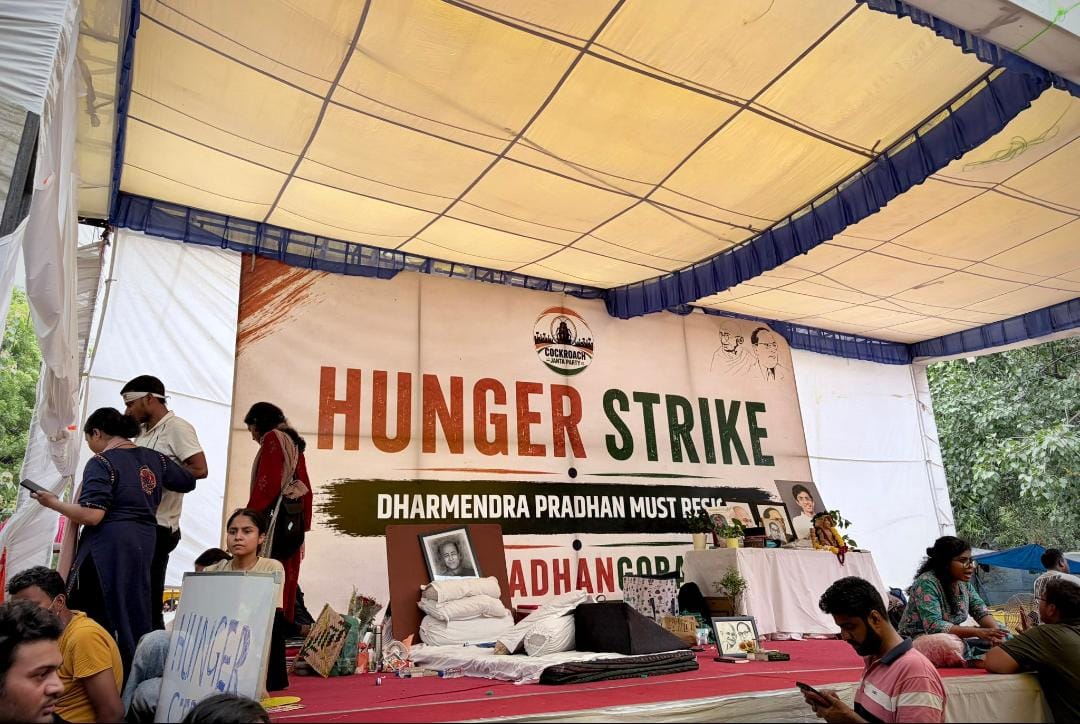
The controversy deepened when Cockroach Janata Party (CJP) founder Abhijeet Dipke announced an indefinite hunger strike following Wangchuk’s hospitalisation.
Dipke and several activists associated with the movement have positioned themselves as advocates for greater transparency in public examinations and institutional accountability. The organisation has repeatedly asserted that the protest extends beyond any single examination and reflects a broader demand for fairness within India’s educational system.
CJP leaders alleged that students participating in demonstrations faced administrative pressure and police action. Authorities have rejected several of these allegations, leading to a growing information battle over what exactly transpired at the protest site.
The situation highlights an increasingly common feature of contemporary public movements: parallel narratives emerging simultaneously through official statements, political reactions, social media campaigns, and activist accounts.
The Constitutional Question: Can Protest and Public Order Coexist?
At the heart of the controversy lies a question that extends far beyond the immediate dispute.
The Constitution of India guarantees citizens the right to freedom of speech, expression, and peaceful assembly under Article 19. At the same time, these freedoms are subject to reasonable restrictions in the interests of public order, security, and administrative necessity.
This constitutional balance often becomes difficult when protests involve prolonged fasts that may threaten the life or health of participants.
Governments and law-enforcement agencies frequently find themselves navigating a delicate situation. On one hand, they must respect democratic dissent. On the other, they face legal and moral responsibilities when an individual’s health reaches a critical stage.
The debate surrounding Wangchuk’s hospitalisation illustrates this tension. Supporters view the intervention as interference with a peaceful protest. Authorities present it as a necessary response to a deteriorating medical condition.
The challenge for democratic institutions lies in ensuring that neither public safety nor civil liberties are unnecessarily compromised.
The Growing Crisis of Trust in Public Examinations
Beyond the hospitalisation controversy, the protest has once again drawn attention to concerns surrounding India’s examination ecosystem.
Competitive examinations today determine access to educational opportunities and professional careers for millions of young Indians. Any allegation of paper leaks, irregularities, manipulation, or administrative lapses therefore carries consequences far beyond individual candidates.
The repeated emergence of examination-related controversies has contributed to growing anxiety among students and parents alike. Even where investigations ultimately clarify facts, the perception of institutional weakness can damage public confidence.
This explains why the current movement has resonated with many students across the country. The demand is not merely for action against isolated irregularities but for a system capable of ensuring transparency, credibility, and equal opportunity.
The issue has therefore evolved from a specific grievance into a broader debate about educational governance and institutional accountability.
Political Reactions and the Battle for Public Perception
The controversy has also acquired a political dimension.
Several opposition leaders criticised the handling of the protest and questioned the circumstances of Wangchuk’s removal from Jantar Mantar. Others focused on the underlying issues being raised by the movement, particularly concerns relating to examination transparency and student welfare.
Meanwhile, government agencies have emphasised the medical necessity of intervention and rejected allegations of wrongdoing.
As often happens in politically charged situations, public discourse has increasingly shifted from the original demands of the protest to competing narratives regarding procedure, responsibility, and legitimacy.
The risk in such situations is that the substantive issues being raised by protesters may receive less attention than the controversy surrounding the protest itself.
Why This Episode Matters Beyond Delhi
The significance of the ongoing protest extends beyond the immediate events at Jantar Mantar.
It reflects three larger trends shaping contemporary India:
- Increasing public scrutiny of educational institutions and examination systems.
- Growing reliance on peaceful civil protest as a means of seeking accountability.
- Persistent tensions between administrative authority and democratic dissent.
Whether one agrees with the methods adopted by the protesters or the response adopted by authorities, the controversy underscores the importance of maintaining public confidence in both governance institutions and democratic processes.
Conclusion: More Than a Protest, a Test of Democratic Accountability
The events surrounding Sonam Wangchuk’s hunger strike and subsequent hospitalisation have become far more than a dispute over a single protest.
They have reopened difficult questions about the treatment of peaceful demonstrators, the accountability of examination systems, the responsibilities of public authorities, and the ability of democratic institutions to engage constructively with dissent.
Ultimately, the strength of a democracy is not measured solely by its ability to maintain order but also by its capacity to listen, respond, and address legitimate public concerns without allowing disagreements to escalate into crises of trust.
Yeh article aapko kaisa laga?