
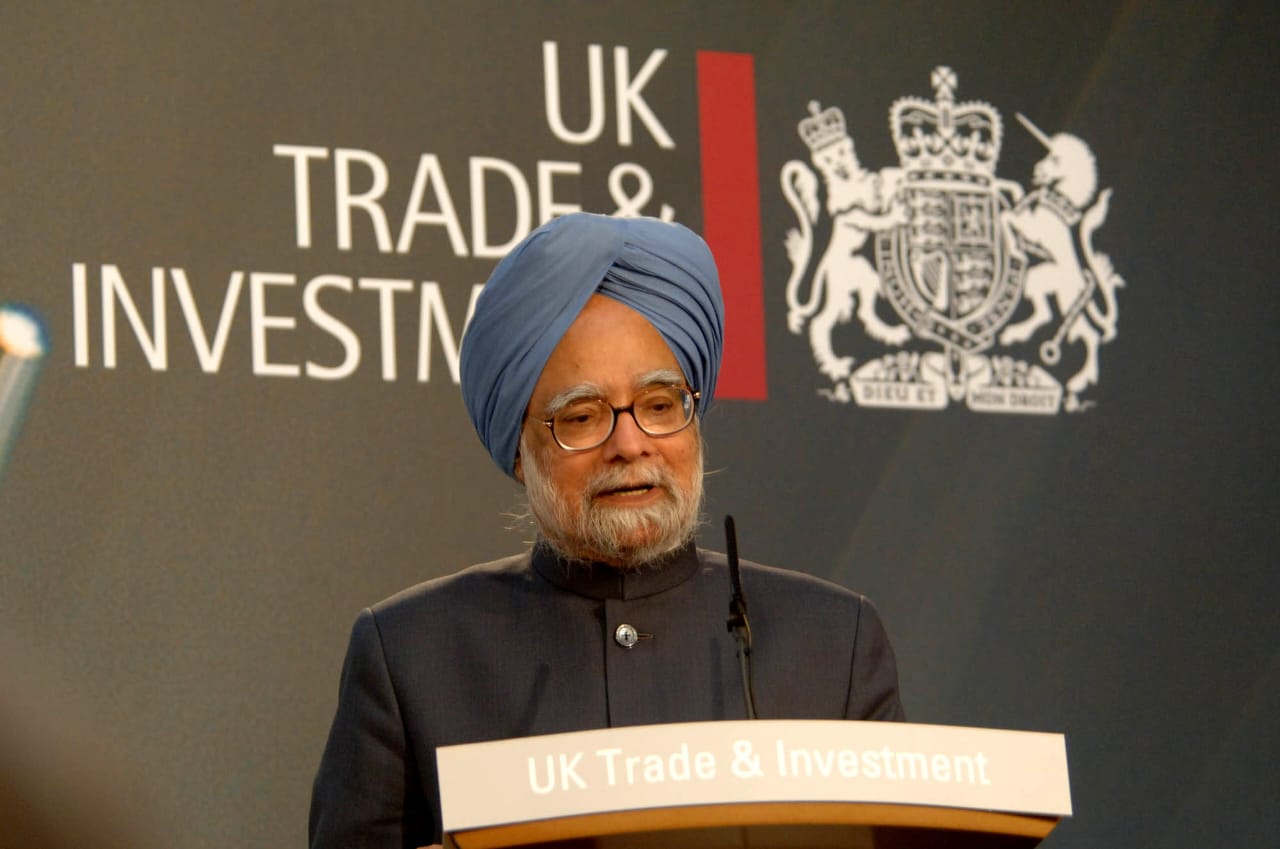
Image credit: The Prime Minister, Dr. Manmohan Singh addressing at India-UK Investment Summit-2006, in London on October 10, 2006.jpg
When the Supreme Court of India officially quashed the criminal summons against former Prime Minister Dr. Manmohan Singh in July 2026, it brought a quiet end to one of the most politically consequential legal sagas in modern Indian history.
Arriving nearly two years after Dr. Singh’s passing in late 2024, the apex court’s verdict formally cleared his name in the Talabira-II coal block allocation case. But beyond individual exoneration, the judgment laid bare a sobering institutional conflict: the rift between investigative findings and judicial cognizance, and the severe, irreversible cost of an eleven-year delay in the administration of justice.
Genesis of Coalgate
Between 2004 and 2009, the Ministry of Coal allocated coal deposits to private and public sector companies via an Inter-Ministerial “Screening Committee.” The policy aimed to boost power generation and heavy industry by expediting raw material access during a period of rapid economic growth.
The controversy erupted in 2012 when a draft report by the Comptroller and Auditor General (CAG) leaked to the media, estimating a staggering “windfall gain” of ₹10.67 lakh crore to allocatees. Although the final report tabled in Parliament lowered this figure to ₹1.86 lakh crore ($19 billion), the political fallout was immediate. The opposition weaponized the phrase “Coalgate,” alleging massive corruption and accusing the government of deliberately bypassing competitive bidding to benefit private industrialists.
The government’s defense rested on economic rationale and statutory limitations: competitive bidding required legislative amendments to the Mines and Minerals (Development and Regulation) Act, 1957, which required state-level consensus that was slow to materialize. However, in the court of public opinion, the policy nuance was eclipsed by the sheer magnitude of the presumptive loss figure.
Talabira-II Allocation: Where the Legal Conflict Began
At the heart of the personal legal action against Dr. Manmohan Singh was the 2005 allocation of the Talabira-II coal block in Odisha. During this period, Dr. Singh held direct charge of the Union Coal portfolio in addition to his duties as Prime Minister.
The Screening Committee had initially recommended allocating the Talabira-II block to the state-run Neyveli Lignite Corporation (NLC). However, industrialist Kumar Mangalam Birla, chairman of the Aditya Birla Group, submitted representations advocating for Hindalco Industries, which was setting up a major aluminum plant in Odisha.
After reviewing inputs from the Odisha state government, which strongly advocated for Hindalco’s inclusion to foster regional industrial development, the Coal Ministry revised the decision. The block was allocated jointly to NLC, Mahanadi Coalfields Limited (MCL), and Hindalco, with Hindalco receiving a 15% share.
Investigation of the CBI
Following Supreme Court monitoring and widespread public outcry, the Central Bureau of Investigation (CBI) launched a full-scale probe into the allocation.
The investigative mandate was clear: determine if there was a criminal conspiracy, breach of trust, or bribery involved in modifying the allocation to accommodate Hindalco.
The CBI conducted an extensive investigation, examining official files, communications, and recording statements including that of Dr. Singh himself. In August 2014, and again in an auxiliary report in October 2014, the CBI submitted formal Closure Reports to the Special Court.
The investigating agency’s legal conclusions were unequivocal:
- No Mens Rea (Criminal Intent):
The modification was a routine administrative decision responding to state government recommendations and industrial needs.
- No Quid Pro Quo:
There was zero evidence of financial improper benefit, bribery, or illicit gain by any public servant involved.
- No Criminal Conspiracy:
The decision-making process was documented transparently within administrative files.
Trial Court’s Unprecedented Step
The pivotal turning point in this legal drama occurred in March 2015.
Exercising powers under Section 190 of the Code of Criminal Procedure (CrPC), Special CBI Judge Bharat Parashar rejected the CBI’s closure reports. The Special Court took cognizance of offences under:
- Section 120-B IPC (Criminal Conspiracy)
- Section 409 IPC (Criminal Breach of Trust by a Public Servant)
- Provisions of the Prevention of Corruption Act, 1988
The trial court issued formal criminal summons to Dr. Manmohan Singh, former Coal Secretary P.C. Parakh, and Kumar Mangalam Birla.
Analytical Flaw in Cognizance
From a jurisprudential standpoint, the trial court’s order conflated administrative discretion with criminal culpability. In Indian criminal law, an administrative policy change even one that subsequently faces policy criticism cannot be converted into a criminal offence without proof of corrupt intent (mens rea) or material benefit.
By summoning the former Prime Minister despite a complete absence of investigative evidence, the trial court effectively applied a standard of strict vicarious liability to executive governance.
Crisis of Judicial Delay
Dr. Singh immediately moved the Supreme Court challenging the trial court’s order. On April 1, 2015, an apex court bench stayed the summons, observing that the challenge raised significant legal questions regarding executive decision-making and trial court jurisdiction.
What should have been an expedited review of a high-profile legal principle instead entered an eleven-year procedural freeze.
For over a decade, the case remained pending before the highest court. Article 21 of the Indian Constitution guarantees the fundamental right to a speedy trial—a right that applies as much to a former Prime Minister as to any citizen. Dr. Singh lived out his final years under the shadow of a criminal trial court order that lacked evidentiary backing.
Posthumous Exoneration
In July 2026, a three-judge bench of the Supreme Court headed by Chief Justice of India Surya Kant delivered the final judgment.
Although the appeal was technically rendered infructuous by Dr. Singh’s demise in late 2024, the Court recognized the imperative need to evaluate the lawfulness of the trial court’s order and erase the stain on his legacy.
The Supreme Court’s conclusions were explicit:
- Lack of Cogent Reason:
The Special Court had no valid or cogent basis to overturn the CBI’s closure reports when no material evidence of a crime existed.
- Acceptance of Closure Reports:
The apex court officially accepted the CBI’s 2014 closure reports, terminating all proceedings in the Talabira-II matter.
- Erasing Adverse Remarks:
The bench formally quashed the 2015 trial court order, removing all criminal observations against Dr. Singh from the judicial record.
Lasting Impact
The tragedy of the Coalgate narrative lies in the stark contrast between its immediate political impact and its eventual legal resolution. Reality (2014–2026)
Politically, the Coalgate controversy served as a primary catalyst for the fall of the UPA-II government in 2014. The perception of systemic corruption, coupled with the dramatic 2015 trial court summons, permanently altered the political trajectory of the nation.
Legally, however, the accusation was a hollow shell. The 2026 Supreme Court verdict proved that the criminal allegations against Dr. Manmohan Singh were unsustainable under the law.
Conclusion
The case of Dr. Manmohan Singh stands as an enduring lesson in the dynamics of governance, media narratives, and judicial process. It demonstrates how easily administrative decisions can be criminalized in the court of public opinion, and how judicial delays can turn an unsubstantiated charge into a lifelong burden. While posthumous acquittal restores the legal record, it confirms an uncomfortable truth: when justice takes eleven years to correct a trial court error, justice delayed is unequivocally justice denied.
Yeh article aapko kaisa laga?