Image credit: MP PYRE MOVEMENT
Introduction: Development’s Human Cost Comes Into Focus
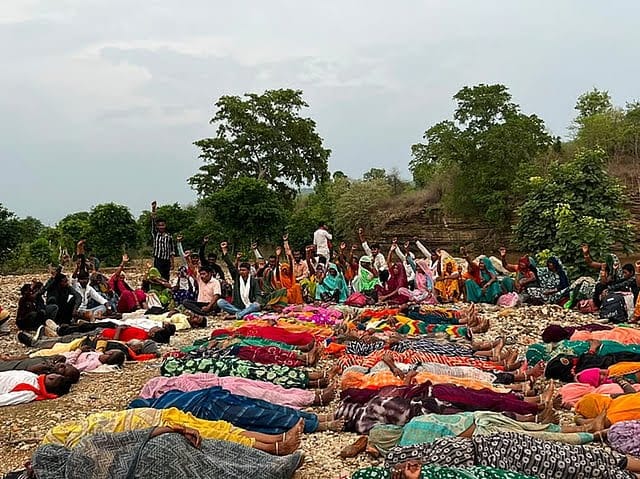
On the banks of the Barana River in Madhya Pradesh’s Panna district, a disturbing form of protest has returned. Families affected by the Ken-Betwa Link Project and other irrigation schemes have resumed their ‘Chita Andolan’ or Pyre Protest, carrying a message that is difficult to ignore: “Provide us justice or death.” What makes the agitation particularly striking is that it is being led largely by tribal women who
allege that repeated promises of rehabilitation, compensation, and resettlement have remained confined to official assurances. Instead of relief, they claim to have witnessed demolitions, evictions, and increasing uncertainty about their future. The protest has once again brought into sharp focus one of India’s most significant and contentious questions: Can development be considered successful if it uproots communities and destroys ecological systems without ensuring justice for those who bear its costs?
The Ken-Betwa Project: Ambition and Strategic Importance
The Ken-Betwa Link Project is among India’s most ambitious river interlinking initiatives. Conceived under the National Perspective Plan for river linking, the project seeks to transfer water from the Ken River basin to the water-deficit Betwa basin. The project is expected to provide irrigation facilities across parts of Madhya Pradesh and Uttar Pradesh, improve drinking water availability, and support hydropower generation. Supporters
argue that the project could significantly improve agricultural productivity and reduce water scarcity in drought-prone Bundelkhand. From a developmental perspective, the project represents an attempt to address one of central India’s most persistent challenges water insecurity.
However, large infrastructure projects inevitably create winners and losers. The ongoing protests suggest that for thousands of affected families, the costs of development are proving far more immediate than its promised benefit
Displacement, Rehabilitation, and Allegations of Administrative Failure
The renewed agitation stems from allegations that rehabilitation measures have either been delayed or inadequately implemented.
According to protest leaders, assurances provided during earlier negotiations have not materialised. Instead, several affected families allege that homes have been demolished even as many continue to await full compensation and rehabilitation benefits.
For displaced communities, relocation is not merely a matter of financial compensation. It involves the loss of homes, agricultural land, livelihoods, social networks, and cultural spaces that often cannot be replaced through monetary payments alone. Activists associated with the movement claim that tens of thousands of people have been directly or indirectly affected by the project and related developments. They argue that many families have been left in a state of prolonged uncertainty, without sufficient time or resources to rebuild their lives elsewhere. The allegations of forced evictions and inadequate rehabilitation have transformed what began as a dispute over compensation into a broader question of procedural fairness and human dignity.
The Ecological Debate: Rivers, Forests, and Biodiversity at Risk
Beyond the issue of displacement lies another equally important concern the ecological consequences of large-scale river-linking projects. Environmental groups have repeatedly warned about the potential impacts of the Ken-Betwa Link Project on forests, biodiversity, and river ecosystems. Critics argue that the project could
result in the diversion of extensive forest areas and the felling of millions of trees.
Particular concern has been expressed regarding the impact on the region’s ecological balance,
including areas associated with the Panna landscape and the habitats that support rich
biodiversity.
Rivers are not merely channels carrying water from one location to another. They function as dynamic ecological systems that sustain forests, wildlife, groundwater recharge, and local communities. Altering their natural flow patterns can trigger consequences that may only become visible years later.
For environmentalists, therefore, the debate extends beyond immediate developmental gains and enters the realm of long-term ecological sustainability.
Why Tribal Communities Are at the Centre of the Protest
The present agitation has drawn significant attention because tribal women have emerged as its principal voices. For many indigenous communities, land is not merely an economic asset. Forests, rivers, and ancestral territories form an integral part of cultural identity, traditional knowledge systems, and
social organisation.
Displacement therefore represents more than physical relocation. It often means severing a relationship with a landscape that has shaped communities over generations. The slogan raised during the protest “Provide us justice or death” reflects the depth of frustration among affected families. It signifies not simply opposition to a project but a feeling of abandonment and exclusion from decision-making processes that directly affect their future.
The protest thus highlights a recurring challenge in development governance: ensuring that affected communities become participants in development rather than its unintended casualties.
The Larger Question: Development Without Justice?
The return of the pyre protest raises questions that extend far beyond the Ken-Betwa Project itself. India’s developmental journey increasingly depends upon large infrastructure projects dams, highways, industrial corridors, mining projects, and river-linking schemes. Such initiatives undoubtedly generate economic opportunities and strengthen infrastructure capacity. Yet their legitimacy ultimately depends upon whether development is pursued in a manner that is socially equitable and environmentally sustainable.
Rehabilitation cannot be treated as a procedural formality. Compensation cannot merely involve monetary calculations. Communities displaced in the name of public interest must receive meaningful opportunities to rebuild their lives with dignity and security.
Similarly, environmental concerns cannot be dismissed as obstacles to progress. Sustainable development requires recognising that ecological systems are not expendable resources but foundations upon which long-term human prosperity ultimately depends.
Conclusion: The Human Face of Development
The images emerging from Panna people gathering around symbolic funeral pyres and demanding either justice or death serve as a stark reminder that infrastructure projects are never merely engineering exercises. They are also questions of rights, rehabilitation, environmental stewardship, and democratic accountability.
The Ken-Betwa Link Project may eventually bring water and development to drought-prone regions. But its legacy will also be judged by another measure: whether those who sacrificed their homes, forests, and livelihoods for the project were treated with fairness, dignity, and justice.
Yeh article aapko kaisa laga?