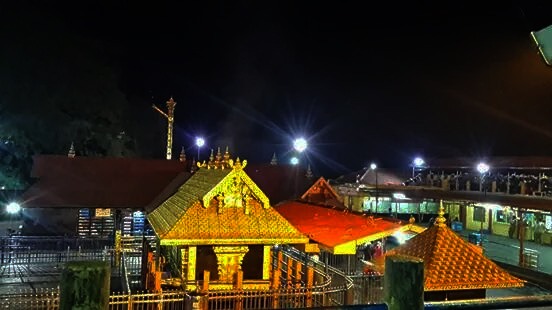
Photo: Sabarimala_2/By Saisumanth532/Commons.wikimedia.org
Introduction: A Courtroom That Refused to Decide Too Quickly
The question before the Supreme Court of India was expected to be legal. It did not remain so.
As the nine-judge bench resumed hearings in the Sabarimala reference, the courtroom turned into something more than a constitutional forum. It became a space where faith, history, gender, and law collided without any easy resolution.
I Written by Hency Kushwah I
At the centre stood a simple but unsettling observation. Justice BV Nagarathna remarked that “true devotees” among women between the ages of 10 and 50 often choose not to enter the Sabarimala Temple, waiting instead until later in life.
That single remark changed the direction of the debate. Because it raised a deeper question what happens when exclusion is not always imposed, but sometimes internalised?
The Shift in Tone: From Rights to Restraint
The Sabarimala case began as a question of equality. The 2018 judgment in Indian Young Lawyers Association v. State of Kerala (2018) framed the restriction on women as unconstitutional.
But the present hearing suggests a shift. The Court is no longer asking only whether women can enter. It is asking whether the Constitution should intervene at all in matters that are deeply embedded in religious belief.
Justice Nagarathna’s observation did not defend exclusion outright. Instead, it introduced a subtle but powerful idea that faith itself may create voluntary boundaries, and that such boundaries may not always be coercive. This reframes the issue entirely. If restraint is chosen, can it still be challenged as discrimination?
“We Will Not Annihilate Religion”: A Line the Court Is Reluctant to Cross
At one point, the Bench made its discomfort explicit. It stated that it does not wish to be part of the “annihilation of religion.” This is not a casual remark. It signals a judicial hesitation that goes beyond the facts of Sabarimala. Because if every religious practice is subjected to individual reinterpretation, the Court fears that the very structure of religion may begin to dissolve.
Justice Sundresh articulated this concern sharply if every believer begins to redefine practices according to personal preference, where does the process stop? The implication is clear. Unlimited individual rights, when applied to collective belief systems, may destabilise them entirely.
The Counterpoint: When Custom Becomes Constitutional
Senior Advocate Indira Jaising, arguing for women seeking entry, pushed back with equal force.
Her position is rooted in a different constitutional logic. The moment a custom is recognised by law, she argued, it becomes subject to fundamental rights. In other words, religion cannot remain insulated once it enters the domain of constitutional recognition.
She did not argue for the abolition of all customs. Instead, she drew a distinction only those practices that are “egregiously violative” of rights, particularly those rooted in ideas of purity, pollution, or exclusion, should be struck down. This introduces a competing principle: reform, but selectively. Yet even this raises a question who decides what is “egregious”?
The Core Conflict: Faith as Identity vs Rights as Freedom
The hearing repeatedly returned to one unresolved tension. On one side lies Article 25 the freedom of religion. On the other lies the guarantee of equality and dignity. For the petitioners, exclusion during the most active years of a woman’s life between 10 and 50 is not just symbolic, but substantive. It effectively denies participation during a significant portion of life.
For the Court, however, the issue is more complex. It is not merely about access, but about preserving the philosophy of a deity and the nature of worship associated with it. This transforms the conflict. It is no longer about entry into a temple. It is about whether the Constitution can alter the meaning of a religious practice without altering the practice itself.
Who Has the Right to Challenge Faith?
Another question emerged one that could have implications far beyond Sabarimala. Can a person who is not a devotee challenge the practices of a religious institution? The Bench expressed concern that individuals with no connection to the temple may still claim rights of entry. This is not just about locus standi. It is about the boundaries of constitutional intervention.
If rights can be claimed without belonging, then religion becomes open to universal scrutiny. If they cannot, then constitutional remedies become limited. Neither position is without consequence.
The Doctrine Under Pressure: Essential Religious Practices Revisited
The debate also revisited the “essential religious practices” test a doctrine that has long guided judicial decisions in religious matters. The concern now is whether this test is sufficient, or even appropriate. The Court appears wary of relying on a single standard to determine what is protected under religion. At the same time, abandoning the test altogether creates uncertainty.
Jaising argued that courts are not determining religion, but merely recognising what religion itself considers essential. The Bench, however, appears unconvinced that such recognition can remain neutral. And that leaves the doctrine itself hanging neither fully accepted nor fully rejected.
Yeh article aapko kaisa laga?