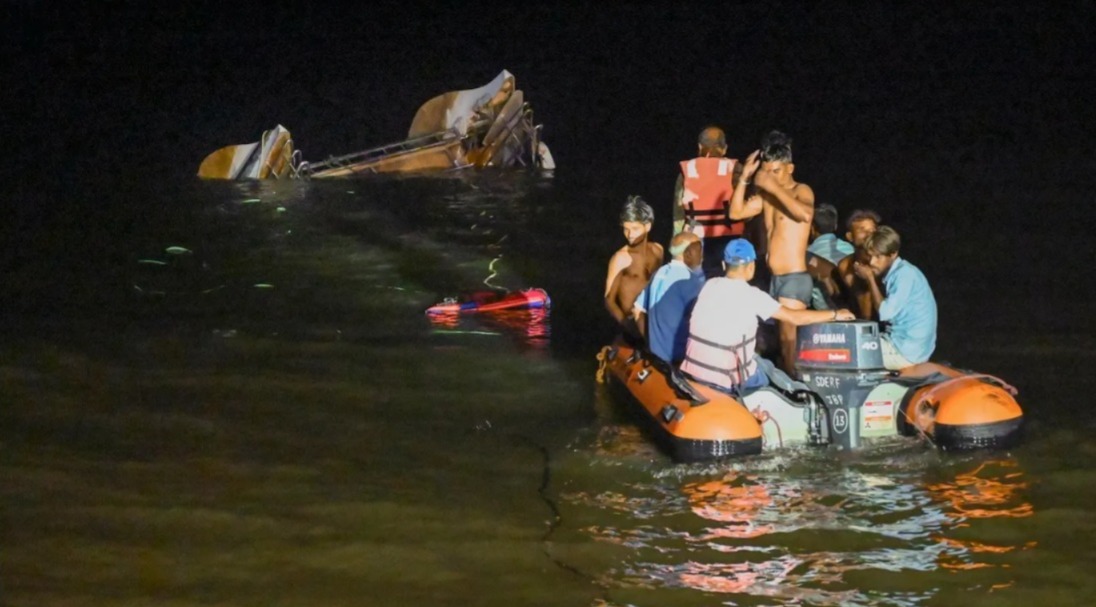
Photo: Rescue operation in the Bargi Dam Reservoir in Jabalpur, MP
On Thursday evening, a cruise vessel operated by the Madhya Pradesh Tourism department capsized in the Bargi Dam reservoir in Jabalpur. Meteorological records indicate the vessel encountered sudden wind speeds of 60 to 70 kmph. Prior to the incident, the India Meteorological Department (IMD) had issued a yellow alert for the region. Despite this advisory, the cruise proceeded.
According to survivor testimonies, life jackets were not distributed prior to departure. Passengers reported that the crew ignored requests to return to the riverbank as weather conditions deteriorated, leaving passengers to locate safety equipment only after the vessel began taking on water.
A Heartbreaking Discovery
The true cost of this terrible failure can be seen in one heartbreaking image that brought even the toughest rescue workers to tears. On Friday morning, deep divers from the State Disaster Response Force (SDRF) pulled the bodies of a mother and her young son from the water.
In her final moments, the terrified mother had hugged her four-year-old boy as tightly as she could. They were found locked in an embrace, tied together to a single life jacket, trying to survive a disaster they could not control. Seeing their bodies brought up from the water was so painful that local Cabinet Minister Rakesh Singh broke down crying at the scene.
Lives Lost and Families Broken
As of Friday, May 1, 2026, the death toll has reached nine. Out of the 40 to 45 people who were on the boat, 22 have been rescued, but several others are still missing. The boat itself is now sitting almost 20 feet deep underwater.
The stories of the survivors are filled with grief. Pradeep Kumar, a man visiting from Delhi, lost his wife and his four-year-old son. He shared that the crew completely ignored their cries for help and never even came down to assist the sinking tourists. Another survivor, Julius, lost his wife, while his daughter and grandson are still missing. A large family of 15 from the Khamaria Ordnance Factory went on the trip together; so far, only one young boy has been saved, while his parents and brother are lost.
In the middle of all this darkness, there was one moment of incredible bravery. A 14-year-old boy named Jafar Ali jumped into the violent water as the boat sank and somehow managed to swim all the way to the shore to save his own life.
Whose Responsibility Was This?
This incident raises the immediate question: Whose responsibility was this? The vessel was not a private charter; it was a state-owned asset operated by the Madhya Pradesh Tourism department.
The primary responsibility rests on the operational framework that permitted a vessel to launch under an IMD yellow alert. It also points to the administrative oversight of allowing a commercial cruise to operate with only two crew members and failing to enforce standard maritime safety protocols, specifically the mandatory distribution of life jackets before the vessel leaves the dock.
Government Action and Rescue Operations
A multi-agency rescue operation is currently underway. Teams comprising the SDRF, the National Disaster Response Force (NDRF), the Indian Army, and local police are stationed at the reservoir. Rescue personnel have deployed gas cutters to breach the hull of the submerged vessel to access compartments where passengers are feared trapped.
In response, Chief Minister Mohan Yadav has authorized an ex-gratia compensation of Rs 4 lakh for the families of the deceased. Madhya Pradesh Tourism Minister Dharmendra Bhav Singh Lodhi announced that a formal investigation will be conducted. He specified that the probe will address the failure to distribute life jackets and assured that action will be taken against those found responsible.
The Question of Accountability
While compensation and departmental inquiries are standard procedures following such events, the broader issue remains: Whose accountability is it?
Accountability extends beyond the on-board crew to the administrative chain of command within the tourism department. This includes the officials responsible for conducting safety audits, monitoring regional weather alerts, and enforcing emergency protocols for a state-run service that has been operational for 15 years.
This incident raises a critical question regarding state oversight: What structural reforms are required within the state’s tourism apparatus to ensure strict compliance with safety mandates, and how will the government guarantee that administrative negligence does not result in further loss of life?
Yeh article aapko kaisa laga?