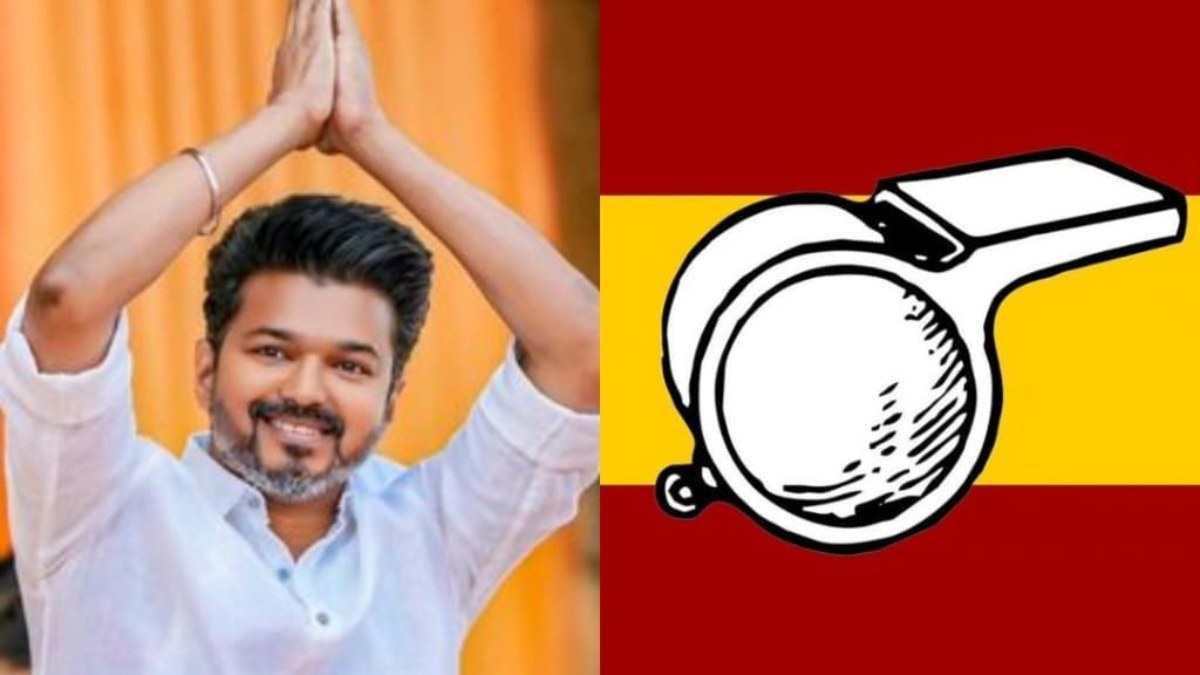
Photo:Vijay Thalapathi/Pinterest/Shankar editz / TVK Flag, Social Media
I Written by Hency kushwah I
For nearly 49 years, politics in Tamil Nadu has been dominated by two Dravidian giants Dravida Munnetra Kazhagam and All India Anna Dravida Munnetra Kazhagam. Power consistently rotated between these two, creating a near-monopoly over the State’s political space.
That dominance has now been directly challenged.
Actor-turned-politician Vijay, through his party Tamizhaga Vetri Kazhagam, has secured 108 seats, breaking into a system that had remained largely unchanged for decades. The massive crowds seen in his rallies have clearly translated into votes, turning what looked like momentum into a political breakthrough.
The Crack in the Dravidian Fortress
Tamil Nadu witnessed a political shift rarely seen in its history. A party formed just over two years ago has shaken a structure built over nearly five decades.Vijay did not just enter politics he disrupted it.
This result reflects a deeper voter sentiment. A large section of the electorate, particularly those frustrated with long-standing political patterns, appears to have been ready for an alternative. The dominance of traditional parties, often associated with family politics, repetitive narratives, and governance fatigue, created the space that TVK ultimately occupied.
Why TVK Won: The Real Drivers
The most decisive factor behind TVK’s success was the overwhelming support from young voters. Tamil Nadu has a massive youth population, with over 2.38 crore voters between 18 and 39 years. This group is less influenced by historical loyalties and more driven by aspiration and relatability. Vijay, with his mass appeal and image, connected directly with this segment.
Women voters also played a crucial role. With women outnumbering men in the State’s electorate, their shift proved significant. While this vote bank was earlier associated with AIADMK and later targeted by DMK through welfare schemes, Vijay’s personal image and connect among younger women created a noticeable shift.
At the same time, the decline of All India Anna Dravida Munnetra Kazhagam significantly helped TVK. Since Jayalalithaa’s death, internal conflicts and leadership struggles weakened the party. Its traditional vote base began drifting, and TVK successfully captured a large portion of this anti-DMK sentiment.
Another critical factor was Vijay’s clean image. His decision to step away from a successful film career created a perception of sacrifice. In Tamil Nadu’s political culture, such narratives carry weight, positioning him as a credible and morally distinct alternative.
The Strategy That Changed the Game
Vijay’s campaign was not just popular due to his image but it was also well calculated. He framed the election as a direct contest against the ruling Dravida Munnetra Kazhagam, while deliberately avoiding aggressive attacks on All India Anna Dravida Munnetra Kazhagam. This effectively pushed AIADMK to the margins and positioned TVK as the primary challenger.
In politics, perception often determines outcomes. Once TVK was seen as the main opposition force, anti-incumbent votes naturally consolidated in its favour.
Additionally, the fragmented nature of the contest worked to TVK’s advantage. In multi-cornered elections, even a 30 to 35% vote share can translate into significant seat victories. TVK utilised this arithmetic effectively, converting divided opposition into electoral gain.
The Political Puzzle Ahead
Despite emerging as the largest party with 108 seats, TVK remains short of the 118-seat majority mark required to form the government. This opens up a crucial phase of political negotiation. Given Vijay’s relatively softer stance toward AIADMK during the campaign, a potential alignment between the two appears plausible. At the same time, other alliance possibilities cannot be ruled out, though they may be more complex.
The election result has created momentum but governance will depend on strategy beyond the ballot.
Conclusion
This election marks more than just a victory it signals a transformation. TVK has broken a 49-year-old political pattern, introducing uncertainty into a system that once appeared fixed. The dominance of two parties has been challenged, and a new political axis has emerged.
Whether this shift becomes permanent or remains a moment of disruption will depend on what follows. But one thing is clear, Tamil Nadu’s politics will not look the same again.
Yeh article aapko kaisa laga?