
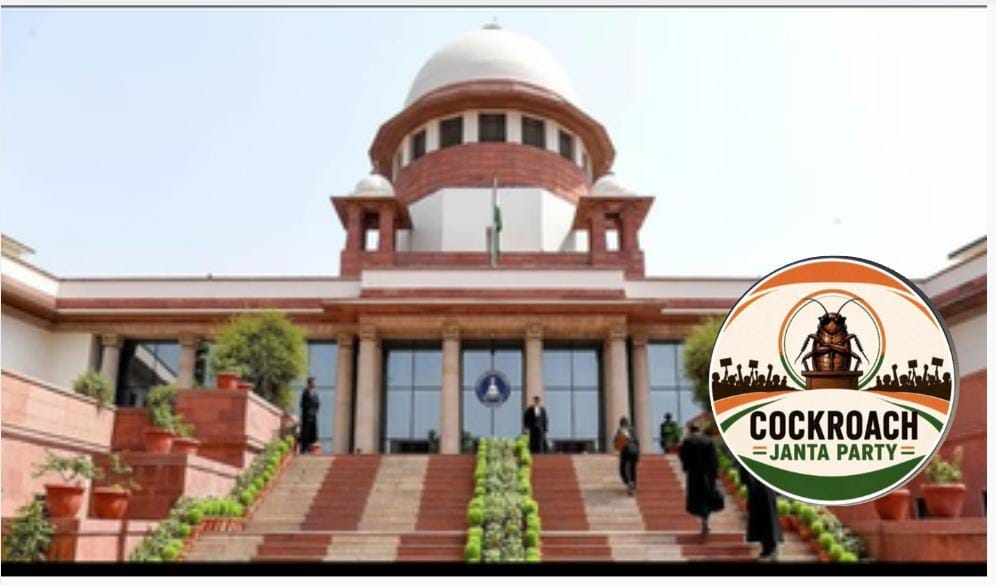
What began as an internet joke has now entered the Supreme Court of India. That journey, from meme to courtroom, says something important about the country we are living in today.
A recent petition before the Supreme Court sought a CBI inquiry into activities linked to the Cockroach Janta Party, a satirical online movement that grew rapidly on social media and soon became larger than satire itself. The petition was filed by Supreme Court advocate Raja Choudhary and names the Union Government, the Ministry of Electronics and Information Technology, the Bar Council of India, and the Central Bureau of Investigation as respondents. Mr. Choudhary was represented by advocate Rajesh Singh Chouhan. At first glance, it may appear to be just another controversy from the internet crossing over into legal space. But the questions raised by the petition, and by the Court’s response to it, go much deeper.
When urgent hearing was sought, the Supreme Court declined to grant it. In doing so, the bench reportedly remarked that the issue should not be taken “so sentimentally.” That short observation immediately became part of the larger public conversation. It travelled across news reports, WhatsApp forwards, social media posts and debate panels. Ironically, the very concern raised in the petition, about how legal proceedings get pulled into the digital storm, began unfolding in real time around the petition itself.
The petition places this concern at the Centre of its argument. Its language is striking. Judicial hearings, it says, no longer remain within the courtroom. “Judicial hearings and exchanges between judges and lawyers metamorphose into clipped fragments, outrage algorithms, trolling cultures, meme warfare, emotional mobilization, and monetized virality.” That is not just legal language. It is also a description of our public life today.
The petition further states that “isolated fragments of oral proceedings are selectively clipped, meme-ified, mimicked, commercially circulated, and transformed into viral digital content detached from constitutional and procedural context.” There is a seriousness to this argument that deserves attention, regardless of one’s view on the movement itself.
Courtrooms have always produced public conversation. That is not new. Judicial decisions are discussed in newspapers, debated in universities and argued over in tea shops. What is new is the speed. What once took days now takes seconds. A courtroom exchange can be turned into a reel before the hearing ends. A passing oral remark can become a slogan. A clipped sentence can become a political symbol.
This changes how law is consumed by the public. And law, unlike viral content, depends on context. A judge’s oral observation is not the final law. The law lies in the written order, in the reasoning, in the final judgment. Lawyers understand this distinction. Judges certainly do. But the internet rarely has patience for nuance. It rewards speed over accuracy, emotion over detail, and reaction over reflection.
That is where the Cockroach Janta Party controversy becomes larger than itself. Whether one sees the movement as political satire, digital protest, organized dissent, or simply internet theatre, it has forced a difficult conversation into the open. Who controls meaning once a courtroom remark leaves the courtroom? Can legal language survive the meme economy? And should courts intervene when satire begins to shape public understanding of legal institutions? These are not easy questions.
Political satire has always been uncomfortable. It is meant to be. Democracies have long lived with caricature, mockery and public ridicule. Newspapers once carried cartoons that unsettled governments. Street theatre challenged authority. Pamphlets mocked kings and ministers. Today memes do the same work, only faster and on a much larger scale.
Sometimes satire is crude. Sometimes unfair. Sometimes deeply intelligent. But it often reveals what formal politics struggles to say aloud. The rise of the Cockroach Janta Party must also be read in that context. It did not emerge in a vacuum. It emerged from digital frustration, youth anger, unemployment anxiety, distrust in institutions, and a generation increasingly fluent in irony as a political language. The meme became a vehicle. The humor carried something heavier underneath it.
That does not mean every act done in its name is above scrutiny. If there are allegations involving fake law degrees, impersonation, or misuse of legal identity, those are serious matters. They deserve independent examination under law. The legal profession rests on public trust. A forged degree is not a joke. False representation before institutions is not satire. If wrongdoing exists, investigation must follow.
But that legal question remains separate from the constitutional question. And that constitutional question is harder. How should the State respond when political speech no longer arrives through speeches or rallies but through memes, parody accounts and viral clips? At what point does online satire become something the law must regulate? And when does regulation begin to look like suppression?
The Supreme Court’s refusal to treat the matter as requiring urgent hearing may be read in different ways. Some may see it as judicial restraint. Others may see it as judicial distance from a controversy that has already become emotionally charged online. Either reading is possible. But what is clear is that the Court did not treat immediacy as necessity. That distinction matters.
Not every viral moment becomes a constitutional emergency. Courts know this. They also know that public sentiment, however intense, cannot become the sole basis for urgent judicial intervention. Yet sentiment cannot be dismissed entirely either. Democracies run on institutions, but they also run on feeling. Public trust, public anger, public confidence, public hurt. These are emotional things. Law may not be built on sentiment, but politics often is. That tension is visible here.
A meme became a movement. A movement became a petition. A petition became a courtroom mention. And a courtroom mention became another wave of public debate.
That circular movement between the internet and the judiciary may well define the next decade of democratic life in India.
The Cockroach Janta Party controversy may eventually fade, as internet controversies often do. Another hashtag will arrive. Another outrage cycle will begin. But the legal and constitutional questions it has exposed will remain.
Because this is no longer only about one satirical movement.
It is about what happens when law enters the age of virality.
And what happens when virality enters the courtroom.
Yeh article aapko kaisa laga?