
 Ahad Khan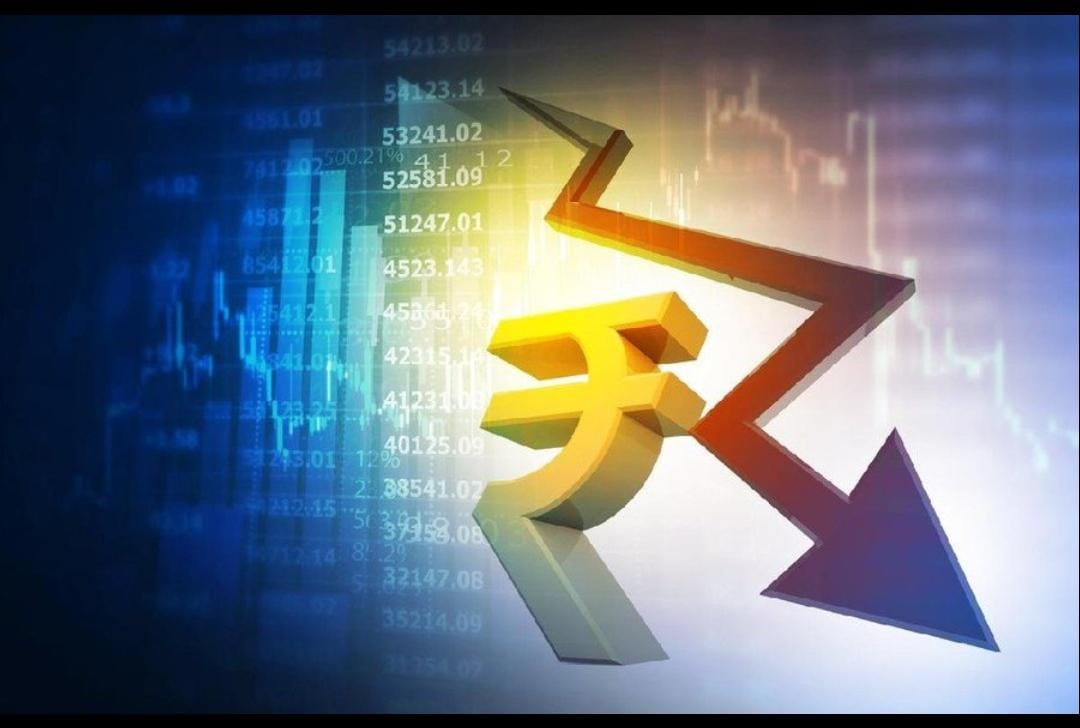
Photo: GK Gourav by X
In late May 2026, the Indian economy is facing a critical turning point: the Indian Rupee is steadily dropping toward the 100-mark against the US Dollar.
Currently trading near a historic low of 96.96, the currency’s performance has sparked widespread worry. If we listen to official press conferences, this drop is often blamed on generic “global headwinds.” But if we look closely at the economic facts, a deeper problem emerges. The continuous pressure on the rupee is not just a random market phase; it is the direct result of a rigid foreign policy and deep weaknesses within India’s financial system.
Heavy Price of Staying Neutral
The foundation of India’s current diplomatic strategy is “strategic autonomy.” This is a policy designed to keep India neutral in global conflicts while maintaining good trade relations with everyone. However, in a connected global economy, you cannot completely protect yourself from the financial shocks of your trading partners.
This weakness was exposed when the recent US-Iran military conflict disrupted global energy markets, pushing Brent crude oil prices past $110 per barrel. Despite years of promises to rely less on foreign energy, India still imports nearly 90% of its crude oil.
In the past, India had a clever financial shield against these kinds of shocks: we bought discounted oil from countries like Russia and Iran using special agreements that allowed us to pay directly in Indian Rupees (INR). By trading in our own currency, we protected our dollar reserves and kept the rupee strong.
But recently, the United States aggressively stepped in and shut this down. While the US didn’t sanction the Indian government directly, they used their global financial power to threaten Indian banks and oil companies. The warning was clear: If Indian businesses continue buying oil from these restricted countries using the Rupee, the US will place heavy sanctions on those Indian banks and lock them out of the global dollar system. Terrified of being punished by the US, our financial system caved in. India abandoned its clever Rupee-trade shield and was forced back into the open market to buy standard, expensive oil.
Because international oil must be bought in US Dollars, Indian oil companies are now dumping massive amounts of rupees onto the market just to buy the dollars they need to keep the country running. This creates a giant financial hole called a Current Account Deficit. When the market is continuously flooded with rupees that everyone is trying to sell, the law of supply and demand naturally pushes the value of the rupee down. Ultimately, India’s inability to stand up to foreign financial threats is being paid for by the money in your pocket.
Why Are Smaller Nations Less Fragile?
When the government defends the falling rupee, they frequently claim that a strong US Dollar is crushing every currency worldwide. While it is true that currencies across Asia are taking a hit, a quick comparison with smaller nations reveals a massive difference in how we survive the blow.
Take a look at emerging economies like Vietnam, Thailand, or Taiwan. They face the exact same expensive oil and high US interest rates. Their currencies also fluctuate, but their central banks are not forced into the same desperate financial panic as the RBI. Why? Because their economic foundations are built differently.
Over the last decade, while India focused heavily on domestic consumption, these smaller nations transformed themselves into global manufacturing hubs. They actually earn massive amounts of US dollars every single day by exporting electronics, vehicles, and physical goods to the world. Because they constantly bring fresh dollars into their economies through hard exports, they have a natural, structural shield against global crises.
India, despite being one of the world’s largest economies, imports far more than it exports. We simply do not generate enough dollars naturally. Instead of relying on real manufacturing export strength like smaller nations do, our financial system relies on borrowing dollars and attracting volatile foreign stock market investments to balance our books, a fragile strategy that completely backfires the second global investors decide to pull their money out.
Exit of Fast-Moving Foreign Money
The second major issue lies within the structure of India’s stock markets. Over the past decade, a lot of our financial growth has been fueled by Foreign Institutional Investors (FIIs). While this foreign cash drives the stock market up, it is essentially “hot money”, fast-moving capital that looks for quick profits and leaves when things get risky.
This reliance on foreign money becomes a serious problem when global interest rates change. Recently, the US Federal Reserve kept its interest rates high, offering secure, risk-free returns of over 4.5% on US government bonds. Why would global investors take risks in emerging markets when they can make guaranteed money back home?
As a result, India has witnessed a severe exit of funds, with foreign investors pulling a net $23.2 billion
out of Indian equities. To take this money back to America, investors must sell their Indian stocks and convert the rupees back into dollars, pushing the value of the rupee down even further.
out of Indian equities. To take this money back to America, investors must sell their Indian stocks and convert the rupees back into dollars, pushing the value of the rupee down even further.
Central Bank’s Desperate Balancing Act
With foreign cash leaving and oil costs rising, the heavy lifting of saving the economy has fallen entirely on the Reserve Bank of India (RBI).
Acknowledging the severity of these pressures, RBI Governor Sanjay Malhotra recently noted: “Our priority remains to curb excessive volatility and anchor macroeconomic stability, but we must recognize that external geopolitical shocks mandate a structural, rather than purely monetary, response.”
In simple terms, the Governor is warning that the central bank cannot permanently fix bad national policies with just money tricks. To prevent the currency from collapsing overnight, the RBI uses a complex tool known as Sterilized Intervention:
1. The RBI releases billions of its emergency US dollars into the market to absorb the shock and support the rupee.
2. But selling dollars naturally sucks rupee cash out of Indian commercial banks. To stop loan interest rates from skyrocketing due to a cash shortage, the RBI immediately buys government bonds to pump rupee cash back into the banking system.
While this balancing act prevents a disaster today, it is only a temporary shield. Furthermore, to help the government manage the national budget, the RBI recently transferred a massive dividend of ₹2.87 lakh crore to the central government. To afford this, the central bank had to reduce its “Contingent Risk Buffer”, its ultimate emergency rainy-day fund from 7.5% down to 6.5%. Relying on emergency savings to manage everyday trade problems highlights the fragility of the current financial strategy.
What Happens When We Hit 100?
A dropping currency is not just a concern for bankers; it translates directly into the daily living costs of every citizen. If the rupee officially crosses the 100-per dollar mark, the consequences will be immediate:
• Rising Prices at Home: Because India pays for oil in expensive dollars, the baseline cost of petrol and diesel will surge. When fuel becomes expensive, the cost of transporting vegetables, grains, and groceries rises, driving up your everyday food bills.
• Costly Technology and Appliances: India is highly dependent on imported electronic parts. A weaker rupee directly increases the retail price of smartphones, laptops, industrial machinery, and medical equipment.
• Expensive Foreign Education: For Indian students aiming to study abroad, a dropping currency ruins financial planning. A university fee of $40,000, which cost about ₹34 Lakhs a few years ago, will cost exactly ₹40 Lakhs at the 100-rupee rate, placing a massive burden on middle-class families.
• Higher Loan EMIs: To fight the rising prices caused by a weak currency, the RBI will eventually be forced to raise domestic interest rates. This will result in higher monthly EMIs for home, auto, and personal loans, leaving families with less spending money at the end of the month.
Conclusion
The Indian Rupee’s slide toward the 100-mark is a predictable economic outcome, not an unforeseen accident. When an economy operates with a foreign policy that leaves it exposed to severe oil shocks, sustains a stock market heavily dependent on fast-moving foreign capital, and relies on the central bank’s emergency reserves to cover the gaps, a currency drop is the mathematical result.
Until the administrative focus shifts from temporary central bank fixes to true, foundational reforms like achieving actual energy independence, the pressure on the rupee will remain. Ultimately, it is the Indian consumer who absorbs the cost of these system flaws.