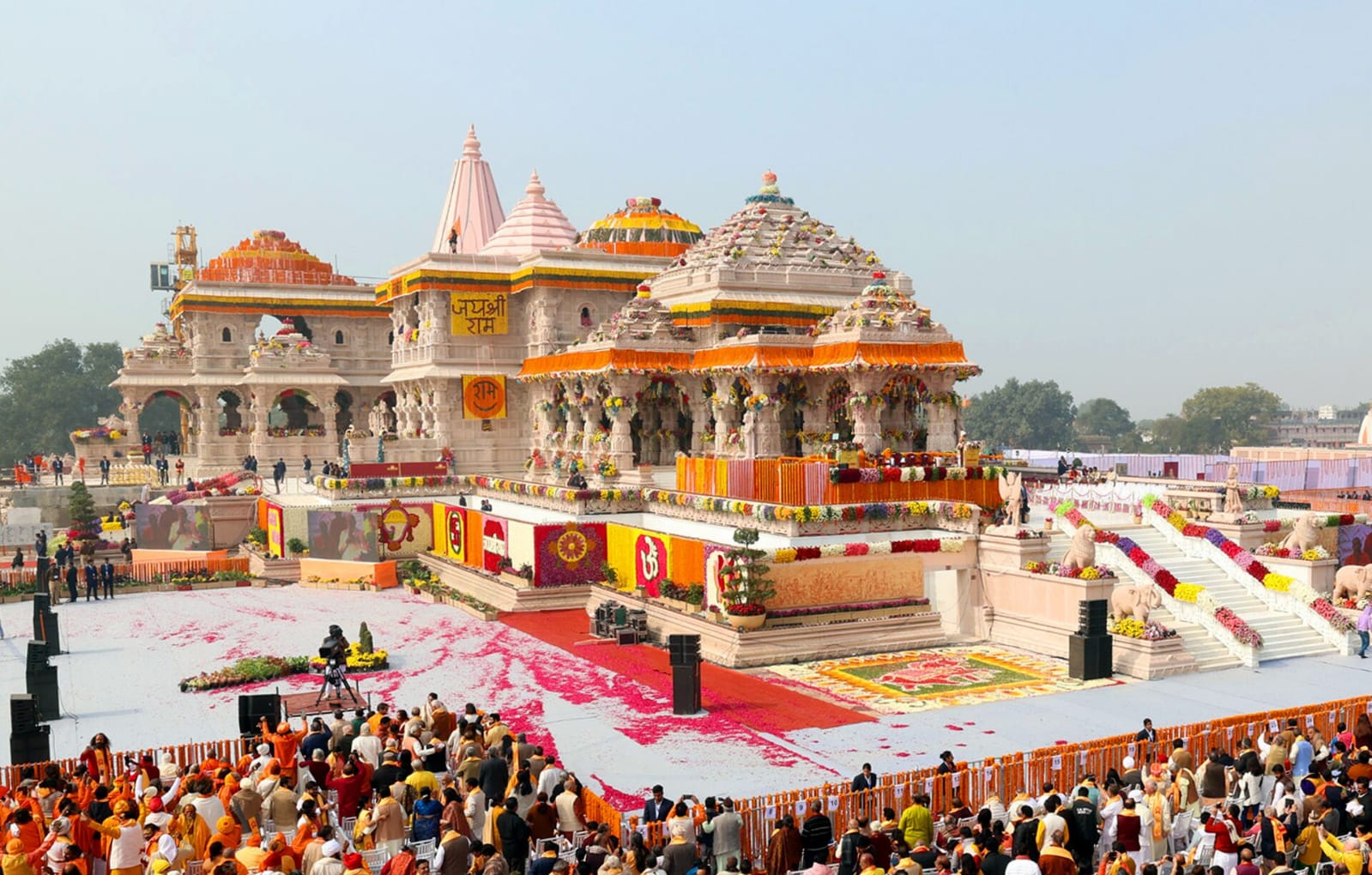
Image Credits: Pran Pratishtha Ceremony of Ram Mandir / Creative Commons.
Key Takeaways from Part 1
1. Cultural Pride of Hindus or Political Move of BJP.
2. Critics on Religious Identity of BJP.
3. Digital growth of Hinduism.
If you have been following global news or scrolling through social media over the last decade, you have likely noticed that Hinduism looks, sounds, and feels a bit different than it used to.
Since 2014, A year marked by a tremendous shift in India’s political landscape with the rise of the Bharatiya Janata Party (BJP) under P.M. Narendra Modi, the conversation around Hinduism has amplified. For some, it feels like a glorious spiritual homecoming and for others, it looks like an aggressive transformation.
But has the religion itself actually changed, or has the world around it simply shifted? To understand this, we need to step back from the social media shouting matches and take a balanced, humanized look at the two sides of modern Hinduism.
The Cultural Renaissance.
For millions of practicing Hindus, the years since 2014 represent a period of long-awaited cultural validation. For generations, many felt that India’s intellectual and political elite sidelined Hindu traditions in the name of a Secularism, again according to Elite political Hindus.
Today, that hesitation has vanished, replaced by a wave of cultural pride.
The de-colonization of the mind there is a growing movement among young, educated Hindus to reclaim their history, philosophy, and sciences (like ayurveda and yoga) from a perspective free of colonial bias.
Ram Mandir & Kashi Vishwanath:
The Reconstruction and revitalization of massive spiritual Centres, most notably the Kashi Vishwanath corridor, the Ujjain Mahakal Lok, and the Grand Ram Mandir in Ayodhya are viewed not just as religious victories, but as the restoration of historical heritage.
Global Recognition:
From international yoga day to world leaders openly participating in Hindu rituals, Hinduism is no longer viewed globally as an “exotic, ancient cult,”
but as a sophisticated, living philosophy with practical answers for modern mental health and ecological crises.
but as a sophisticated, living philosophy with practical answers for modern mental health and ecological crises.
The Practitioner’s View:
“for the longest time, practicing my faith openly in corporate or academic spaces felt old-fashioned. Today, there is a sense of validity. We are proud of our roots, and we aren’t apologetic about it anymore.”
The Critique on Religious Identity of BJP.
On the flip side of this cultural pride lies a parallel reality that critics and minority communities view with deep concern. Hinduism, which historically operated as a decentralized, highly fluid “way of life,” has increasingly been tied to state power and national identity.
From faith to political Hindutva:
While Hinduism is the spiritual tradition, “Hindutva” is a modern political ideology that seeks to define Indian identity through the lens of Hindu culture. Critics argue that since 2014, the Gap between the two become dangerous for Nation’s Growth and Sustainable Development.
Social Polarization:
The assertiveness that brings pride to many has, in some instances, manifested as intolerance. Issues like cow vigilantism, aggressive social media trolling, and exclusionary rhetoric have created an atmosphere of anxiety for India’s massive minority populations, particularly Muslims and Christians.
Organised Hindutva:
Historically, Hinduism lacked a single holy book, a central authority, or a uniform way to pray. Some scholars argue that modern movements are trying to make Hinduism more rigid and structured, mimicking western monotheistic religions in order to create a unified political voting bloc.
Religion in the age of Algorithms
Perhaps the biggest catalyst for change since 2014 isn’t politics at all. It’s-Technology. The explosion of cheap mobile data in India occurred right alongside this political shift, completely changing how faith is consumed.
Spiritual learning:
Passed down by family elders, local priests, or reading physical scriptures. short-form reels, YouTube gurus, WhatsApp forwards, and spiritual podcasts.
Passed down by family elders, local priests, or reading physical scriptures. short-form reels, YouTube gurus, WhatsApp forwards, and spiritual podcasts.
Community:
Centred around the local neighbourhood temple or family gatherings. global digital echo chambers, online forums, and virtual Sat-Sangs.
Rituals:
Rigidly dependent on physical presence and local priests. e-pujas booked via apps, live-streamed temple darshans from across the world.
This digital wave has democratized the faith, making complex texts like the Bhagavad Gita accessible to Gen Z. However, it has also allowed radical, highly aggressive interpretations of the faith to go viral, often overshadowing the religion’s core tenets of peace (shanti) and universal oneness (Vasudhaiva- Kutumbakam).
The Verdict is, Evolution, not Extinction
So, has Hinduism changed since 2014?
The core theology of Hinduism the pursuit of truth (Satya), cosmic order (Dharma), and liberation (Moksha) remains entirely untouched. A devotee sitting in a quiet temple in Bali, a tech worker meditating in San Francisco, and a villager praying on the banks of the Ganges are practicing the same timeless faith they would have a century ago.
What has changed is its socio-political expression. Hinduism has transitioned from a quiet, private practice into a loud, highly visible, and politically potent force.
Let’s know in its Second Part, Ground Reality and Actual Hinduism from the Truth’s Perspective (Philosophical) from a Philosophy cum Spirituality Student. Right Perspective and Not from Right or Left wing’s Lens. Keep Learning Keep Growing.
Yeh article aapko kaisa laga?