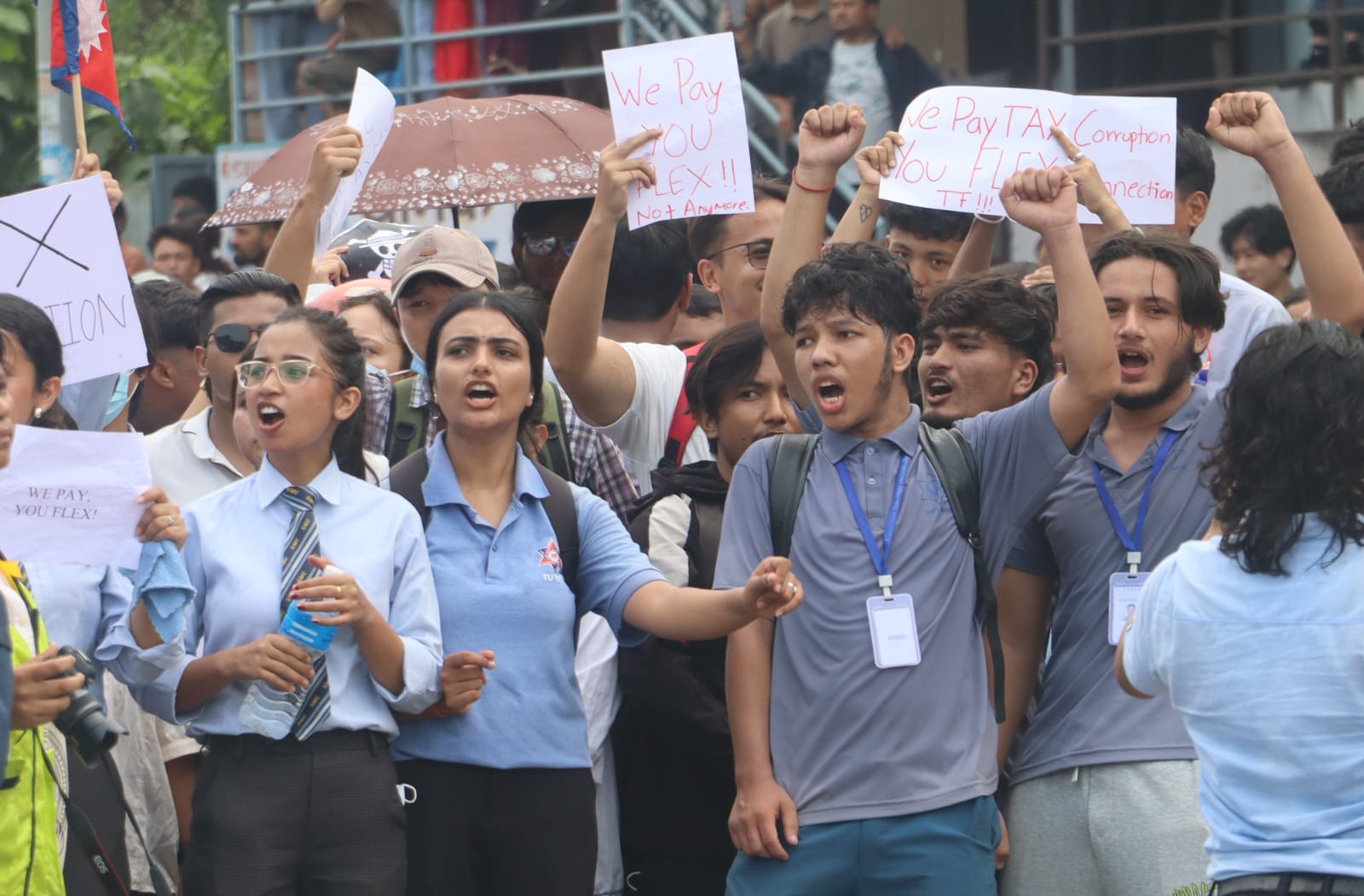
Photo: Genz Protest
What begins as a student protest rarely stays inside a campus.
Across South Asia, governments are once again facing a political force they know well, but often recognize too late: youth anger. In recent months, both Bangladesh and Nepal have seen unrest that started with young people and quickly spilled into the streets, into public life, and into larger questions about the state itself. The reasons were local. The outcomes were political. And the speed with which things escalated was a reminder of something history has shown many times before: when youth dissatisfaction meets state silence, unrest rarely remains limited to the original issue. What we are witnessing is not new. It is history repeating itself in a familiar form.
There is a phrase for this. A youth legitimacy crisis. It happens when a generation begins to feel that those governing them no longer understand them, no longer represent them, or no longer respond to them. It is not always about revolution at first. Often it begins with something narrower. A policy decision. A job crisis. A demand for reform. A call to be heard. The problem begins when that call is mistaken for rebellion.
History is full of such moments. The French Revolution did not begin with a demand to overthrow everything overnight. It began with deep economic pain, inequality, and anger toward institutions that seemed distant from ordinary life. The Revolutions of 1848 were driven in large part by young liberals, students, and workers asking for political reform and representation. The Russian Revolution emerged from war, scarcity, and disillusionment with power. The Velvet Revolution too saw students and youth at the front of political transformation.
These movements differed in ideology, geography and outcome. But they shared one common pattern. Young people were unhappy with decisions affecting their future. They demanded reform in a particular space. And when power responded with repression instead of dialogue, the demand widened. A policy protest became a legitimacy crisis. A grievance became an uprising.
That pattern feels visible again across South Asia. The region has one of the youngest populations in the world. For years, this has been celebrated as a demographic dividend. And rightly so. A young population can become an engine of economic growth, innovation and social change. But a demographic dividend is not automatic. It only becomes an advantage when economies create meaningful work, when institutions create mobility, and when governments can match rising aspirations with opportunity.
That is where the strain begins. Across much of South Asia, millions of young people are educated, connected, politically aware, and deeply ambitious. But many are also unemployed, underemployed, or trapped in insecure work. Degrees have multiplied faster than opportunities. Expectations have risen faster than systems can absorb them. Social media has made comparison constant. Young citizens can now see what is possible elsewhere while feeling blocked where they are. That gap creates frustration. Not because young people expect too much, but because they are often promised much more than they receive. Yet unemployment alone rarely produces revolt. Economic hardship can simmer for years. What turns frustration into mobilization is usually a trigger. A spark falling onto accumulated dry tinder.
In Nepal, that spark came through government restrictions on certain social media platforms over compliance disputes. What may have appeared administrative on paper felt deeply personal on the ground. For many young people, these platforms were not just apps. They were spaces of expression, community, and for some, livelihood itself. Influencers, digital entrepreneurs, creators and small businesses depended on them. The response was immediate resistance. But what could have been managed through conversation was instead met with a heavy-handed crackdown. The crackdown changed the nature of the protest. It was no longer just about a platform. It became about power.
Bangladesh followed a similar script, though through a different issue. Protests around the civil services quota system reflected a much deeper anxiety about fairness, access, and opportunity. At its core was a simple question: who gets to imagine a future through the state? Again, the initial demand was reform. Again, it was misunderstood. And again, a harsh response transformed a sectorial protest into something much broader and politically combustible.
The details differ. The political lesson does not. Which raises an uncomfortable but important question for India. If the social conditions exist across South Asia, why has India, despite having unemployment, youth frustration, and political polarization of its own, not followed the same route?
The answer lies less in the absence of anger and more in the presence of outlets. India has never been free from mass dissent. It has seen student movements, street protests, ideological clashes, and generational confrontations with authority. But unlike many of its neighbors, India was founded through a political imagination rooted not in seizure of power through armed revolution, but in constitutionalism, negotiation, and rule of law. The transfer of power at independence was not perfect, and certainly not without violence around Partition, but the Indian republic itself anchored legitimacy in institutions. That matters.
The Constitution of India did more than create a government. It created pathways for disagreement. Courts. Elections. State assemblies. Universities. Civil society. A federal structure. Public interest litigation. Judicial review. Parliamentary opposition. Street protest with legal visibility. These are imperfect spaces, often slow and often frustrating. But they exist. And that existence acts as pressure release.
Indian history offers repeated examples. The Mandal protests were deeply emotional and politically explosive. Yet the conflict remained mediated through commissions, courtrooms, electoral politics and public debate. The movement led by Jayaprakash Narayan became one of independent India’s most powerful challenges to authority, but it still found resolution through democratic transfer of power. More recently, the protests against the Citizenship Amendment framework and the nationwide farmers’ protests demonstrated something similar. The disagreements were intense. The streets were full. The politics was sharp. But the system, however strained, retained channels through which pressure could move. Not always smoothly. Not always fairly. But visibly.
This makes India structurally different from both Nepal and Bangladesh. Nepal’s democratic journey came through repeated confrontation with monarchy, civil uprising, and prolonged instability before constitutional democracy could take root. Bangladesh emerged through a brutal liberation war against Pakistan, and its political history after independence was marked by coups, assassinations, and deep institutional turbulence, including the assassination of Sheikh Mujibur Rahman and much of his family.
India carries its own scars. But its foundational political story is different. It rests more firmly on institutional continuity than on repeated regime rupture. Still, resilience should not be mistaken for immunity. That may be the most important lesson here.
No constitution can substitute for conversation. No election can permanently replace trust. No legal framework can fully repair a widening distance between the governed and those governing them. And that distance is often where crises truly begin. By the time students are in the streets, the problem is usually older than the protest itself. It begins much earlier. In ignored petitions. In unanswered grievances. In dismissive press conferences. In policies announced without listening. In citizens feeling spoken to, but not spoken with. That is what Nepal and Bangladesh reveal beyond the headlines. Not simply youth unrest, but a breakdown of dialogue between state and society. India has stronger democratic buffers. But buffers are only useful if maintained.
Which leaves us with a simple question.
Think about the last time you had to deal with a government office, a public institution, or any arm of the state. Did you feel heard? Did you feel someone was listening? Or did you feel you were merely navigating a system too distant to notice you?
The answer to that may tell us more about the future of democracy in South Asia than any election result ever will.
Let us know your thoughts in the comments.
Yeh article aapko kaisa laga?